




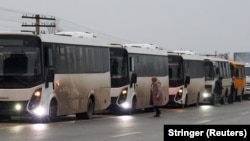
Moscow and Kyiv said the evacuation of residents from the Russian-occupied southern Ukrainian city of Oleshky had been completed "without incident," as buses filled with civilians left the area for the first time in more than four years under a US-brokered truce that is set to remain in effect until November 1.
Russian Human Rights Commissioner Yana Lantratova said in a social media post on October 30 that after arriving in Ukraine's Russia-occupied Crimea, one convoy of buses then headed toward Russia, while a second convoy was bound for Ukraine.
"We are concluding our humanitarian mission in Oleshky. We are currently in the territory of Armyansk (in northern Crimea)," she said in a video posted on Telegram, adding that both sides had praised the high standard of its organization.
Ukrainian Human Rights Ombudsman Dmytro Lubinets confirmed the evacuation saying those residents of Oleshky who wished to travel to Ukraine were on their way to the Russian city of Anapa.
"At this point, those who wished to leave Oleshky for Ukraine have been able to do so and are now on their way. Humanitarian aid has been delivered. The convoys have split up, and I am heading to Ukraine," he wrote.
Hundreds of Oleshky residents were expected to return to Ukrainian-controlled territory via a roundabout route: once in Anapa, in southern Russia, the civilians will head by plane to the Belarusian city of Homel, and from there by bus into Ukraine's northern Chernihiv region.
The circuitous route was needed to avoid roads along front lines that have been heavily mined and destroyed by the conflict, sparked by Russia's full-scale invasion of Ukraine in February 2022.
"I am currently speaking with local residents to hear their concerns and understand what assistance they need most," Lubinets, who is leading the Ukrainian delegation, wrote on Telegram on October 30.
He also shared videos of conversations with local Ukrainians who appeared to cheer the long-awaited support and evacuations.
As part of the joint relief operation, aid was distributed to those who stayed behind in the city. Lantratova said that "tens of tons of humanitarian aid" was being distributed.
In separate social media posts, Lubinets and Lantratova called for regular humanitarian missions coordinated by the US first lady to assist civilians in frontline areas.
The Ukrainian and Russian human rights commissioners said their cooperation during the Oleshky mission demonstrated that humanitarian arrangements can make a real difference and help civilians even under the most difficult circumstances.


Since October 27, Ukraine and Russia have observed a localized cease-fire in Oleshky with no violations reported. The arrangement was brokered by US first lady Melania Trump, who announced the agreement a week earlier.
Trump said civilians from both countries were expected to visit people in their homes to assess their needs, while those seeking to evacuate would receive coordinated assistance and transportation to their preferred destinations.
Having spent years living under Russian occupation, some Oleshky residents had expressed concern about the evacuation process, fearing "filtration" while traveling through Russian territory, Ukrainian journalist Maria Semenchenko, who grew up in the city, told RFE/RL's Ukrainian Service.
The residents, she said, were concerned about potential "coercive screenings and interrogations used by Russia to identify people deemed disloyal," adding that "some have already experienced torture in the past" and that she knew "at least one person who does not want to leave for precisely this reason."
No such incidents were reported so far.
Russian forces captured Oleshky early in the full-scale invasion of Ukraine that Moscow launched in 2022. Later that year, it effectively became a frontline city after Ukraine retook the regional capital, Kherson, less than 10 kilometers away on the other side of the Dnieper River.
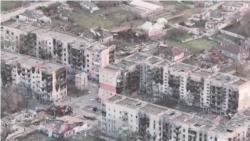
Once home to around 24,000 people, Oleshky's population has declined dramatically due to displacement and deaths caused by Russia's war. The destruction of the nearby Kakhovka Dam in June 2023 further compounded the devastation, with an estimated 90 percent of the city's territory flooded.
Fewer than 2,000 people remained in the city by the fall, including around 50 children, according to Melania Trump's office. Most are believed to be elderly residents who have been unable or unwilling to leave.

Remaining in a largely ruined city that is ringed by land mines, Oleshky residents for months were trapped in a war zone that is cut off from the outside world, with little to no food, drinking water, medicine, or electricity.
Kyiv has blamed Russia for the dire situation in the city, accusing Moscow of failing to ensure the safety and well-being of civilians. The Kremlin, in turn, has blamed Ukrainian drone strikes for its inability to do so.
Ukrainian officials and volunteers had previously told RFE/RL that they believed people in Oleshky were essentially being held hostage to Russia's military goals in the region.
While the city has served as an important staging ground for Russian attacks in southern Ukraine, they said its residents were effectively serving as a human shield for Moscow's forces.