




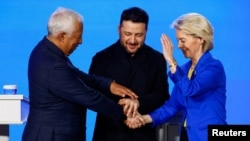
President Volodymyr Zelenskyy said Ukraine is at its "most stable" shape on the battlefield in months as the European Union formally approved a major, long-debated loan to Ukraine and a new sanctions package against Russia.
"Today is an important day for our defense and for our relations with the European Union," Zelenskyy wrote on X after the approval of 90 billion-euro ($105 billion) loan officially announced on April 23.
"This package will strengthen our army, make Ukraine more resilient...It matters that Ukraine is securing this level of financial certainty," he added.
European Council President Antonio Costa also praised the move, saying the bloc's strategy to achieve peace in the war-torn country was "strengthening Ukraine" and "increasing pressure on Russia."
"Today we moved forward on both," Costa wrote in a post on X.

The loan is seen as key financial support for Kyiv amid the fifth year of Russia's ground offensives and relentless air strikes, and after the White House changed its approach to funding Ukraine's defensive efforts.
Long blocked by Hungary and Slovakia, billions of euros are set to be disbursed over this and next year, as countries have lifted their vetoes after the resumption of operations on the Soviet-era Druzhba pipeline, which carries Russian oil through Ukraine to Central Europe.
The development comes as Zelenskyy told journalists that Ukraine may have shifted the balance on the "complicated" and "vivid" front line in its favor, saying Kyiv was in its most stable shape in almost a year.



In a voice message to a group of media, including RFE/RL, the president explained that the rare sense of positivity came from Ukraine's tendency to de-occupy more territory on the battlefield than it has lost since the beginning of the year.
"Over the past 10 months, we've been in our most stable shape, but we still realize that it's really tough for the guys," he said, also suggesting that Russian forces lose up to 35,000 men each month as Moscow tries to advance its new offensive plans.

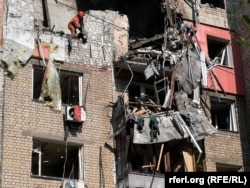
In another aspect of the war, Russia has continued its air strikes, killing at least three people in Ukraine's major eastern city of Dnipro, which has long been one of the country's key refugee and volunteer centers.
Governor Oleksandr Hanzha said Russian drones attacked the region more than 20 times on April 23, adding that at least 13 people were injured, including two children aged 9 and 14.
Trying to hold back tears, local resident Halyna told RFE/RL’s Ukrainian service that a boy named Mykhaylo, whom she had known since he was very young, had suffered burn injuries.
"It was terrifying. The blast was very loud… I came here to see what happened, and it's a nightmare. I can't look at it. It's very hard," Halyna said at the scene of the aftermath.
According to Hanzha, a 13-story residential building, a store, a car, and an administrative building were damaged in the attack.
A series of Russian strikes overnight also targeted at least five other Ukrainian regions, killing and injuring people and damaging the country's energy and railway infrastructure.
Meanwhile, in Russia's Samara region, a drone attack on industrial facilities in Novokuybyshevsk early on April 23 killed one person, according to Governor Vyacheslav Fedorishchev.
While Fedorishchev did not specify which facilities were targeted, the incident is the latest in a series of strikes deep inside Russia in recent weeks.
Seeking to reduce Moscow's energy revenues by stepping up attacks on its oil infrastructure, the Ukrainian military has struck oil drilling platforms and refineries from the Gulf of Finland to the Caspian Sea, some 1,000 kilometers from the front lines.
"We are targeting what is painful for Russia, and it is indeed very painful. We can see the results: today, their losses are already measured in tens of billions," Zelenskyy said.
"These are critical losses for Russia," he added.

