




WASHINGTON -- The United States says it will bring Ukrainian and Russian delegations together in Abu Dhabi on November 10-11 for a new round of working-level negotiations aimed at ending Moscow’s war against Ukraine, as Washington looks to build on the success of last week's temporary cease-fire.
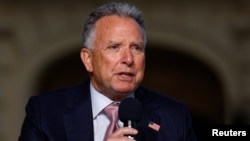
US special envoy Steve Witkoff announced the meetings on November 2, saying the United States would mediate discussions focused on “post-war security arrangements, de-escalation, humanitarian efforts, and next steps toward peace.”
Witkoff and Jared Kushner, the lead US negotiators, are expected to represent Washington in Abu Dhabi, a senior US official told reporters. Russian President Vladimir Putin agreed to the new trilateral format following a meeting with Witkoff in St. Petersburg two weeks ago.
The latest diplomatic push comes as President Donald Trump seeks progress toward ending Europe's deadliest conflict since World War II. The previous round of US-mediated trilateral talks took place in February, before the war involving the US, Israel, and Iran interrupted the diplomatic process.
A successful US-brokered cease-fire last week, which allowed residents of the Russian-occupied southern city of Oleshky to receive humanitarian aid and evacuate if they wished, has offered some hope of a broader settlement. But the Kremlin has suggested the operation does not mean Moscow is ready for a wider truce.
Meanwhile, the fighting has continued.
Russia struck a school where humanitarian aid was being distributed in the Zaporizhzhya region on November 2, Ukraine said, killing at least 29 people in what President Volodymyr Zelenskyy called a "vile" attack in which Moscow's forces dropped at least 10 bombs and targeted a site where people were sheltering after the initial hit.
A day later, Russian attacks injured at least 62 people at a medical facility in Kharkiv and damaged energy infrastructure elsewhere in Ukraine, while Ukrainian drones struck an oil refinery in the Russian city of Yaroslavl, according to officials.
Against this backdrop, analysts and former US officials interviewed by RFE/RL cautioned against expecting a major breakthrough in Abu Dhabi, pointing to the wide gap between Moscow and Kyiv and the absence of any clear indication that Putin is prepared to accept a cease-fire.

William Taylor, a former US ambassador to Ukraine under President George W. Bush and later charge d’affaires during Trump's first administration, said the central question was whether Russia had changed its position on a cease-fire.
“Has Putin decided to agree to a cease-fire?” Taylor asked, noting that both Washington and Kyiv have repeatedly expressed support for one.
He recalled that Trump previously proposed an energy cease-fire, which Ukraine accepted but Russia rejected. Putin has repeatedly said a comprehensive peace agreemet is neeed and fighting can stop once one is reached.
During earlier trilateral expert-level meetings in January and February, negotiators made progress on technical questions, including how a potential cease-fire could be monitored. But they failed to secure agreement on the cease-fire itself, Taylor said.
“The hard part and the breakthrough would be for Putin to say yes, he's agreed to a cease-fire,” he told RFE/RL.
Cease-Fire Remains Key Hurdle
For Taylor, the benchmark for success in Abu Dhabi is straightforward: an agreement by Russia to stop fighting.
Once that political decision is made, military and technical experts could work out the details of monitoring and enforcing a cease-fire, including the use of aerial surveillance, drones and sensors, as well as procedures for responding to violations.
But Heather Conley, a senior fellow at the American Enterprise Institute and a former State Department deputy assistant secretary for European and Eurasian affairs, was more skeptical about the prospects for substantive progress.
“I don’t believe we can expect much from these technical meetings other than the fact they are restarting,” Conley told RFE/RL. “There will not be a breakthrough but possibly a follow-on meeting will be scheduled.”
She said additional prisoner exchanges could be among the more realistic outcomes.
Security Guarantees?
Alongside the Abu Dhabi negotiations, US officials will meet European representatives in Brussels this week to discuss security guarantees for Ukraine, Europe's future security framework, and economic support for Ukrainian reconstruction.
The meetings will involve France, Germany, Britain, the European Union, and NATO, according to the senior US official, and are intended to build on recent discussions in Kyiv, Oslo, and St. Petersburg.
Taylor said European countries should not merely be consulted separately but should participate directly in the Abu Dhabi negotiations.
A cease-fire without credible security guarantees would not be sufficient to protect Ukraine against another Russian attack, he said.


Taylor pointed to the proposed European-led “coalition of the willing,” backed by the United States, as a potential mechanism for enforcing a cease-fire and providing security assurances.
“The Europeans need to be engaged in these negotiations,” he said. “They need to be as main players in Abu Dhabi as well.”
Conley argued that Washington was revisiting the question of European security guarantees partly to determine whether they could persuade Ukraine to accept a negotiated agreement.
But she questioned whether such assurances would be sufficient.
“There is really not a security guarantee short of Ukraine joining NATO or having the Ukrainians indigenously develop their own defensive and offensive capabilities to defend themselves with European support,” she said.
Ukraine is working to build up those capabilities, Conley added, but doing so will require time and a scale of production that the country does not currently possess.
'Yalta 2.0'
Matthew Boyse, a senior fellow at the Hudson Institute who served as deputy assistant secretary of state for Eurasian affairs during Trump's first administration, also expressed doubts that the talks would produce progress on the central political issues.
He said previous negotiations had sometimes delivered important humanitarian results, including prisoner exchanges and the return of Ukrainian children taken to Russia, but had done little to bridge the fundamental differences between the sides.
The Kremlin, Boyse said, has remained committed to demands that leave little room for compromise.
He suggested Moscow could see an advantage in prolonging negotiations, calculating that Trump may emerge from the US elections in a weaker political position while his administration remains eager to broker an end to the war.
“Chekists excel at drawing foreigners into endless discussions that usually lead nowhere,” Boyse said, using a term for Soviet and Russian security operatives, including veterans of the KGB, where Putin served.

Boyse also questioned whether discussions about de-escalation and post-war security reflected any genuine narrowing of differences.
Russia may be seeking to use the prospect of additional localized cease-fires as leverage to extract major concessions from Ukraine, he said, while believing that time is on its side.
He also warned that Moscow would prefer to negotiate directly with Washington rather than with European governments, which he said Russia has little respect for.
Boyse described Putin's broader ambition as a modern version of the 1945 Yalta settlement, through which Moscow could secure recognition of a European sphere of influence and legitimize Russian control over Ukrainian territory.
He called this vision “Yalta 2.0,” arguing that a deal perceived as sacrificing Ukraine's sovereignty would damage Washington's standing in Central and Eastern Europe and evoke the historical memory of millions of Europeans left under Soviet domination after World War II.
Boyse said Washington should approach the discussions with a clear understanding of responsibility for the conflict.
“We would all like to see an end to Russia’s war against Ukraine,” he told RFE/RL, adding that Russia has been the aggressor state for almost 13 years.
“They should focus on extracting concessions from Moscow,” he said.

