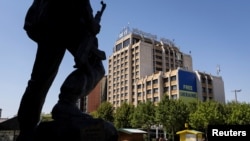
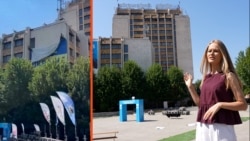
PRISTINA -- Comments by Ukrainian President Volodymyr Zelenskyy have sparked political controversy in Kosovo, with the removal of a large Ukrainian flag in central Pristina and critical comments from the government.
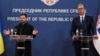
Zelenskyy told journalists during a news conference in Belgrade on August 8 that Ukraine’s position on Kosovo’s independence was “unchanged” -- i.e. that Kyiv still did not recognize it.
The comment came during Zelenskyy’s first ever visit to Serbia and also amid an ongoing political crisis in Kosovo.


“Zelenskyy’s visit and statement on Kosovo became a big deal for the country because it helped grant international legitimacy and whitewash Vucic’s authoritarian regime,” Agon Maliqi, a nonresident senior fellow with the Europe Center at the Atlantic Council, told RFE/RL on August 10.
What Did Zelenskyy Say?
Asked whether Serbian officials could count on Ukrainian support for nonrecognition of Kosovo, which declared independence in 2008, Zelenskyy said Serbia and Ukraine were “partners.”
“We respect the territorial integrity of our partners; we respect international law; therefore, our position regarding…Kosovo’s unilateral declaration of independence remains unchanged,” Zelenskyy said.
“Likewise, we are grateful to our partners for their respect for Ukraine’s territorial integrity and sovereignty, including…Crimea’s status as part of Ukraine. Serbia’s position on this has also not changed,” he added.
The comments highlighted Ukraine’s sensitivities regarding its own territorial integrity.
Russia seized Crimea by force in 2014 and now claims the peninsula as its territory along with four other Ukrainian regions.
Zelenskyy’s comments also reflected efforts to cement ties with Serbia, which has reportedly been supplying it with ammunition despite Vucic’s friendly relations with Russia.
"Zelensky did more than simply restate Ukraine’s position of nonrecognition of Kosovo. He allowed Kosovo’s independence to be folded into Serbia’s account of territorial loss and placed it, by implication, in the same conceptual basket as Russia’s seizure of Ukrainian territory," wrote Ramadam Ilazi from the Kosovar Center for Security Studies on August 10.
"For a country whose modern statehood emerged after mass repression, war crimes, ethnic cleansing, international administration, and a UN-led status process, that comparison is historically inaccurate, careless, and legally false," he added.
A Flag Removed
The response from Pristina was swift. The next day, a large Ukrainian flag that had dominated a prominent downtown location was taken down. The removal was posted on social media by Pristina Mayor Perparim Rama.
Foreign Minister Glauk Konjufca took to social media to voice “regret” at Zelenskyy’s remarks, noting that “while Kosova has imposed sanctions against Russia, Serbia has not aligned with the EU sanctions.”
He also noted that most European Union member states do recognize Kosovo, although five do not -- an obstacle to the country’s EU membership ambitions.
On the streets of Pristina on August 10, opinions on the flag removal and the wider controversy were mixed.
“That is not good. Everyone should understand that in Ukraine they are also fighting for our fate, because if Russia is defeated, that is in our interest and in the interest of the entire Albanian nation,” 68-year-old maintenance worker Fadil Xhemajli told RFE/RL’s Kosovo Service.
Retiree Sabit Gashi disagreed.
“Perhaps they should not have put up that flag in the first place, because we already knew Ukraine’s position from before,” he said.
Eggs Thrown In Parliament
Zelenskyy made his comments the same day that Kosovar Prime Minister Albin Kurti had eggs thrown at him by an opposition lawmaker in the country’s parliament, underlining an ongoing political crisis.
Kosovo has been through three elections in the last two years as political leaders have been unable to form workable majorities.
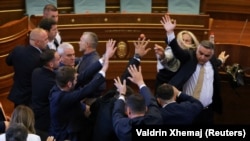
The egg-throwing incident came as Kurti sought to delay a vote on a new speaker of parliament, amid disputes over a new president that threaten to propel the country into yet more snap elections.
“With Kosovo unable to form legitimate institutions over the past two years and deeply polarized, this incident with Ukraine has now been used for domestic consumption,” Maliqi, the political analyst, said.
The issue is far less controversial in Ukraine but has drawn some criticism.
Opposition lawmaker Oleksiy Goncharenko described it as a “political blunder” and called for Ukraine to recognize Kosovo.
Oleksandr Merezhko, a legislator from Zelenskyy’s Servant of the People party, told RFE/RL that he was “skeptical” about the arguments against recognition.
“As for the relationship with Serbia, regrettably, a considerable part of its population remains under the influence of Russian propaganda, which is still not banned in Serbia,” he said.
“The problem is that Vucic is not going to impose sanctions against Russia. He needs to create before the EU the pretense that he is not only Putin’s ally, but that he also has ‘good relations’ with Kyiv,” he added.