


WASHINGTON -- The elaborate state funeral for Ayatollah Ali Khamenei was designed to project continuity and strength. But beneath the carefully choreographed images, questions remain about who now holds power inside Iran.
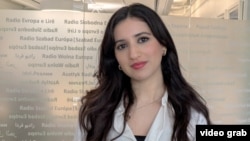
RFE/RL spoke with Zineb Riboua, a research fellow with the Hudson Institute's Center for Peace and Security in the Middle East, about Iran's post-Khamenei power structure, the expanding influence of the Islamic Revolutionary Guards Core (IRGC), and why she believes growing repression reflects weakness rather than confidence.
RFE/RL: We've just watched a highly choreographed funeral for Ayatollah Ali Khamenei. Was this a genuine display of regime strength, or an effort to project stability at a moment of unprecedented uncertainty?
Zineb Riboua: I truly do think that they had to project some strength, some unity, especially because the survival of the Islamic republic as a project, as a revolutionary state, as a doctrine, but also as a model for the region, is necessary for them.
On top of having this grandiose funeral, one of the things they've done is start ramping up condemnations, assassinations, and hangings because they correctly assess that one of the things Operation Epic Fury demonstrated was how weak the regime is, how incapable it is of projecting power.
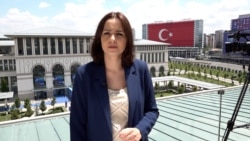

A lot of the proxies they have, have not been helpful, especially the Houthis. They could have easily joined attacks against the United States on an immense scale, and they have not. Hezbollah is trapped in its situation with Israel. Syria is no longer a landscape and a country through which they can do what they've always done in terms of logistics and military projection.
So I think there are a lot of soft-power tools that remain -- and it's not a coincidence that this funeral took this shape or that their communications have become much more aggressive than before. They correctly assess that information warfare and the projection of unity are all they have for now.
Amplified Role For Revolutionary Guards
RFE/RL: If the funeral was meant to send a message of continuity, what did it actually reveal about where power now resides? Many analysts argue that authority has shifted from the clerical establishment toward the Revolutionary Guard. Did we see evidence of that this week?
Riboua: I think the most interesting thing is that the IRGC has always played an enormous role in allocating resources, governing, shaping military strategy, especially when it comes to directing the proxies. Qassem Soleimani (senior IRGC commander who was assassinated by the US in 2020) was one of the most important men in the Islamic republic.
So the idea that there was fragmentation and that they were not necessarily coordinating, I don't think so. What I do think, however, is that because of the relationship the IRGC has with the current ayatollah, its role has been much more amplified, and it is taking a bigger stake in decision-making.
That being said, something interesting was happening while the negotiations back and forth in Pakistan and elsewhere were ongoing. There are different factions inside the IRGC. It was very interesting how [US] President [Donald] Trump would say, "We're talking to three groups." [Iranian] President [Masud] Pezeshkian had one position, the IRGC had another.
So while the IRGC functions as both a military institution and an economic one, I don't think they have decided yet where they want to take things, who should talk to the United States, and who shouldn't.
It was also very interesting that [parliament speaker Mohammad Baqer] Qalibaf took on a larger role. He obviously plays an enormous role when it comes to dealing with the IRGC and in its annual budget. That's very natural. But he might have ambitions that are not necessarily the same as those of his peers inside the IRGC.
So while the IRGC has always played an important role and that role has clearly expanded, there is still a question mark over whether it is as unified as before.
RFE/RL: Beyond the funeral itself, the guest list also sent a message. Even some of Tehran's closest partners dispatched relatively low-level delegations. Does that suggest Iran is becoming more isolated internationally, or are we seeing a recalibration of its alliances?
Riboua: I think the isolation of the Islamic republic is undeniable. They have hit Arab countries. They have hit the UAE more than it hit Israel. They hit Qatar, which was actually very involved in maintaining diplomatic ties with Tehran. They have also targeted Saudi Arabia, even though Saudi Arabia normalized relations with Iran through Beijing.
There were different channels Iran could have used to mobilize the Arab street by portraying Israel and the United States as the major aggressors, and it simply didn't happen. We did not see protests in Riyadh or Dubai against the United States or Israel's operation.
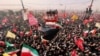
I think this funeral was really part of a domestic messaging campaign more than an international one. One of the most important things that happened for Iran, apart from the military operation itself, was the January protests and the massive crackdown that followed. They have to respond to that.
They understand they have recruitment problems. Even during the war, the IRGC started recruiting children because they couldn't recruit enough young men. The IRGC is struggling to pay its own soldiers. There was also a debate among officers who saw Hezbollah fighters getting paid while they themselves were not.
So there are different economic and social problems the Islamic republic is facing. On top of not being able to mobilize Arab countries, Arab governments also see the growing disenchantment of the Iranian population with its own regime.
Iran's Economic Woes
RFE/RL: Behind those displays of unity lies an economy suffering from soaring inflation, financial hardship, and growing public frustration. How much pressure is the regime really under?
Riboua: People often point to countries like Cuba or North Korea and say they survived immense pressure and public dissatisfaction. But Iran is facing two threats. The first is the military pressure from the United States and Israel. The second is that the regime has already exhausted much of its capacity because the population had already risen up in January and two years before.
If one looks at the protests, from Mahsa Amini (a Kurdish-Iranian woman whose death in police custody in 2022 sparked a huge protest) to the more recent demonstrations, they're becoming more violent. People are willing to die. I think that's a very good indicator of what the population thinks of the regime.
There are also many problems the Islamic republic is not solving, and I don't think it can because of its military defeat.
Beyond inflation and the currency crisis, there are serious problems with water management. The government is not delivering basic services. At some point, Iranians see that a lot of their tax money is going to proxies instead of their own basic needs.
Because of the priorities of the IRGC, I think the regime is eventually going to hit a ceiling in terms of what it can ask society to sacrifice just to preserve the Islamic republic.
RFE/RL: Do you expect the crackdown on dissent to intensify as the leadership consolidates power?
Riboua: I definitely think the repression will intensify. We already had a taste of it during the January protests. I think they have no choice. I think the IRGC is willing to sacrifice many people in order to remain in power, and I think it is willing to do so as much as it can.
Whether that will actually be effective in preventing the population from rising up again remains an open question, and I think we'll find out very soon.
RFE/RL: Is this primarily about enforcing ideology, or preventing another nationwide protest movement?
Riboua: I think it's both. It's worth looking at the Middle East today. Armenia and Azerbaijan are moving toward peace, more trade, and modernization.
The UAE, Bahrain, Kuwait, and others have ambitious development agendas. Saudi Arabia has Vision 2030. It's true they face economic and fiscal issues, but their leadership is putting forward a strategy that is meant to benefit young Saudis.
The Islamic republic looks around and sees that it is not delivering those things. What it is delivering is a constant revolution that many people no longer support. So it is trying to force everyone to comply with the rules and the symbolism because it believes that will satisfy the Iranian population.
But I think there is now a generational divide that it is simply not responding to, and I think it lacks the tools to do so.
RFE/RL: What more can Washington and its allies do to increase pressure on the regime without hurting ordinary Iranians?
Riboua: Putting much greater pressure on China is essential. Ninety percent of Iran's oil goes to China. China has also helped Iran acquire chemical components for ballistic missiles and supported its drone program.
One of the best things the administration did was sanction Chinese shipping companies and geospatial firms that provided Iran with targeting data and also supported the Houthis.
The US has to recognize the broader role China has played in enabling Iran and make sure Beijing can no longer purchase sanctioned Iranian oil at discounted prices.
RFE/RL: Looking ahead, what poses the greatest threat to the Islamic republic: military pressure, difficult negotiations with Washington, economic deterioration, or growing domestic dissent?
Riboua: I think it's the combination of military and economic pressure the United States has launched. It was very important to see the US Treasury target the IRGC's shadow banking system operating through Dubai and other financial centers. Every military campaign has to make the damage permanent. When political concessions aren't possible, you have to make sure your enemy cannot rebuild what you've just destroyed.
That said, Iran still has a nuclear program. It is buried, yes, but it still poses a threat. There is still the drone program and the missile architecture, much of it directed at Gulf countries. So there is still a great deal left to do.
But for a campaign that was this short -- and I consider it a very short campaign given the nature of the region and Iran's geography -- it weakened the regime in a way it simply had not been weakened since its inception.

