



20:04
19.6.2014
The infamous Smersh (Death to Spies) and KGB are apparently being re-created in the Lugansk People's Republic http://t.co/RvzE4olbeL
— Radosław Sikorski (@sikorskiradek) June 19, 2014
20:03
19.6.2014
Prospects of #Ukraine ceasefire dimming as fighting rages in east. #Akhmetov in statement says: "Donbass is in distress. Blood is flowing."
— David M. Herszenhorn (@herszenhorn) June 19, 2014
19:00
19.6.2014
Russia analyst Michael Weiss has an interesting piece in the Daily Beast today that suggests Vladimir Putin is actually only getting started in Ukraine:
Read the entire article here
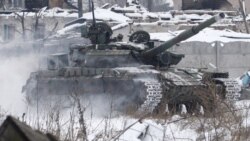
When Russian tanks used to roll into a foreign country, it was known as an invasion. Today it’s known as a “failure by Russia to de-escalate [a] situation.” That was State Department spokesperson Marie Harf’s comment on widespread reports, since corroborated by NATO, that three T-64 tanks, along with multiple rocket launchers and armored personnel carriers (APCs), entered east Ukraine from Russia last week. And such are the gifts of diplomatic nicety still being bestowed upon Russian President Vladimir Putin that the United States continues to treat him as a recalcitrant child at reform school rather than as a lying authoritarian who still seeks to partition or balkanize Ukraine. If only he’d behave himself…
Contrary to press claims that Putin has wound down his direct and indirect interference in east Ukraine —claims which were mostly based on his seeming acceptance of Petro Poroshenko’s election as Ukraine’s president, and his brief one-on-one conversations with Poroshenko and President Obama during the D-Day anniversary in France last week —the opposite is the case. As the West has been busy rediscovering a country called Iraq, the Kremlin has been not-so-quietly increasing its support for militants seeking to carve out satrapies in Donetsk and Lugansk. In fact, it has also cut off Ukraine’s gas supply and is now moving troops back to the Ukrainian border, a fortnight or so after belatedly withdrawing them.
For the last several weeks, my team at The Interpreter, a Russian news and analysis website, have been documenting mounting evidence of what we’ve termed Russia’s “remote controlled war” in east Ukraine. Typically, this has been a war defined by the military doctrine of maskirovka, which traffics in concealment, plausible deniability, and carefully leaked or disseminated disinformation (dezinformatsiya) designed to both confuse the enemy and deter him from predicting or responding to one’s next move. Nevertheless, every once and a while, the mask slips.
Contrary to press claims that Putin has wound down his direct and indirect interference in east Ukraine —claims which were mostly based on his seeming acceptance of Petro Poroshenko’s election as Ukraine’s president, and his brief one-on-one conversations with Poroshenko and President Obama during the D-Day anniversary in France last week —the opposite is the case. As the West has been busy rediscovering a country called Iraq, the Kremlin has been not-so-quietly increasing its support for militants seeking to carve out satrapies in Donetsk and Lugansk. In fact, it has also cut off Ukraine’s gas supply and is now moving troops back to the Ukrainian border, a fortnight or so after belatedly withdrawing them.
For the last several weeks, my team at The Interpreter, a Russian news and analysis website, have been documenting mounting evidence of what we’ve termed Russia’s “remote controlled war” in east Ukraine. Typically, this has been a war defined by the military doctrine of maskirovka, which traffics in concealment, plausible deniability, and carefully leaked or disseminated disinformation (dezinformatsiya) designed to both confuse the enemy and deter him from predicting or responding to one’s next move. Nevertheless, every once and a while, the mask slips.
Read the entire article here
18:46
19.6.2014
Investigation of the February mass murder on Maidan in Kyiv is the 1st priority - Ukraine's newly appointed AG Yarema at his 1st presser
— Maxim Eristavi (@MaximEristavi) June 19, 2014
18:40
19.6.2014
Let's get the facts straight about #EU-#Ukraine | FAQs: http://t.co/Q02VMLZxVo
— EU External Action (@eu_eeas) June 19, 2014
17:31
19.6.2014
Sergei Ivanov uses the word "genocide" re E.Ukraine. Allegation of genocide was pretext for intervention in S.Ossetia http://t.co/4lK46uhU5d
— Oliver Bullough (@OliverBullough) June 19, 2014
16:29
19.6.2014
BREAKING: Ukraine's new pro-Western President Petro Poroshenko says he will sign a key trade and economic relations portion of a crucial EU pact in Brussels on June 27.
Ukraine's previous Kremlin-backed leadership's rejection of the EU Association Agreement in November triggered months of deadly protests that led to the February ouster of President Viktor Yanukovych.
Poroshenko made the announcement on June 19, while introducing the new foreign minister, Pavlo Klimkin, to the ministry staff.
Ukraine's previous Kremlin-backed leadership's rejection of the EU Association Agreement in November triggered months of deadly protests that led to the February ouster of President Viktor Yanukovych.
Poroshenko made the announcement on June 19, while introducing the new foreign minister, Pavlo Klimkin, to the ministry staff.
16:27
19.6.2014
15:07
19.6.2014
14:23
19.6.2014
Here's a wrap up from our news desk on Poroshenko's key appointments:
Ukraine's President Petro Poroshenko has received parliamentary backing for his nominations to several key posts in his new team.
The parliament on June 19 endorsed Poroshenko's nominations for foreign minister, central bank chief, and prosecutor-general, with each of the candidates winning more than two-thirds of parliament's votes.
Pavlo Klimkin, until now ambassador to Germany, was approved as foreign minister.
Klimkin, 46, has played a key role in negotiating the association and free-trade agreements with the European Union, which Ukraine is expected to sign later this month.
Klimkin is currently Poroshenko's representative in OSCE-mediated negotiations with Russia that were launched in Kyiv.
Russia's RIA state news agency quoted the Russian Deputy Foreign Minister Grigory Karasin as saying "we wish the new minister success and are ready for contact with him."
Valeriya Hontareva, an investment banker who has worked in international financial institutions for nearly two decades, is the new head of the central bank.
Vitaliy Yarema, currently first deputy prime minister, becomes prosecutor-general.
Presenting Yarema's nomination, Poroshenko said he would a key figure in the fight against corruption in the country.
Poroshenko still has to announce his nominations for defense minister and the head of the SBU state security service -- two other key posts as government forces clash with pro-Russian separatists in eastern Ukraine.
The parliament on June 19 endorsed Poroshenko's nominations for foreign minister, central bank chief, and prosecutor-general, with each of the candidates winning more than two-thirds of parliament's votes.
Pavlo Klimkin, until now ambassador to Germany, was approved as foreign minister.
Klimkin, 46, has played a key role in negotiating the association and free-trade agreements with the European Union, which Ukraine is expected to sign later this month.
Klimkin is currently Poroshenko's representative in OSCE-mediated negotiations with Russia that were launched in Kyiv.
Russia's RIA state news agency quoted the Russian Deputy Foreign Minister Grigory Karasin as saying "we wish the new minister success and are ready for contact with him."
Valeriya Hontareva, an investment banker who has worked in international financial institutions for nearly two decades, is the new head of the central bank.
Vitaliy Yarema, currently first deputy prime minister, becomes prosecutor-general.
Presenting Yarema's nomination, Poroshenko said he would a key figure in the fight against corruption in the country.
Poroshenko still has to announce his nominations for defense minister and the head of the SBU state security service -- two other key posts as government forces clash with pro-Russian separatists in eastern Ukraine.