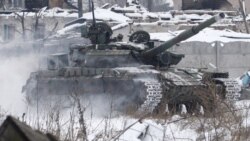
Ukrainian servicemen ride in a tank close to the airport in the eastern city of Donetsk, a facility which has been the site of intense fighting for several weeks.
CNBC correspondent Steve Sedgwick on June 19 had an interview with Igor Sechin, close associate of Russian President Vladimir Putin and CEO of the state-owned Rosneft oil company. The transcript is posted here.
Sechin fairly rarely gives interviews, so it is interesting particularly to read the following exchange on the sanctions against Sechin and other Russian offiicials and firms over the conflict in Ukraine:
SS: May I ask you about sanctions? You have been directly targeted by the US State Department, what is your reaction to that?
IS: The sanctions have been discussed a lot and I would like us to abstain from this discussion because the more we talk about the sanctions, the more important they seem. I am trying to put myself in the shoes of those people who introduce sanctions and I believe that there should be some purpose of the sanctions and some justification of them. And I cannot understand the purpose of the sanctions whatsoever. Especially myself personally I cannot understand what purpose they are pursuing, because I am not involved in the political decisions. I am not a person or element that matters - from the standpoint of obtaining advantages.
Secondly, I cannot understand any justification or basis for taking the sanctions. I don't think that my active cooperation with the American companies that is aimed at ensuring mutual profit could be a basis for sanctions.
I think this sad situation was described quite well by the French politician Charles Maurice de Talleyrand. As far as I remember, what he said is everything that is excessive doesn't have significance. I think serious people should not take any serious decisions under pressure. Therefore this decision that target me don't make any sense to me.
However, I respect such people who take such decisions because our task is to keep working and we will try to demonstrate our efficiency in our activities, including the work of American companies. In my opinion, this is the only option of good response to this type of actions.
SS: Do you fear that your cooperation with American companies will be threatened by a next round of sanctions, which has been talked about it will affect technology and the energy sector and it would hurt your relationships with your American partners?
When I started answering your question on sanctions I said it would be better for us not to discuss this issue. Now you are trying to develop this topic. By doing this, you are trying to give more significance to the sanctions.
I will repeat myself and I will say that we will continue working to demonstrate our efficiency in our joint work that would be mutually beneficial to both Russian and American companies. However if new decisions are taken about sanctions we will continue working at implementing our projects ourselves but we will leave the option open for the American partners to come back when it is possible.
SS: I have a final question, and it is not about sanctions, it is about Igor Sechin, I read a lot about you, I have read a lot about you in the Western press, some of them complimentary, some of them talking about your power, some of them talking about your past and the influence you have. In your words, who is Igor Sechin?
IS: Igor Sechin is the person who you currently can see in front of you. I think that as a result of our conversation, each of us will form an opinion of the person whom he has talked to. If we meet often in the future, at some point there will be trust and maybe even friendship between us. Don't listen to anyone, just try to form your own opinion and live your own life. Thank you.
Sechin, left, speaking to Putin in 2013.
11:2721.6.2014
The website of Russian President Vladimir Putin has posted a statement responding to Ukrainian President Petro Poroshenko's cease-fire initiative in eastern Ukraine.
Here is the statement in full:
The announcement of Ukrainian President Petro Poroshenko about a temporary halt of military activities was accidentally or intentionally made against the background of firing on Russian territory in the region of the Dolzhansk border crossing, which caused the destructgion of a building and, more importantly, wounded a Russian border guard.
Russia is awaiting an explanation and apology regarding this incident.
Considering this situation, the Russian side must carefully analyze the text of the corresponding decision of the Ukrainian president and the plan for implementing it.
Unfortunately, an initial analysis shows that it is not an invitation to peace and negotiations, but an ultimatum to the militias of southeastern Ukraine to lay down their arms.
So far, the main element -- a proposal to begin negotiations -- is missing.
11:1621.6.2014
Don't miss this week's excellent Power Vertical (@PowerVertical) podcast on "Russia's New Utopianism."
After decades in the shadows, those age-old utopian and imperial instincts are back with a vengeance.
In this week's Power Vertical Podcast, we discuss Eurasianism, Russia's latest messianic ideology. Is it a passing fad? Or a long-term project?
11:0721.6.2014
Here's an interesting ITAR-TASS analytical piece on the measures Russia will "be forced to take" to protect its economy "against duty-free European goods" if Ukraine and Moldova sign free-trade agreements with the European Union.
The director for trade negotiations at the Ministry of Economic Development, Maxim Medvedkov, believes the problems can arise when the territory of Ukraine begins to be used by EU companies for simple value added operations or knock-down assembly and further re-export to the Customs Union countries, which will concern agricultural produce, energy cooperation, in particular nuclear power, aviation and other fields.
and
Higher School of Economics professor Mikhail Berger said the Russian government was going to revise employment conditions for Moldovans and deport about 300,000 of the 700,000 Moldovan migrant workers, which will strip many building companies of cheap labor force. Construction workers from Moldova will hardly be able to find jobs in the EU, where labor market competition is high. The same fate could lie in store for 5-6 million Ukrainian citizens working in Russia, the expert told ITAR-TASS.
10:5121.6.2014
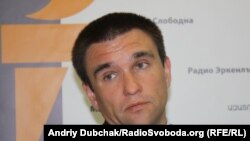
Do take a few minutes to read this compelling profile on new Ukrainian Foreign Minister Pavlo Klimkin by RFE/RL Washington correspondent Carl Schreck (@CarlSchreck).
Signals from Moscow indicate that the Kremlin feels it can work with Klimkin, whose immediate predecessor, Andriy Deshchytsya, sparked controversy last week when he was caught on camera using an obscenity to describe Russian President Vladimir Putin. "All we can do is wish him a productive start to his work in this new, important post," Deputy Russian Foreign Minister Grigory Karasin told RIA Novosti, calling Klimkin one of Ukraine's "most experienced, well-known diplomats."
10:3321.6.2014
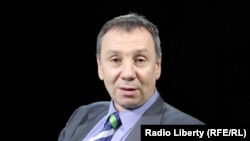
Kremlin ideologue and former United Russia Duma Deputy Sergei Markov wrote in a Facebook post this morning that the "peak of the crisis" in Ukraine is near. He claims that the Ukrainian Army is moving from both the south and the north to seal the country's border with Russia, after which will come "a massive attack on the key objects in the rebellious Donbas." This supposed plan, Markov argues, will lead to "thousands of civilian deaths and the deaths of hundreds of armed antfascists." The rest of the plan entails mass arrests, purges, and forced de-Russification."
If Russian President Vladimir Putin is unable to negotiate a deal with Ukrainian President Petro Poroshenko or Western leaders, "Russi will have to either significantly increase its participation in the conflict by a massive injection of equipment and volunteers or by the use of the Russian Army in the conflict" or "it will have to agree to the military victory of ultra-anti-Russian forces after which, at the direction of foreign commanders, will begin preparations for aggression against Russia."
10:2521.6.2014
Here are a couple of sound bites from Ukrainian President Petro Poroshenko, who spoke to reporters about the cease-fire in the Kharkiv region on the evening of June 20:
"We hope very much that this order [for a cease-fire] will be heard and supported by all sides of the conflict, by all those who have weapons. And I hope that this historic chance to restore peace in Donbas will be used."
"We will invite an OSCE observer to every checkpoint to record any possible attacks or use of weapon against Ukrainian soldiers -- in that case, Ukrainian soldiers have the right to fire back."
"I gave orders that in case of attempts to break through to Ukrainian territory by either heavy [military] equipment or vehicles with armed mercenaries, Ukrainian armed forces are able to defend the state border."
10:1621.6.2014
Russian news agencies are reporting that President Vladimir Putin has ordered forces in the Central Military District (which includes the Urals Region and is headquartered in Yakterinburg) to conduct emergency readiness drills. Forces are reportedly on full combat alert, Russian agencies quoted Defense Minister Sergei Shoigu as saying. Agencies also reported paratroop units in the region are conducting exercises. The readiness test will continue until June 28.
Good morning. RFE/RL's Ukraine Live Blog is beginning activity for June 21. Here is the latest from our News Desk:
The leaders of the United States, France, and Germany say Russia faces the risk of new sanctions from the West if it fails to defuse tensions on the Ukraine border.
The White House said U.S. President Barack Obama had spoken separately with French President Francois Hollande and German Chancellor Angela Merkel.
The leaders spoke amid fresh concerns about Russian activity along Ukraine's border.
The U.S. State Department said it had information that Russia had gathered tanks and artillery at deployment sites that may be provided to separatist fighters in Ukraine.
Meanwhile, the U.S. Treasury Department imposed sanctions on seven pro-Russian separatist leaders, including self-proclaimed separatist mayors, governors, and commanders.
On June 20, Ukrainian President Petro Poroshenko ordered a seven-day cease-fire in the fight against pro-Russian separatists, but also warned them they could face death if they did not use the time to put down their guns.
In Moscow, the Kremlin denounced the cease-fire as an ultimatum rather than a peace offering.
21:1520.6.2014
Barring major developments, that ends the live blogging for today. See you again tomorrow.