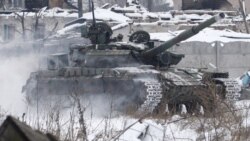
Ukrainian servicemen ride in a tank close to the airport in the eastern city of Donetsk, a facility which has been the site of intense fighting for several weeks.
The Russian news agency Interfax has reported that Russia's Investigative Committee has put Ukrainian acting Interior Minister Arsen Avakov and Dnepropetrovsk Oblast Governor Ihor Kolomoiskiy on an Interpol international wanted list.
Investigative Committee spokesman Vladimir Markin told Interfax the warrants were issued "in the framework of a criminal case on the use of banned means and methods of warfare, aggravated murder, hindrance of the professional activity of journalists, and abductions of people in eastern Ukraine."
12:3721.6.2014
Here is the latest on fighting in eastern Ukraine, despite the beginning of the cease-fire:
The Ukrainian Border Guard Service says pro-Russian separatists have attacked two border posts in the eastern Donetsk region.
The attacks came despite a unilateral cease-fire declared by President Petro Poroshenko.
The agency said six border guards were injured in one of the overnight attacks.
Poroshenko declared the week-long unilateral cease-fire during a visit to the Donetsk region on June 20.
A statement said the plan is aimed to give separatists time to disarm, but does not mean the troops will not respond to "aggression."
Poroshenko also presented a peace plan, which includes the establishment of a 10-kilometer buffer zone at the Ukrainian-Russian border, and a safe exit for foreign fighters.
Several separatist commanders immediately rejected the plan, while Russia described it as an ultimatum rather than a peace offer.
12:3321.6.2014
Russian analyst Lilya Shevtsova, of the Carnegie Moscow Center, has posted on Facebook a response to an announcement by Russia's Investigative Committee that it is investigating the alleged firing on a Russian border post from Ukrainian territory:
This is Moscow's answer to the antiterrorism operation and [Ukrainian President Petro] Poroshenko's peace plan. And it is not the last "shot." Moscow's goal is clear: to prove to the West that Kyiv cannot end the bloodshed and is already threatening Russia. This means that it is necessary to introduce "peacekeepers" into Ukraine. And they are already ready! We can continue guessing whether this is blackmail or not... But for now Putin does not intend to back down. Gentlemen, you were wrong in Normandy.
12:2221.6.2014
Volunteer fighters have been being sworn in in Donetsk today:
12:1121.6.2014
In a speech at London's Chatham House on June 19, NATO General-Secretary Anders Fogh Rasmussen discussed NATO's "open-door policy" and its impact on relations with Russia.
Here is the money bit:
ANDERS FOGH RASMUSSEN: But let me stress NATO's open-door policy is not a provocation against anybody. On the contrary, everybody, including Russia, has profited from the zone of stability, security, and prosperity we have contributed to develop in Eastern and Central Europe.
But first and foremost, let me emphasize, in parallel… in parallel with enlargement of NATO, we have engaged intensively with Russia. And actually we have created something very, very special, namely a NATO-Russia Council. It was established in Rome in 2002.
Already in 1997, before the first of the recent enlargement of NATO, we adopted a joint document called the Founding Act, which created the first framework for a structured cooperation between NATO and Russia.
And it was followed, as I said in 2002 by the establishment of something very particular, the NATO-Russia Council, which since then has served as a framework for political consultations as well as decisions on practical cooperation between NATO and Russia.
And I think the peak of all this was the NATO-Russia Summit in Lisbon in November 2010, at which summit we decided to develop a true strategic partnership between Russia and NATO.
So let me stress that we have not accepted new members of NATO as part of any aggression against Russia. On the contrary, we have for more than 20 years now tried to include Russia in a constructive cooperation.
But apart from all that, we adhere to a fundamental principle, namely that each and every nation has a fundamental right to decide itself its security policies and Alliance affiliation. Actually, that's also enshrined in the OECE Charter for European Security, which was adopted in 1999 and also signed by Russia. So Russia has subscribed to that principle, that each and every nation has a right to decide itself.
So NATO's open-door policy follows from our NATO Treaty, Article 10, which states that we may invite any European country that is in a position to improve Euro-Atlantic security and further the principle upon which we have built our societies. Each such European country may be invited to join our Alliance.
And these two things in combination, our open door and the right of every country to decide itself, has led to an expansion of NATO from 16 to 28 nations. That's not directed against Russia. But it's based on some fundamental principles, and of course our goal to create a Europe whole, free, and at peace. And we will not accept new dividing lines in… in Europe.
So I… I completely dismiss that allegation, that our open-door policy should be a provocation against Russia.
And just have a look also at economic figures -- trade, investment, and other things -- you will see that Russia has profited immensely from that zone of security, stability, and prosperity we have contributed to create in Eastern and Central Europe.
So basically, it's in Russia's interest. So… but it goes beyond my imagination how the Kremlin thinks, actually.
RFE/RL recently published this feature on Russian pressure against Montenegro, which hopes to be invited to join NATO as early the alliance summit in September.
11:5121.6.2014
CNBC correspondent Steve Sedgwick on June 19 had an interview with Igor Sechin, close associate of Russian President Vladimir Putin and CEO of the state-owned Rosneft oil company. The transcript is posted here.
Sechin fairly rarely gives interviews, so it is interesting particularly to read the following exchange on the sanctions against Sechin and other Russian offiicials and firms over the conflict in Ukraine:
SS: May I ask you about sanctions? You have been directly targeted by the US State Department, what is your reaction to that?
IS: The sanctions have been discussed a lot and I would like us to abstain from this discussion because the more we talk about the sanctions, the more important they seem. I am trying to put myself in the shoes of those people who introduce sanctions and I believe that there should be some purpose of the sanctions and some justification of them. And I cannot understand the purpose of the sanctions whatsoever. Especially myself personally I cannot understand what purpose they are pursuing, because I am not involved in the political decisions. I am not a person or element that matters - from the standpoint of obtaining advantages.
Secondly, I cannot understand any justification or basis for taking the sanctions. I don't think that my active cooperation with the American companies that is aimed at ensuring mutual profit could be a basis for sanctions.
I think this sad situation was described quite well by the French politician Charles Maurice de Talleyrand. As far as I remember, what he said is everything that is excessive doesn't have significance. I think serious people should not take any serious decisions under pressure. Therefore this decision that target me don't make any sense to me.
However, I respect such people who take such decisions because our task is to keep working and we will try to demonstrate our efficiency in our activities, including the work of American companies. In my opinion, this is the only option of good response to this type of actions.
SS: Do you fear that your cooperation with American companies will be threatened by a next round of sanctions, which has been talked about it will affect technology and the energy sector and it would hurt your relationships with your American partners?
When I started answering your question on sanctions I said it would be better for us not to discuss this issue. Now you are trying to develop this topic. By doing this, you are trying to give more significance to the sanctions.
I will repeat myself and I will say that we will continue working to demonstrate our efficiency in our joint work that would be mutually beneficial to both Russian and American companies. However if new decisions are taken about sanctions we will continue working at implementing our projects ourselves but we will leave the option open for the American partners to come back when it is possible.
SS: I have a final question, and it is not about sanctions, it is about Igor Sechin, I read a lot about you, I have read a lot about you in the Western press, some of them complimentary, some of them talking about your power, some of them talking about your past and the influence you have. In your words, who is Igor Sechin?
IS: Igor Sechin is the person who you currently can see in front of you. I think that as a result of our conversation, each of us will form an opinion of the person whom he has talked to. If we meet often in the future, at some point there will be trust and maybe even friendship between us. Don't listen to anyone, just try to form your own opinion and live your own life. Thank you.
Sechin, left, speaking to Putin in 2013.
11:2721.6.2014
The website of Russian President Vladimir Putin has posted a statement responding to Ukrainian President Petro Poroshenko's cease-fire initiative in eastern Ukraine.
Here is the statement in full:
The announcement of Ukrainian President Petro Poroshenko about a temporary halt of military activities was accidentally or intentionally made against the background of firing on Russian territory in the region of the Dolzhansk border crossing, which caused the destructgion of a building and, more importantly, wounded a Russian border guard.
Russia is awaiting an explanation and apology regarding this incident.
Considering this situation, the Russian side must carefully analyze the text of the corresponding decision of the Ukrainian president and the plan for implementing it.
Unfortunately, an initial analysis shows that it is not an invitation to peace and negotiations, but an ultimatum to the militias of southeastern Ukraine to lay down their arms.
So far, the main element -- a proposal to begin negotiations -- is missing.
11:1621.6.2014
Don't miss this week's excellent Power Vertical (@PowerVertical) podcast on "Russia's New Utopianism."
After decades in the shadows, those age-old utopian and imperial instincts are back with a vengeance.
In this week's Power Vertical Podcast, we discuss Eurasianism, Russia's latest messianic ideology. Is it a passing fad? Or a long-term project?
11:0721.6.2014
Here's an interesting ITAR-TASS analytical piece on the measures Russia will "be forced to take" to protect its economy "against duty-free European goods" if Ukraine and Moldova sign free-trade agreements with the European Union.
The director for trade negotiations at the Ministry of Economic Development, Maxim Medvedkov, believes the problems can arise when the territory of Ukraine begins to be used by EU companies for simple value added operations or knock-down assembly and further re-export to the Customs Union countries, which will concern agricultural produce, energy cooperation, in particular nuclear power, aviation and other fields.
and
Higher School of Economics professor Mikhail Berger said the Russian government was going to revise employment conditions for Moldovans and deport about 300,000 of the 700,000 Moldovan migrant workers, which will strip many building companies of cheap labor force. Construction workers from Moldova will hardly be able to find jobs in the EU, where labor market competition is high. The same fate could lie in store for 5-6 million Ukrainian citizens working in Russia, the expert told ITAR-TASS.
10:5121.6.2014
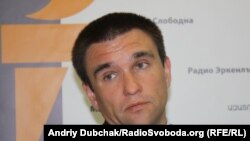
Do take a few minutes to read this compelling profile on new Ukrainian Foreign Minister Pavlo Klimkin by RFE/RL Washington correspondent Carl Schreck (@CarlSchreck).
Signals from Moscow indicate that the Kremlin feels it can work with Klimkin, whose immediate predecessor, Andriy Deshchytsya, sparked controversy last week when he was caught on camera using an obscenity to describe Russian President Vladimir Putin. "All we can do is wish him a productive start to his work in this new, important post," Deputy Russian Foreign Minister Grigory Karasin told RIA Novosti, calling Klimkin one of Ukraine's "most experienced, well-known diplomats."