



Bloomberg: #Merkel says sanctions on table amid slow #Ukraine progress http://t.co/7sahFHVwcn #Russia
— Kyiv Post (@KyivPost) June 25, 2014
Poroshenko says Ukrainian will remain only constitutionally-enshrined language, despite decentralization. http://t.co/otjOUymbb3
— Annabelle Chapman (@AB_Chapman) June 25, 2014
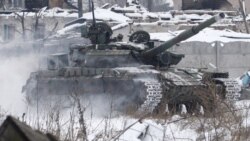
Train loaded with these sped by today near Russian town of Kamensk-Shakhtinsky not far from #Ukraine border. pic.twitter.com/qn2KK2Ljdb
— Paul Sonne (@PaulSonne) June 25, 2014
I have just found out that as a Russian tax payer I paid roughly 1.500 USD for annexation of Crimea and other "anti-crisis measures".
— Yulia Bragina (@YuliaSkyNews) June 25, 2014
Here's a more extended bulletin from our news desk on the vote in Russia's Federation Council:
Russia's upper house of parliament has voted overwhelmingly to revoke authorization for Russian military intervention in Ukraine.
Senators in the Federation Council on June 25 voted 153-to-1 to revoke the resolution -- adopted in March -- that provided for Russia to use its military forces in Ukraine if needed.
There was no debate on the proposal before the vote.
Putin announced that he had asked the council to withdraw the authorization before going into talks with officials in Austria on June 24, saying the move was meant to support the peace process in Ukraine.
The vote enters into force immediately.
The Federation Council's deputy speaker, Ilyas Umakhanov, said the March 1 resolution allowing Russia to send military forces into Ukraine was the correct move at the correct time.
"Russia confirmed its status as a great power, which independently defines its foreign policy course, acting out of its national interests," Umakhanov said.
He added Russian senators were not correcting a mistake by revoking the right to use military force in Ukraine but were "giving our [foreign] colleagues an opportunity to save face and return to a normal working relationship with the Russian parliament."
Ukrainian President Petro Poroshenko on June 24 welcomed Putin's move as the "first practical step" taken by Russia to resolve the crisis.
Later, however, Poroshenko said he might be forced to cancel a one-week cease-fire he implemented on June 20 as part of his peace plan after pro-Russian separatists near the eastern Ukrainian town of Slovyansk shot down a Ukrainian helicopter, killing nine soldiers.
Poroshenko's cease-fire had already been broken by sporadic clashes.
Poroshenko is due to discuss the incident with Russian President Vladimir Putin in a teleconference on June 25 that would also be joined by German Chancellor Angela Merkel and French President Francois Hollande.
Ukraine's Defense Minister Mykhailo Koval said on June 25 that Ukraine has lost 142 troops since hostilities with pro-Russian rebels in the east intensified in March.
I regret to say that we see no signs that Russia is respecting its international commitments - @AndersFoghR @NATO @France24_en
— Méabh (@Brusselsness) June 25, 2014
Refugee-camp is on the Azov coast. Water is shallow, warm. One of few places with sand beach pic.twitter.com/TpzE13yYfg
— Olaf Koens (@obk) June 25, 2014
There is some Ukraine-related news in this RFE/RL report on the NATO talks in Brussels:
NATO chief Anders Fogh Rasmussen has opened a meeting of alliance foreign ministers by noting Russia's use of "ambiguous" warfare in Ukraine while saying its door "remains open" to aspirant countries.
The meeting in Brussels is also expected to include discussion of the crisis in Iraq, with U.S. Secretary of State John Kerry in attendance.
In opening remarks, Rasmussen called it a "critical moment for our security."
He said NATO needs to continue to adapt its readiness, as the alliance faces "old threats and new, from Eastern Europe to North Africa and the Middle East."
Rasmussen said NATO has witnessed Russia using a "new, different type of warfare" against Ukraine and has seen "no signs" Russia is respecting its international commitments.
He said NATO will discuss how to improve its understanding of "ambiguous threats and how we deal with them in the longer term."
He also said NATO will open "intensified" talks with Montenegro and assess by the end of 2015 whether to invite Podgorica to join.
He said a substantive package is being developed for Georgia to help it move closer to the alliance but made no mention of membership.
As for Iraq, Kerry met late on June 24 with EU foreign policy chief Catherine Ashton and other European allies and discussed what a spokeswoman called the "grave security situation in Iraq."
Kerry flew in from Iraq, where he met on June 24 with officials in the northern autonomous Kurdish region following talks a day earlier in Baghdad with Prime Minister Nuri al-Maliki.
The Brussels meeting is the final top-level gathering before a summit of NATO leaders scheduled for September in Wales.
Klitschko: ‘I had no idea #Kyiv was in such bad shape’ - big guy shows off new office (PHOTOS) http://t.co/WN7xGj570W pic.twitter.com/2p9bvQBW8E
— Christopher Miller (@ChristopherJM) June 25, 2014