


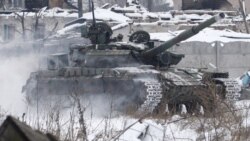
Kyiv says four Ukrainian soldiers die in night fighting in Donetsk region http://t.co/NnVLhfEivV
— Kyiv Post (@KyivPost) June 27, 2014
Ukraine -- along with Georgia and Moldova -- has signed an Association Agreement with the EU. Our news desk has the details:
Ukraine, Georgia, and Moldova have signed key economic and political accords with the European Union in Brussels.
Ukraine signed an agreement on closer economic ties with the EU, as did Moldova and Georgia, who also signed documents on closer political ties.
The moves represent a big step toward the West and away from Russia for the three nations.
European Council President Herman Van Rompuy said "future generations will remember this day."
Both Van Rompuy and European Commission President Jose Manuel Barroso stressed the accords are not aimed at harming Russia.
Georgian Prime Minister Irakli Garibashvili said becoming a member of the European family is Georgia's "unwavering will."
Moldovan Prime Minister Iurie Leanca said the accords offer his country "a future."
Ukrainian President Petro Poroshenko said "over the last months, Ukraine has paid the highest possible price to make its European dream come true."
Former President Viktor Yanukovych's abrupt refusal to sign the agreements back in November sparked the Euromaidan revolt that led to his ouster in February.
Poroshenko is currently in the process of signing a "historic" Association Agreement with the EU. Here is a little bit more detail from our news desk:
Ukraine, Georgia, and Moldova are taking a big step toward the West and away from Moscow on June 27 when they sign key accords with the European Union in Brussels.
Ukraine will sign an agreement on closer economic ties with the EU, formally known as a Deep and Comprehensive Free Trade Area agreement (DCFTA).
Moldova and Georgia will each also sign a DCFTA, along with an Association Agreement on closer political ties with the EU.
Arriving at EU headquarters in Brussels, Ukrainian President Petro Poroshenko said today represents a "new perspective" for Ukraine and called it "one of the most historic days" for Ukraine since its independence.
Former Ukraine President Viktor Yanukovych's refusal to sign the agreements back in November sparked the Euromaidan revolt that led to his ouster.
In March, the EU and Kyiv signed an Association Agreement after Russia's annexation of Crimea.
Brussels had planned to sign the political and trade pacts with Chisinau and Tblisi later this year but moved up the date amid concerns Moscow may try to obstruct the process.
Russia has threatened to respond with trade barriers as it pushes its own Eurasian Economic Union.
Among other things, the agreements will allow the three countries unfettered access to the EU's market of 500 million consumers.
Kyiv says four Ukrainian soldiers die in night fighting in Donetsk region http://t.co/NnVLhfEivV
— Kyiv Post (@KyivPost) June 27, 2014
#BREAKING: Poroshenko hails 'historic day' of EU-Ukraine association accord
— Agence France-Presse (@AFP) June 27, 2014
In BBC interview, Putin adviser calls Poroshenko a 'Nazi', warns Europe 'Nazi Frankenstein' will knock at their door https://t.co/ZjS3bh64mE
— Steve Rosenberg (@BBCSteveR) June 27, 2014
Ukraine will figure prominently at a meeting of EU leaders in Brussels today. Here's a look-ahead from RFE/RL's news desk:
Today, European Union leaders are due to discuss whether to impose further sanctions on Russia over the crisis in eastern Ukraine.
On the eve of the Brussels summit, U.S. Secretary of State John Kerry called on Russia to take steps to disarm separatists in Ukraine within "the next hours."
The U.S. State Department has said it has new Russia sanctions "ready to go," but Kerry said the United States would prefer not to be in "sanctions mode" and wanted Russia to take action without pressure.
On June 26, Ukrainian President Petro Poroshenko called on Russia to support his peace plan "with deeds, not words."
EU leaders are also due to debate candidates to become the next president of the European Commission, to replace Jose Manuel Barroso. Luxembourg's Jean-Claude Juncker is the favorite, despite strong opposition from Britain.
This pro-Russian bunny is just one of the animals featured in Claire Bigg's piece on the Internet memes generated by the Ukraine crisis. Read more here.
There also seem to be these particularly dangerous-looking "separatist" bunnies in the #Donetsk Republic. ;) #Донецк pic.twitter.com/McClqOLRkY
— Nina Byzantina (@NinaByzantina) April 28, 2014
Important day for #Ukraine: #Poroshenko signs economic part of association agreement. One goal of the #Maidan reached. But ceasefire ends
— Ann-Dorit Boy (@anndoritboy) June 27, 2014
Good morning. We'll start the live blog today with this report from our news desk about the release of four OSCE observers who had ben held captive in eastern Ukraine for 31 days:
Four monitors for the Organization for Security and Cooperation in Europe (OSCE) who were abducted in May by pro-Russian gunmen in eastern Ukraine have been freed.
A leader of the pro-Russian separatists in the Donetsk region said the four had arrived at a hotel in the city of Donetsk.
Alexander Borodai said the four OSCE monitors had been held by a rebel leader in the neighboring restive region of Luhansk.
Borodai said the release was a goodwill gesture.
It comes as a weeklong truce that has failed to halt the fighting in eastern Ukraine is due to end later on June 27.
An OSCE official in Kyiv confirmed the four had been freed, noting they had "been absent for 31 days."
Mark Etherington also expressed concern over the fate of a further four OSCE monitors who were allegedly abducted by pro-Russian separatists in eastern Ukraine on May 29.
According to the AFP news agency, the four freed OSCE observers -- from Switzerland, Turkey, Estonia, and Denmark -- appeared tired and tense and they declined to speak to journalists in Donetsk.
Later on June 27, European Union leaders are due to discuss whether to impose further sanctions on Russia.
On the eve of the Brussels summit, U.S. Secretary of State John Kerry called on Russia to take steps to disarm separatists in Ukraine within "the next hours."
The U.S. State Department on June 25 said it had new Russia sanctions "ready to go," but Kerry said the United States would prefer not to be in "sanctions mode" and wanted Russia to take action without pressure.
On June 26, Ukrainian President Petro Poroshenko called on Russia to support his peace plan "with deeds, not words."
Addressing the Council of Europe's parliamentary assembly in Strasbourg, Poroshenko said he will make "a very tough decision," if the cease-fire is not extended.
Earlier, separatists in eastern Ukraine said they had agreed to fresh talks with Kyiv.
Former Ukrainian President Leonid Kuchma, representing Kyiv in the negotiations, confirmed another round would take place on June 27.
Russian President Vladimir Putin again said on June 26 that the cease-fire should be extended, and pointed to the growing number of people crossing into Russia from Ukraine.
According to the AP news agency, thousands of Ukrainians in cars stuffed with belongings lined up at the border to cross into Russia as the shaky cease-fire entered its final hours on June 26.
Meanwhile, separatists in Luhansk and Donetsk announced on June 26 that they have elected Oleh Tsaryov as speaker of a new unelected parliament uniting the unrecognized people's republics of the two Ukrainian regions.
According to Interfax, the two regions also announced they would form a confederation called the "union of people's republics."