

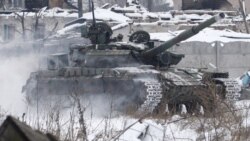
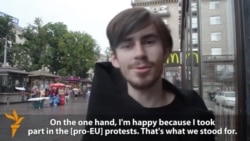
And now some vox pops from Ukrainians reacting to their government signing a pact with the EU today.

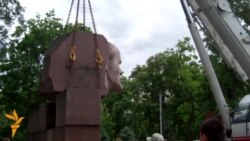
A monument to Bolshevik leader Vladimir Lenin near a regional government building in the Ukrainian city of Dnipropetrovsk was dismantled on June 27. Our Ukraine Service were there.
Some vox pops are coming from our language services, guaging reactions to the signing today of key EU agreements. First up Georgia:
The Twittersphere has been abuzz with talk of an extension of the cease-fire. Our news desk has some more details:
Ukrainian President Petro Poroshenko says he will decide whether to extend a unilateral cease-fire in eastern Ukraine when he returns to Kyiv later from an EU summit in Brussels.
The cease-fire is due to expire today.
Media reports citing diplomatic sources said Poroshenko told EU leaders he was ready to extend the cease-fire by 72 hours, the same time period the EU has given Russia to act on Ukraine or face the prospect of sanctions.
Russian Foreign Minister Sergei Lavrov said Moscow would welcome a three-day extension of the cease-fire, but it must not simply delay an "ultimatum" for separatists to disarm.
President Vladimir Putin has called for a long-term cease-fire to allow for peace talks.
Meanwhile, the Interfax news agency says talks involving representatives of Kyiv, Moscow, the Organization for Security and Cooperation in Europe (OSCE), and pro-Russian separatists on the cease-fire are under way in Donetsk.
Bloomberg has been looking at how things could quickly turn nasty for Russian President Vladimir Putin despite his soaring approval ratings:
Even Vladimir Putin, in his 15th year in power, can’t convert an 86 percent approval rating into economic growth when global banks stop lending and money flows mostly one way: out.
So far, Putin has paid a small price for the most blatant land grab in Europe since World War II: a few frozen credit cards, some travel restrictions on his billionaire friends and a bit of finger-wagging by U.S. and European Union leaders. For all his vows to modernize and diversify the economy, though, Russia remains a nuclear-armed petrostate and Putin’s remedy for growth now is more, not less, government control.
“The measures the president is proposing will certainly limit competition and freeze modernization,” Alexei Kudrin, a Putin adviser who steered the country’s finances for more than a decade, said in an interview in Moscow. “They will lead to an increase in market regulation and protectionism.”
[...]
State enterprises now account for more than half of the economy, up from 30 percent when Putin came to power at the end of 1999, according to BNP Paribas SA. (BNP) As the bureaucracy swelled during that period, Russia emerged as the world’s most corrupt major economy. It ranks alongside Pakistan and Nicaragua at 127th, out of 176 nations, by Transparency International, down from 82nd in 2000.
[...]
State enterprises now account for more than half of the economy, up from 30 percent when Putin came to power at the end of 1999, according to BNP Paribas SA. (BNP) As the bureaucracy swelled during that period, Russia emerged as the world’s most corrupt major economy. It ranks alongside Pakistan and Nicaragua at 127th, out of 176 nations, by Transparency International, down from 82nd in 2000.
Read the entire article here
Donetsk People's Republic says the latest round of "consultations between OSCE, Ukraine, Russia and Novorossiya" has begun
— Alec Luhn (@ASLuhn) June 27, 2014