

From our newsroom:
European Union leaders will work to block loans for new projects in Russia by two multilateral lenders and broaden the scope of other sanctions in response to Moscow's actions in Ukraine.
According to a draft statement seen by Reuters, EU leaders, who are meeting in Brussels on July 16, will ask the European Investment Bank to suspend financing of new Russian public sector projects.
It says EU countries will also work together to suspend funding for new projects in Russia through the European Bank for Reconstruction and Development.
The draft statement also says the bloc will broaden the scope of asset freezes to target companies and other organizations that undermine Ukraine's sovereignty.
The text of the draft could change, however, until its final adoption.
In another indication of how today's European Council meeting might go vis-a-vis Russia sanctions, AFP quotes a German government spokesman saying that Russian actions to resolve the Ukraine conflict have so far been insufficient.
Today's map of military activity in eastern Ukraine, commissioned and issued by the Information-Analytical Center of the Ukrainian National Security and Defense Council:
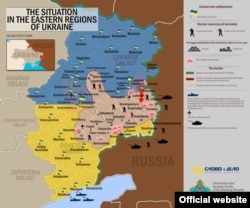
Pro-Kyiv military blogger Dmitry Tymchuk's latest post -- a summary for July 15 translated into English and republished in full by the "Kyiv Post" -- describes the "successes of the ATO (Anti-Terrorist Operation)" in eastern Ukraine as having "changed into 'trench warfare.'"
With Russia seeking to counter Western influence in Ukraine and elsewhere, here's our infographic highlighting precisely where the economic might within BRICS lies.
Russian Emergency Situations Ministry spokesman Aleksandr Drobyshevsky says his country is sheltering nearly 25,000 Ukrainian refugees, Interfax reports.
Here is the text of the Trilateral Contact Group's statement alleging "a lack of willingness on the side of the separatists to engage in substantive talks on a mutually agreed cease-fire."
Following the understanding reached during recent telephone conversations by theChairman-in-Office of the OSCE, the Swiss President Didier Burkhalter, with the Minister of Foreign Affairs of the Russian Federation, Sergey Lavrov, and the Minister of Foreign Affairs of Ukraine, Pavlo Klimkin, and based on the results of a conference call between the Foreign Ministers of France, Germany, Ukraine and the Head of Administration of the President of the Russian Federation, the Trilateral Contact Group has made all necessary efforts for a resumption of consultations with representatives of the separatists in the east of Ukraine.
Unfortunately, a video conference with the separatists, scheduled for today with the aim of agreeing on modalities for a next round of consultations, and agreed upon at the highest international level, did not materialise. The Contact Group is seriously concerned about the fact that since June 27, no such consultations have taken place. In the opinion of the Contact Group, this indicates a lack of willingness on the side of the separatists to engage in substantive talks on a mutually agreed cease-fire.
The Contact Group reconfirms its support to President Poroshenko’s Peace Plan and to the commitments stated in the Joint Declaration in Berlin on 2 July 2014.
The Contact Group appeals to the separatists to return to consultations without further delay. The Group stresses that a sustained cease-fire will require the following principles to be observed:
-
An OSCE supported monitoring and verification mechanism coming into effect simultaneously with the entry into force of the cease-fire;
-
the implementation of an effective border monitoring;
-
the release of all hostages;
-
the start of inclusive dialogue.