



Putin via Interfax:
"In fact, I would like to say that those in the United States who are behind foreign policy actions have unfortunately been holding a rather aggressive foreign policy for the past ten to fifteen years and, in my opinion, [this policy] is rather unprofessional. So, no matter what they do, they always have problems," he told reporters on Thursday.
He cited situations in various countries as examples.
"There are problems in Afghanistan, Iraq is breaking up and Libya is breaking up, and if Gen. El-Sisi had not taken control of Egypt, Egypt might be a complete mess now. They touched Ukraine and it had problems, as well," Putin said.
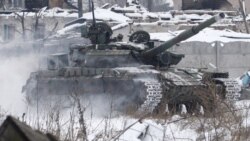
Pro-Kyiv military blogger Dmitry Tymchuk says there was no letup in fighting overnight and cites the "terrorists'" use of drones minutes ahead of an attack on a checkpoint.
Big news, if corroborated.
White House video of U.S. President Barack Obama announcing the new sanctions:
Not sure "plummets" is the right word, but the message is clear.
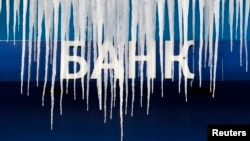
One of the features of these latest sanctions is the adverse effect they could have on Russian companies' access to Western capital markets, given the dollar's global role. Reuters reports:
The chief executive of Russia's VTB bank said on Thursday new U.S. sanctions imposed on Moscow over the Ukraine crisis were inappropriate and warned of potentially devastating consequences for the global financial system.
"Of course, these sanctions are inappropriate and of course they do not correspond to the spirit or the legal standards of existing international relations, in particular in the field of finance and banking," Andrei Kostin, whose bank is Russia's second largest, was quoted as saying by Itar-Tass news agency.
"I believe that if we do not take measures to stop such unilateral actions, we could see devastating consequences for the global financial system."
Here's our overnight wrap-up of the announcements of new sanctions against Russia by the United States and European Union, reported from Washington (@johnson) and Brussels (@RikardJozwiak):
The United States and the European Union significantly strengthened sanctions on Russia over Ukraine on July 16, with Washington for the first time directly targeting Russia's banking, military and energy sectors.
U.S. President Barack Obama announced the new sanctions over what he called a failure by Russia to take concrete steps to stop an escalation of violence in eastern Ukraine.
"I've repeatedly made it clear that Russia must halt the flow of weapons and fighters across the border into Ukraine," Obama said, adding that he had said this directly to President Vladimir Putin.
"What we are expecting is that the Russian leadership will see once again that its actions in Ukraine have consequences," said the president.
The Treasury Department used its authority for the first time under a separate executive order to sanction several top Russian banks and energy companies.
Under Secretary for Terrorism and Financial Intelligence David S. Cohen said in a statement,“Because Russia has failed to meet the basic standards of international conduct, we are acting today to open Russia’s financial services and energy sectors to sanctions and limit the access of two key Russian banks and two key energy firms to U.S. sources of financing, and to impose blocking sanctions against eight arms firms and a set of senior Russian officials.”
The entities include Rosneft, a state-owned oil company, state-owned bank Vnesheconombank, natural gas producer Novatek and Gazprombank, the financing arm of Gazprom.
U.S. firms would still be allowed to do business with the firms, according to the Treasury Department, but prohibited U.S. entities from issuing new debt longer than 90 days maturity. A senior administration official said that the measure would restrict their access to capital markets because of the dominance of the U.S. dollar worldwide.
The list did not include Russia's state-controlled natural gas company Gazprom, nor its CEO, Aleksey Miller. The company has cut its supply to Ukraine over a payment dispute.
The shift in targeting sectors of the Russian economy indicated a harder approach to Russia by the Obama administration as the Ukraine crisis continues with no resolution in sight.
Past rounds of sanctions had mostly focused on sanctioning individuals and banning them from traveling to the United States.
The Treasury Department simultaneously sanctioned five more Russians under that authority, including Sergey Beseda, Commander of the Fifth Service of the FSB, Duma Deputy Chairman Sergei Neverov, Minister for Crimean Affairs Oleg Savelyev, Aleksandr Borodai, prime minister of the self-proclaimed Donetsk People's Republic and Igor Shchegolev, an aide to Russian President Vladimir Putin.
The administration also sanctioned the self-proclaimed Donetsk and Luhansk People's Republic, Fedosiya Enterprise, a Crimean oil company, and several Russian arms manufacturers, including Kalashnikov. (The Treasury Department clarified that existing owners of the weapons in the U.S. would not be subject to sanctions.)
In a first reaction to the U.S. sanctions, Putin warned that the move will take relations with Russia to a "dead end" and damage U.S. business interests in his country.
Putin told reporters on a visit to Brazil, "Sanctions have a boomerang effect and without any doubt they will push U.S.-Russian relations into a dead end, and cause very serious damage."
Meanwhile, European Union leaders also agreed to expanded sanctions against Russia, after a marathon meeting in Brussels.
But the EU, which has a far deeper economic relationship with Russia than the United States, was more restrained.
An EU statement at a summit in Brussels said the measures will target "individuals or entities who actively provide material or financial support to the Russians decision-makers responsible for the annexation of Crimea or destabilisation of eastern Ukraine."
The statement said that European countries would agree on names and entities by the end of the month.
The 28 leaders also agreed to suspend new investments in Russia by the EU's European Investment Bank (EIB) and European Bank of Reconstruction and Development (EBRD).
Russian Deputy Foreign Minister Sergei Rybakov responded in a statement to Interfax news agency, saying"We condemn those politicians and officials behind such actions, and confirm the internation to adopt measures, that will be received in Washington quite painfully and strongly."