


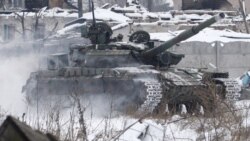
Irakli Kurasbediani, a former head of the Georgian Military Intelligence Service, is currently fighting in eastern Ukraine against pro-Russian separatists. He spoke with RFE/RL's Georgian Service about the situation on the ground:
"A clear picture has emerged in terms of our goals -- now we see the road we need to follow. In other words, we quit our initial battle tactics that used to lead to great numbers of unnecessary deaths. That was the game changer and we clearly gained the momentum. To cut it short, our enemies now clearly see that their attacks will be pernicious. They have been pernicious all along, but now we are able to get over with all of this faster. Now they are on defense, they are hiding behind civilian population, firing at us from population centers, which we are doing our best to avoid at all times. This is the reason why it gets protracted in time."
"[Ukraine] amounts to a lot of open space and long distances. [Pro-Russian separatists] are as a rule hiding in populated areas because in them they are able to stock on groceries and beverages. They need cars, which they snatch from local people, to move around. They also need people to use as human shields and they prevent them from leaving. We try to hold our fire to create a lull in fighting and some sort of safe corridors for local civilians to leave. In essence, civilian population is the only factor behind the lengthy [Ukrainian antiterrorist] operation and difficulties that we face."
"Sure, there are people [in Ukraine's southeast] who believe whatever Moscow is telling them. However, once they see with their own eyes how these guys [pro-Russian separatists] are installing Grad [truck-mounted multiple-rocket-launcher] systems in their backyards, fire a shot or two in our direction and then turn them around to shell the city of Donetsk -- I don't know why, maybe to instigate hatred among locals; I was shocked to see this at first, because I haven't seen anything like this even during Abkhazia and Ossetia wars -- this speaks for itself."
"I do not expect anything more rewarding than our victory. On top of that, there are words I have heard and read on the Internet from Ukrainians themselves -- words of gratitude and hope that they are not alone during this very difficult time for them. I don't need anything else. [Ukrainians] also need support, just like we needed it, although Ukraine is larger than Georgia. One needs to feel supported in times like this."
"There is a good chance of wrapping it all up by winter. I'll tell you something as a former military intelligence officer -- everything depends on what the enemy is up to. Should there be a direct and open aggression with [Russian] military forces rolling in like in Crimea -- although we'll hardly see the Crimean scenario unfolding here -- then we are to face a large-scale battle. This, of course, would extend the whole thing. At the same time it would help drive the last nail into the coffin of Russia's image as the biggest power around -- Russia stands no big chance of achieving a victory."
From our news desk:
Russian President Vladimir Putin has signed a decree banning or limiting imports of food and agricultural products from countries that have imposed sanctions on Russia.
The decree, whose text was released on August 6, says such imports will be "banned or restricted" for one year.
Putin also ordered his government to come up with a list of goods whose imports are to be banned or restricted.
On August 5, Putin said the government should make sure the retaliatory measures do not hurt Russian consumers.
Moscow has already imposed bans on certain agricultural imports from Ukraine, Moldova, and several EU countries.
The Russian bans follow new sanctions imposed by the United States and the European Union against Russia's banking, oil, and energy sectors over Moscow's perceived backing of pro-Russian separatists fighting government forces in eastern Ukraine. (Reuters, AP, Interfax)
Former Polish dissident Adam Michnik likens Russian President Vladimir Putin's actions regarding Ukraine to Adolf Hitler's annexation of the German-speaking part of Czechoslovakia in 1938. The veteran of Poland's anticommunist opposition told RFE/RL's Aleksei Dzikavitski in Warsaw that Europe should find ways to "stop Putin" despite potential economic costs. (RFE/RL's Russian Service)


This could finally tilt the balance against Russia:
From our news desk:
Ukraine's Foreign Ministry says NATO Secretary-General Anders Fogh Rasmussen will visit Kyiv on August 7.
The ministry said the visit, at the invitation of Ukrainian President Petro Poroshenko, is intended to discuss an upcoming meeting on the NATO-Ukraine partnership.
Earlier on August 6, NATO said a Russian force buildup near the Ukrainian border amounts to some 20,000 troops.
NATO said Moscow could use the excuse of a humanitarian or peacekeeping mission to send them into Ukraine.
Also on August 6, Polish Prime Minister Donald Tusk said he had received information "in the last several hours" suggesting the threat of direct Russian military intervention in Ukraine was “higher than it was several days ago.”
Moscow on August 4 announced what it said were military training exercises near the border with Ukraine.
The Ukrainian government says fierce clashes with pro-Russian rebels had left 18 soldiers dead over the past 24 hours. (Reuters and AFP)
Our Ukrainian Service explains how the recent collapse of Russia's travel industry can be linked to the annexation of Crimea (in Ukrainian):