


Actually, he seems to say war WAS inevitable, but still. (Interview in Russian):
Here's an update from RFE/RL's news desk concerning alleged Russian troop movements in eastern Ukraine:
Ukraine has leveled new allegations about Russian troop movements in its restive east, one day after President Petro Poroshenko promised to draft a new cease-fire plan following talks with Russian President Vladimir Putin.
Military spokesman Andriy Lysenko said today that Russian soldiers and armor had crossed into Ukraine and entered the town of Amvrosiyivka, 60 kilometers southeast of Donetsk -- a stronghold of pro-Russian rebels.
Ukraine also said a large convoy of tanks and heavy weaponry from Russia was traveling toward Telmanove, 80 kilometers south of Donetsk.
The reports came after Poroshenko concluded what he said were "tough" crisis talks with Putin late on August 26 in Minsk.
Poroshenko said agreement had been reached on further talks on gas supplies and border controls.
Putin said any cease-fire plans were an internal matter between Kyiv and the rebels.
(Reuters, AFP, AP, dpa, ITAR-TASS, Interfax)
things are going wrong,very wrong in #Kyiv."Ukraine’s economy: Broken down - http://t.co/Nxapd0NDQf http://t.co/T5rPG4i3rI за допомогою @FT
— Kateryna_Kruk (@Kateryna_Kruk) August 27, 2014
Regular Power Vertical podcast contributor and security expert Mark Galeotti has been looking at possible scenarios vis-a-vis the battle for Donetsk -- and also scrubbing any lazy comparisons with Stalingrad and Grozny while he's at it:
So long as Donetsk is at war, humanitarian relief efforts will not be able to provide more than a fraction of their needs. Supplies did continue to flow into Stalingrad and even besieged Leningrad, courtesy of Lake Ladoga.
A ruthless, disciplined regime could either force the population to work for the defense of the city or at the very least ignore their plight and hoard what supplies were available for the fighters. In Stalingrad and Leningrad, after all, genuine patriotism was stiffened by the judicious application of terror by a state apparatus that had the skill, will and experience to use it effectively.
The "Donetsk People's Republic" is not such a regime. With the departure of Alexander Borodai and Igor Strelkov, the rebels have lost an effective political broker and military commander, respectively.
Its chain of command is largely fictional, with individual field commanders exerting disproportionate authority, and it lacks the infrastructure of repression and propaganda to hope to mobilize the population.
Nor will Donetsk become another Grozny. Unlike the Russian Army in Chechnya, Ukraine has publicly committed itself to refraining from wholesale air and artillery bombardments. Although its use of inaccurate Grad rockets has lead to civilian casualties, it has avoided simply leveling the city. This is at once a humanitarian, political and practical decision.
Such barrages not only would take a savage toll of civilian lives, leading to international condemnation of Kiev — and perhaps giving Moscow an excuse for intervention — they also turn cities into rubbled wastes that actually hinder the attacker's advance.
Instead, according to National Security and Defense Council spokesman Andriy Lysenko, Kiev "will use only ground forces, who will free the city street by street, block by block."
That would be neither easy nor quick. Urban warfare is always especially dangerous, chaotic and bloody, a close-in knife fight, rather than the choreography of the open battlefield. It is also advantageous for the dug-in defender, especially when, as in Donetsk, they have had time to dig their trenches, barricade their strong points and stockpile their weapons. But the Ukrainian Army, with its superior numbers, will not be at a disadvantage in this fight.
Read the entire article here
It seems that two more McDonald's outlets may have been caught in the cross fire of Russia's food fight with the West:
Two more McDonald's restaurants are closing temporarily in Moscow on the orders of state food regulators as Russia and the West feud over Ukraine.
Moscow courts today granted requests by the regulatory agency Rospotrebnadzor to suspend the operation of a McDonald's at Manezh Square, just outside the Kremlin, and one on Prospekt Mira for 90 days.
The new suspensions bring to eight the number of McDonald's restaurants closed nationwide in recent weeks.
Regulators have cited "technical violations" of health codes and ordered the restaurants to correct them before they can re-open.
Russia has responded to Western sanctions over Ukraine by targeting Western food imports and some U.S. companies.
Moscow slapped a ban on most Western food imports earlier this month after Washington and Brussels imposed economic sanctions targeting Russian economic sectors including finance and energy.
(ITAR-TASS, Interfax)
In #Lugansk, all Russian humanitarian aid has been handed out, queues all over city of people looking for anything. pic.twitter.com/zhNWknu54x
— GrahamWPhillips (@GrahamWP_UK) August 27, 2014
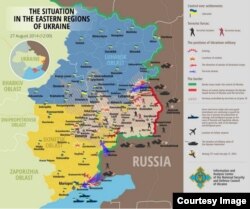
Here is the latest map of the situation in eastern Ukraine from Kyiv's National Security and Defense Council: