

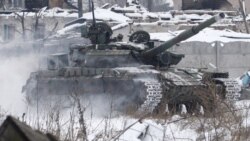
https://t.co/UxUZs2Dmpi @lifenews_ru interviews captured Ukrainian officer who says as few as 17 of his 150 men survived rebel encirclement.
— Kevin Rothrock (@KevinRothrock) August 29, 2014
This group of singers-performers claiming to be pro-Russian separatists in Ukraine have become a YouTube sensation:
The BBC has tracked them down and interviewed them.
Our news desk reports that the IMF has approved some more funds for Kyiv:
The International Monetary Fund (IMF) has approved the release of nearly $1.4 billion in fresh loan funds to help stabilize Ukraine's economy and its currency, the hryvnya.
The disbursement, approved in Washington today, is the second release of funds under the IMF's $17 billion, two-year loan package for Kyiv.
Ukraine received $3.2 billion in May in the first tranche of the loan package.
An IMF spokesman praised Kyiv yesterday for complying with conditions of the loan program so far.
Gerry Rice also told reporters that the current level of IMF assistance might need to be "significantly recalibrated" if the conflict in eastern Ukraine gets worse.
The government's tax revenues from the eastern region have fallen, even as Kyiv continues to spend money on fighting the separatists.
(AFP, Reuters)
Here's another update from our news desk:
Several European Union foreign ministers have accused Russia of invading eastern Ukraine, saying Moscow should be punished with harsh additional economic sanctions.
Swedish Foreign Minister Carl Bildt said today that "we have to be aware of what we are facing: We are now in the midst of the second Russian invasion of Ukraine within a year."
He spoke as EU foreign ministers began two days of informal talks in Milan.
Dutch Foreign Minister Frans Timmermans said that "if Russia does not change its stance, then we can't do anything but sharpen ours."
Estonian Foreign Minister Urmas Paet said the EU "should be ready to move forward with possible new measures against Russia" because the situation continues to worsen.
EU foreign ministers are expected to propose new sanctions against Russia for consideration at an EU summit in Brussels tomorrow.
(AP, dpa)
#France has evidence of 'unacceptable intervention' in Ukraine by #Russia, but still keen 2 sell #Putin them Mistrals http://t.co/VMrfiY5OHE
— Maxim Tucker (@MaxRTucker) August 29, 2014
Rebels getting bter at shooting planes according to @lifenews_ru which claims 4 SU-25s today http://t.co/QmKnvLLvuQ pic.twitter.com/PTQGMtD1i1
— Glenn Kates (@gkates) August 29, 2014
Tomorrow at the European Council in Brussels I will speak to Europe's leaders on Ukraine
— Петро Порошенко (@poroshenko) August 29, 2014
Historian Anne Applebaum has been hypothesizing (quite chillingly) for Slate about where the Ukraine conflict could be headed:
Over and over again—throughout the entirety of my adult life, or so it feels—I have been shown Polish photographs from the beautiful summer of 1939: The children playing in the sunshine, the fashionable women on Krakow streets. I have even seen a picture of a family wedding that took place in June 1939, in the garden of a Polish country house I now own. All of these pictures convey a sense of doom, for we know what happened next. September 1939 brought invasion from both east and west, occupation, chaos, destruction, genocide. Most of the people who attended that June wedding were soon dead or in exile. None of them ever returned to the house.
In the past few days, Russian troops bearing the flag of a previously unknown country, Novorossiya, have marched across the border of southeastern Ukraine.
In retrospect, all of them now look naive. Instead of celebrating weddings, they should have dropped everything, mobilized, prepared for total war while it was still possible. And now I have to ask: Should Ukrainians, in the summer of 2014, do the same? Should central Europeans join them?
I realize that this question sounds hysterical, and foolishly apocalyptic, to American or Western European readers. But hear me out, if only because this is a conversation many people in the eastern half of Europe are having right now. In the past few days, Russian troops bearing the flag of a previously unknown country, Novorossiya, have marched across the border of southeastern Ukraine. The Russian Academy of Sciences recently announced it will publish a history of Novorossiya this autumn, presumably tracing its origins back to Catherine the Great. Various maps of Novorossiya are said to be circulating in Moscow. Some include Kharkov and Dnipropetrovsk, cities that are still hundreds of miles away from the fighting. Some place Novorossiya along the coast, so that it connects Russia to Crimea and eventually to Transnistria, the Russian-occupied province of Moldova. Even if it starts out as an unrecognized rump state—Abkhazia and South Ossetia, “states” that Russia carved out of Georgia, are the models here—Novorossiya can grow larger over time.
Russian soldiers will have to create this state—how many of them depends upon how hard Ukraine fights, and who helps them—but eventually Russia will need more than soldiers to hold this territory. Novorossiya will not be stable as long as it is inhabited by Ukrainians who want it to stay Ukrainian. There is a familiar solution to this, too. A few days ago, Alexander Dugin, an extreme nationalist whose views have helped shape those of the Russian president, issued an extraordinary statement. “Ukraine must be cleansed of idiots,” he wrote—and then called for the “genocide” of the “race of bastards.”
Read the entire article here
Dozens of cars lined up at checkpoint to leave Mariupol in southeast #Ukraine pic.twitter.com/flKgQXojiF
— Kristina Jovanovski (@kjovano) August 29, 2014
.@tvrain: 200 army conscripts in Russian region bordering Ukraine being "forced to sign contracts". Assumption in order to fight in Ukr
— Oliver Carroll (@olliecarroll) August 29, 2014