


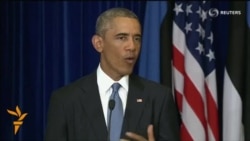
U.S. President Barack Obama speaking today in Tallinn, Estonia, on international support for Ukraine and on Russia's involvement in eastern Ukraine:
"We are going to have to make sure that the international community stands behind the Ukrainian economy in the short-term, even as we encourage and advise and work with Ukraine to carry out some of the basic reforms, that are going to be required for them in order to achieve the kinds of models of success that we have seen in Estonia, Poland, and other places."
"And if we combine those efforts with a commitment to continuing the NATO-Ukraine military relationship -- they are not a member of NATO, but we've consistently worked with their military in terms of training and support -- then I think that not only will Ukraine feel that in words we are behind them, but they'll see that in deed we are working with them as well."
"We haven't seen a lot of follow-up on so-called announced cease-fires. Having said that, if, in fact, Russia is prepared to stop financing, arming, training, in many cases joining with Russian troops, activities in Ukraine and is serious about a political settlement, that is something that we all hope for."
U.S. President Barack Obama reaffirmed his commitment to defend other NATO states under what is known as Article 5 of the alliance's charter. He spoke at a news conference in Tallinn with Estonian President Toomas Ilves. In reaction to Russia's military actions in Ukraine, NATO's secretary-general recently announced that alliance troop rotations in Central and Eastern Europe would be carried out at "very high frequency" to deter "any potential aggressor." (Video by Reuters)

This just in from our News Desk on the Ukrainian "cease-fire":
Ukraine and Russia said their presidents have discussed steps toward a possible cease-fire in eastern Ukraine, where pro-Russian separatists are fighting government troops, while U.S. President Barack Obama said a truce could only work if Russia stopped "pretending" it was not involved in the conflict.
Ukrainian President Petro Poroshenko issued a statement on September 3 saying Poroshenko and Russian President Vladimir Putin had reached agreement on a permanent cease-fire in eastern Ukraine.
Later, however, it replaced that statement with one that said the two presidents had agreed "on a cease-fire regime."
Putin's spokesman said they had discussed potential steps but denied any deal had been reached, saying Russia "is not a participant in the conflict."
Obama, on a visit to Estonia on September 3, spoke of Russian "aggression against Ukraine" and reaffirmed the U.S. commitment to the security of Eastern European NATO allies.
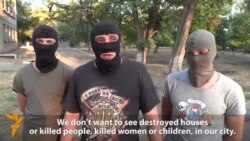
As pro-Russian separatists made advances against Ukrainian forces near Donetsk, residents of the southeastern port city of Mariupol some 100 kilometers from the provincial capital took part in combat training offered by members of Ukraine's Azov volunteer battalion. Trainees said they were prepared to wage a "partisan war" if the rebel forces were to reach their city. (Video by RFE/RL's Ukrainian Service)
Slovakia on September 2 launched a pipeline capable of delivering natural gas from the European Union to Ukraine. Ukrainian Prime Minister Arseniy Yatsenyuk, Slovak Prime Minister Robert Fico, and Klaus-Dieter Borchardt, director for energy markets at the European Commission, attended the ceremony in the Slovak town of Velke Kapusany. The pipeline could potentially supply up to 20 percent of Ukraine's annual consumption as Kyiv grapples with a halt of Russia supplies ahead of winter. (Video by Reuters)

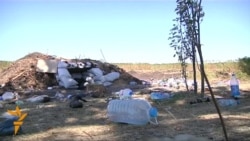
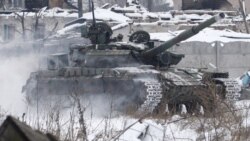
Workers cleared an abandoned Ukrainian checkpoint near the village of Olenivka in the Donetsk region on September 2. Remains of armored vehicles were scattered across the road at the checkpoint, situated en route from Donetsk to the southeastern port city of Mariupol. The Ukrainian army used Olenivka as a base for attacks on separatist forces in Donetsk, the provincial capital just about 25 kilometers away, but was forced out by the pro-Russian rebel fighters. (Video by Reuters)