



Our latest wrap-up of the situation, via our news desk:
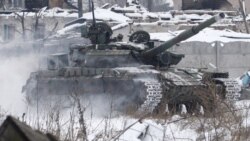
Artillery shelling was reported outside a key city in eastern Ukraine ahead of talks that could produce a cease-fire in the conflict between government forces and pro-Russian rebels.
Ukrainian pro-government forces said they had come under fire several times during the night east of Mariupol, where Organization for Security and Cooperation in Europe (OSCE) observers reported heavy fighting in two villages on September 4 .
Mariupol, a strategic port city on the Sea of Azov west of the Russian border, would be a big prize for rebels who hold the provincial capitals of Donetsk and Luhansk and have gained ground across southeastern Ukraine recently after appearing on the verge of defeat just weeks ago.
Rebels recently occupied a town between Mariupol and the Russian border, and government forces in the city have been bracing for an attack.
Russian news agencies, meanwhile, reported shelling in Donetsk overnight.
The fighting comes despite hopes a meeting due to begin in Minsk at 2 p.m. local time on September 5 will produce a cease-fire deal and a plan to end the conflict.
The talks will involve representatives of Ukraine and the separatists, along with envoys from Russia and the OSCE.
Ukrainian President Petro Poroshenko and the separatists both said they were ready for a truce if agreement on a plan to end the five-month conflict was reached.
The breakthrough follows two weeks of separatist gains, which NATO says were made with the direct involvement of thousands of Russian troops. Russia denies this.
Poroshenko, speaking at a NATO summit in Wales on September 4, expressed "cautious optimism" that a deal could be struck in Minsk.
The separatists said they could order a cease-fire if agreement can be reached on a political settlement for the mostly Russian-speaking Donetsk and Luhansk regions.
Russian President Vladimir Putin proposed a seven-point cease-fire plan on September 3 that would include the withdrawal by Ukrainian forces from positions from which they can potentially hit civilians, a condition that could leave rebels in control of the two regions.
Poroshenko has said it is crucial that Ukraine rather than separatists control the border with Russia, something Putin did not mention.
NATO Secretary-General Anders Fogh Rasmussen cautioned that previous Russian initiatives had proved to be "smokescreens for continued destabilization of Ukraine."
A cease-fire deal could allow Russia to stave off new Western sanctions over its role in the Ukraine conflict, which has killed more than 2,600 people and driven ties between Moscow and the West to a post-Cold War low.
The European Union was expected to decide on new, tougher sanctions on September 5, but EU spokeswoman Maja Kocijancic said that if a cease-fire was agreed, "member states would look how serious it was and decide whether to go forward."
British Foreign Secretary Philip Hammond said on September 5 that the West would push ahead with new sanctions but that they could be lifted if a cease-fire took hold.
At the summit, NATO leaders pledged support for Ukraine, but not weapons.
British Prime Minister David Cameron said on September 5 that "Russia is ripping up the rule book" with the annexation of Crimea and troops in eastern Ukraine, and that NATO must reaffirm its commitment protect allies, including members in eastern Europe.
Rasmussen said NATO's door will remain open to countries that are willing and able to join, signaling that Ukraine should not be shut out of the alliance for good.
Russia adamantly opposes calls by senior Ukrainian officials to abandon the country's non-aligned status and seek NATO membership.
It denies it has sent troops or arms into Ukraine.
NATO also announced the creation of four trust funds worth 15 million euros ($20 million) to support Kyiv in logistics, cyberdefense, the rehabilitation of wounded troops, as well as command, control, and communication. (Reuters, AP, and AFP)
A crowd protesting Russian military action in Ukraine held a mock funeral with an effigy of Russian President Vladimir Putin in the eastern Ukrainian city of Kharkiv on September 4. The coffin was taken to the Russian Consulate. Around 2,600 people have been killed since a Russian-backed insurgency began in eastern Ukraine in April. (RFE/RL's Ukrainian Service)


During a visit to Kyiv on September 4, U.S. Senator John McCain said "truly crushing sanctions" should be imposed on Russia. He told journalists he's urging the U.S. government to provide defensive weapons for Ukraine to be able to defend against what he described as the "invasion of a sovereign country" by Russia. (Reuters)

Ukrainian authorities on why they didn't impose martial law:
LATEST: British Prime Minister David Cameron says that "Russia is ripping up the rule book" with the annexation of Crimea and troops in eastern Ukraine, NATO must reaffirm its commitment protect allies.
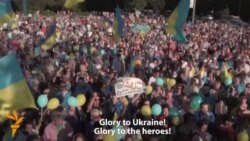
As Ukrainian forces fought pro-Russian separatists just 20 kilometers east of Mariupol, a strategic port city on the Sea of Azov, about 5,000 people gathered in the city center for a peace rally on September 4. The demonstrators sang the Ukrainian national anthem and chanted "Glory to Ukraine! Glory to the heroes!" (RFE/RL's Ukrainian Service)
LATEST from our news desk:
Artillery shelling has been reported to the east of the Ukrainian city of Mariupol, hours before talks on a possible cease-fire.
Pro-government Ukrainian forces said on September 5 they had come under fire several times during the night.
OSCE observers reported heavy fighting in two villages east of the city on September 4.
Mariupol, a strategic port city on the Sea of Azov west of the Russian border, has become the latest hotspot in the five-month-old conflict in eastern Ukraine.
Rebels recently occupied a town between Mariupol and the Russian border as part of an offensive in which they have also gained ground further north, near Luhansk and Donetsk.
Russian news agencies reported shelling in Donetsk overnight.
The fighting comes despite hopes for a cease-fire deal at a meeting in Minsk later on September 5. (Reuters, AFP, and AFP)