



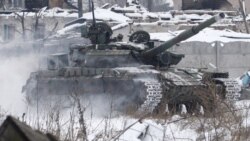
#Donetsk People's Republic throwing their weight behind a 'Yes' for #Scotland today. #Indyref. pic.twitter.com/A6yVXkIVzP
— Conflict News (@rConflictNews) September 18, 2014
BBC formal complaint "co-ordinated attempt to stop journalists reporting a legit news story." http://t.co/LlTWQqFYzu pic.twitter.com/JYXnUIlv0k
— Andrew Roth (@ARothNYT) September 18, 2014
BBC protests journalist attack, demands "thorough investigation" by authorities. You know, the kind Russia famous for http://t.co/j1n0V8MpGH
— Oliver Carroll (@olliecarroll) September 18, 2014
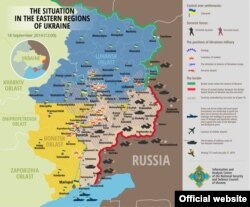
Here is today's map of the situation in eastern Ukraine, according to Kyiv's National Security and Defense Council.
Game of telephone: EU says Poroshenko said Putin said could have soldiers in Kiev Riga Vilnius Tallinn Warsaw + Bucharest in 2 days
— Ian Bateson (@ianbateson) September 18, 2014
Duma deputy says Russia Foreign Min Lavrov has 'brought his daughter back from America' (she reportedly lived in NYC) http://t.co/OmB3Co5ooS
— greg white (@whitegl) September 18, 2014
While we're working on Hromadske International website, follow our must-read explainers on Ukraine here... http://t.co/aH2ZyxJUhN
— Nataliya Gumenyuk (@ngumenyuk) September 17, 2014
Son of Russia's state TV giant VGTRK (who brought you this https://t.co/MsBprYQ2BT), is now running the country's biggest social network.
— Laura Mills (@lauraphylmills) September 18, 2014
Timothy Garton-Ash has been writing in "The Guardian" about how Europe should respond to Russia's involvement in Ukraine:
Our plan should have three main prongs – military, political and economic – each of them with multiple components, all to be adapted as circumstances change. The US has its part to play, but in a supporting, not leading, role.
To have a plan, we Europeans must know what we are responding to. This is difficult, since Putin is in the erratic, hubristic mental state typical of your late-period autocrat. Nonetheless, my best guess is that what he currently aims to do is to keep southeastern Ukraine in such a state of turmoil, divided power and Russian influence that the country as a whole cannot consolidate its position as a sovereign, functioning state – let alone move closer to the EU and Nato. Crucial to this strategy is a porous Russian-Ukrainian frontier, through which Russian arms and agitators can move at will.
This was not Putin’s original idea. He wanted a whole client state inside his Eurasian Union, not half a ruined house. But he seems to be falling back on what in the post-Soviet world has come to be known as the “frozen conflict” option. How, then, to respond to it, while keeping our eyes wide open for both worse and better possibilities?
Some have argued for an escalation of military support to the Ukrainian armed forces, so they are in a position to win. Morally, that seems justifiable. Realistically, it won’t work. Following reforms of the Russian military over the past six years Putin has modernised, effective forces just across the frontier, and his generals have thought hard about the new forms of covert, undeclared warfare they have practised rather successfully in Crimea and eastern Ukraine.
You cannot transform Ukraine’s own military overnight by equipment transfer and training, any more than you can turn a battered old Lada into a BMW simply by inserting a BMW gearbox and hiring a German mechanic. Unless Washington is prepared to wage an undeclared war against a still nuclear-armed Russia, Moscow will have what strategists call escalation dominance. Putin can always up the ante, and has shown that he will.
Nonetheless, western countries should deliver carefully selected equipment, supplies and training to the Ukrainian military, and not least to their frontier forces. In the longer term, one of the keys to ensuring that Putin does not get his “frozen conflict” is to close that frontier. Nato as a whole must also make it plain that no such Russian covert military or paramilitary tricks will be allowed on any square centimetre of Nato territory – and that includes places such as the largely Russian-populated Estonian city of Narva, hard by the Estonian-Russian frontier.
Diplomatic and political negotiations should be tried whenever possible. But the chances of reaching a constitutional settlement in eastern Ukraine that is acceptable to both Putin’s Russia and Kiev’s Ukraine are small. None of the sides can agree what is meant by words like decentralisation, federalisation or “special status”, and to which areas they apply. (“Ukraine is free to adopt any law it wants,” one rebel leader in Donetsk told AFP, “but we are not planning any federalism with Ukraine.”)
More fundamentally, Putin cannot actually want a stable, peaceful, durable settlement, since this would allow Ukraine to function as a federal state, capable of coming closer to the EU. He and his supporters may care about the fate of those they see as Russians in neighbouring states; but Putin’s great game is geopolitics, not the detail of local minority rights.
Read the entire article here
@pravolivo Video by Ukraine soldier coming under fire from Russian forces today: http://t.co/L2jhBbfMsP …
— Gotno Gizmo (@GotnoGizmo) September 17, 2014