



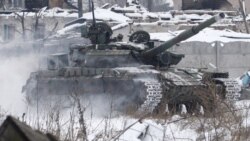

Reports of progress at the Minsk talks, our news desk reports:
Progress has been reported from the late-night talks in Minsk about the situation in Ukraine.
The so-called Contact Group of representatives from Russia, Ukraine, pro-Russian separatists from eastern Ukraine, and the Organization for Security and Cooperation in Europe (OSCE) started a meeting during the night of September 19.
On September 20, reports said the group had reached a series of agreements aimed at deescalating the situation in eastern Ukraine.
Former Ukrainian President Leonid Kuchma, who is leading Ukraine's delegation at the Minsk talks, said a nine-point memorandum had been signed at this latest meeting.
The nine points seek to expand on progress made when the parties involved signed a cease-fire agreement on September 5.
Kuchma said the new provisions included a requirement for parties fighting in eastern Ukraine, government and pro-Russian separatists, to move heavy-caliber weapons back 15 kilometers, creating a 30-kilometer wide cease-fire zone.
The warring parties also agreed not to use artillery, tanks, and other heavy weapons near cities and towns, to suspend flights by combat aircraft or drones over the region, implement fresh exchanges of prisoners, and place OSCE monitors along the disengagement line.
The chairman of the Supreme Council of the so-called Luhansk People's Republic (LNR), Aleksei Karyakin, said between 300 to 500 OSCE monitors would be deployed along these disengagement lines and Kuchma said the OSCE monitors would also be stationed along the Russian-Ukrainian border.
Kuchma also said there was also an agreement to withdraw all foreign armed groups, military equipment, fighters and "mercenaries" from Ukrainian territory.
These agreements were due to come into effect within 24 hours.
The first deputy prime Minister of the so-called Donetsk People's Republic (DNR), Andrei Purgin, said, "We hope for a complete cease-fire."
The self-proclaimed prime minister of the DNR, Aleksandr Zakharchenko, said the issue of independence for his separatist region and the Luhansk separatist region was not discussed at this latest round of talks.
Russian representative Mikhail Zurabov, who is also Russia's ambassador to Ukraine, noted since the signing of the September 5 cease-fire agreement hostilities in eastern Ukraine have decreased by what he claimed was some 70 percent.
Zurabov pointed to the exchange of more than 120 prisoners of war since the September 5 agreement as a sign of progress in de-escalation.
Karyakin of the LNR said the next meeting of the Contact Group could be held in about one week. (ITAR-TASS, AFP, and dpa)
That concludes the live blogging for this evening. See you again tomorrow.
Few more details on the Minsk talks from our news desk:
Participants include Ukrainian former President Leonid Kuchma, Russia’s Ambassador to Kyiv Mikhail Zurabov, OSCE Special Representative Heidi Tagliavini, and four leaders of Ukraine's separatist Luhansk and Donetsk regions: Aleksandr Zakharchenko, Igor Plotnitsky, Aleksey Karyakin, and Andrei Purgin.
Earlier this week, Ukraine's parliament adopted legislation granting broader autonomy to rebel-held parts of the country’s east for a three-year period.
The new Minsk talks have started:
A new round of talks aimed at finding a lasting solution to the Ukraine crisis has started in the Belarusian capital, Minsk.
The so-called Contact Group includes representatives of Russia, Ukraine, pro-Russian separatists, and the Organization for Security and Cooperation in Europe (OSCE).
Participants include Ukrainian former President Leonid Kuchma, the Russian Ambassador to Ukraine Mikhail Zurabov, and OSCE Special Representative Heidi Tagliavini.
Reports said Andrei Purgin, the self-styled deputy prime minister of the self-proclaimed Donetsk People's Republic, would take part.
The new talks come after Ukraine and separatists agreed to a cease-fire on September 5 as part of a "road map" to resolving five months of deadly conflict.
The fragile truce has largely held despite sporadic fighting.