



Vitaly Milonov, who is best known for introducing the law against so-called "gay propaganda" in Saint Petersburg, here being confronted by protesters. "Remind me when Ukraine was a state," he says. Questioning the existence of a Ukrainian nation (separate from a Russian one) is a common refrain of the Russian far-right.
Saint Petersburg protesters outside Kazan Cathedral as police continue to warn protesters that their rally in unsanctioned.
Far-right Saint Petersburg deputy Vitaly Milonov apparently has arrived at the antiwar demonstration as a counter-protester. Crowd shouts, "shame."
Police have warned participants over loudspeakers that their rally is unsanctioned and they risk arrest.
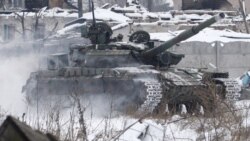
Russian news agency Interfax is reporting that Ukrainian forces are pulling back from certain areas in the east "to avoid encirclement":
The Ukrainian Armed Forces and other formations have left a number of towns and villages in Donbas to straighten out the line they control and also to get entrenched on new positions, the National Security and Defense Council of Ukraine (SNBO) announced.
"With the purpose of straightening out the line that is currently controlled by the Ukrainian military it was decided to transfer our formations to new positions, to fortify them for further control over the situation and to avoid a situation in which our military could be surrounded," spokesman for the SNBO information and analysis center Andriy Lysenko said at a Sunday briefing.
That was his commentary on the report that the army left the town of Zhdanivka and several other communities in Eastern Ukraine.
In the Siberian city of Barnaul, unidentified attackers reportedly assaulted a local activist named Artyom Kosaretsky. They also tore up a banner he was holding that said, "Siberia against war." Later police detained Kosaretsky and another activist.
Crowd gathering in Saint Petersburg.
Live stream of march, which now looks like it has about 200 people, here. There are some hecklers. The cameraman calls them "Titushky," the word Ukrainian protesters used for pro-government men, dressed in street-clothes, who would sometimes physically attack Euromaidan protesters.