

More from our newsroom on Grybauskait's criticism of Moscow in New York:
Addressing the United Nations General Assembly, Lithuanian President Dalia Grybauskaite denounced Russia's "illegal acts of aggression" in Ukraine.
Speaking on September 26, Grybauskaite also called on the international community to protect Ukraine’s sovereignty.
In an interview with "The Washington Post” newspaper released on September 25, Grybauskaite said Russia is acting like a "terrorist" in Ukraine and in its intimidation of other neighbors.
She also criticized the West for a lack of leadership in standing up both to Russia in Ukraine and the Islamic State extremist group in Syria and Iraq.
Russia's annexation of Ukraine's Crimean peninsula in March rattled nerves in Lithuania and its fellow Baltic states, Latvia and Estonia.
The three former Soviet republics won independence in 1991 and joined NATO and the European Union in 2004 in a bid to secure their independence.
With reporting by AFP
From AFP and ITAR-TASS on results of the gas talks today in Berlin:
The EU says Russian gas giant Gazprom is prepared to send Ukraine some 5 billion cubic meters of gas when Kyiv pays some $2 billion next month. EU Energy Commissioner Guenther Oettinger says more trilateral talks are planned for next week.
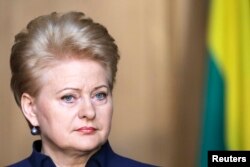
Addressing the UN General Assembly, Lithuania's President Dalia Grybauskaite says the international community must protect Ukraine's sovereignty. She also denounces Russia's "illegal acts of aggression" in Ukraine.
Via Interfax, which describes the "purpose" of the September 21 rally as "protest[ing] against violations of the Russian Constitution and norms of international law," thus avoiding any mention of the demonstrators' objection to Russian actions vis-a-vis Ukraine:
Forty-nine percent of Russians surveyed by Levada Center said they do not support the so-called "Peace March," a protest conducted by the opposition. Twenty-nine percent of the respondents said they support it and 23% are undecided.
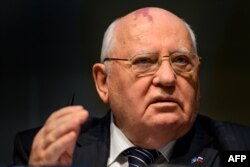
In response to President Obama's remarks before the UN General Assembly on Wednesday, former Soviet leader Mikhail Gorbachev -- who has tried and failed to launch political parties on three occasions since he was pushed aside by Russian President Boris Yeltsin -- had this to say about the United States. (Obama listed Russian aggression alongside the outbreak of Ebola hemorrhagic fever in West Africa and the threat from Islamic State militants in the Middle East as the "tests of this moment.")
"We have one main virus: it's America and its leadership ambitions," Gorbachev told Russian radio, according to Interfax.
He added:
"It's not even political dialogue, it's badmouthing. They want to hurt and provoke, and the main thing is that the conflicts in Europe should continue. For this reason, they [the U.S.] have ambitions to have a monopoly. Ukraine and other things are just pretexts," Gorbachev said.
On a "new cold war," he said: "There is no cold war, but there are indications of it. We don't need a cold war. Such things last for decades and it's difficult for our citizens."
A new crack in Russia's ban of food imports in response to Western sanctions may be filled with cheese, Interfax reports:
Russia's Economic Development Ministry is not ruling out the possibility of currently banned cheeses and fermented milk products returning to the Russian market since lactose-free milk has been removed from the sanctions list.
"The likelihood exists of renewing shipments of milk products from countries that fell under the food embargo," the Economic Development Ministry said in its social and economic development forecast for Russia in 2015-2017. The ministry added that this move might occur in connection with the removal of lactose-free milk from the list.
According to experts, a number of dairy products, such as long-ripened cheeses, fermented milk products and others, have a low level of lactose, which does not create particular difficulties for foreign companies to reorient their facilities to produce, register and export dairy products to the Russian market as lactose-free, the Economic Development Ministry said.
More from Berlin gas talks: according to ITAR-TASS, Russia and the EU have "discussed, bilaterally, all planned issues for the settlement of Ukraine's debt and gas supplies."
The Russian news agency quotes Russian Energy Minister Aleksandr Novak as saying: "At the bilateral meting we discussed all issues concerning the settlement of debt and the need to ensure regular gas supplies and transit."