

More madness from Ukraine's border guards, who are apparently right now deporting Russian journalist @AndreiSoldatov. Dont they have google?
— Shaun Walker (@shaunwalker7) September 28, 2014
Don't think they should ban any Russian journos, tho understand difficult & thorny issue. But deporting the few independent ones just crazy
— Shaun Walker (@shaunwalker7) September 28, 2014
Good news in the end! RT @AndreiSoldatov: Just told I'm to be let in, thanks all for support!!
— Shaun Walker (@shaunwalker7) September 28, 2014
Ceasefire in #Ukraine: pro-Russians firing artillery https://t.co/Y6pkzyDVBo
— Bojan Pancevski (@bopanc) September 28, 2014
Waiting for Putin to attack NATO before responding to his aggression is as short-sighted as waiting for ISIS to bomb an American city.
— Garry Kasparov (@Kasparov63) September 28, 2014
Demonstration for united Ukraine in eastern city of Kharkiv. RT @tuumapomm: More from #Kharkiv. #Ukraine pic.twitter.com/hDcAS4RwSj
— Simon Kruse (@crusoes) September 28, 2014
Swedish Foreign Minister and former UN Balkans Envoy Carl Bildt has been talking to WorldPost editor-in-chief Nathan Gardels about the Ukraine situation. Here are a few choice quotes:
WorldPost: You are among Vladimir Putin’s toughest foes in Europe. Why are you so much more outspoken than most other European statesmen on Russia’s annexation of Crimea and meddling in eastern Ukraine?
Carl Bildt: It is for a very simple but extremely clear reason: Europe’s borders have been drawn in blood and to change them will draw blood again. One thing that was absolutely central in all agreements with Russia and Europe at the end of the Cold War was that borders would not be changed, no less changed by force. By crossing that line, Putin’s actions threaten the entire basis of the post-Cold War order in Europe.
WorldPost: The US and Europe have imposed ever-stiffer sanctions on Russia over its invasive meddling in Ukraine. NATO has announced a rapidly deployable force for the region. And now there is a cease-fire. Is Western pressure working?
Bildt: There is a cease-fire, yes. But a cease fire is a cease-fire, not peace. What is needed is some sort of political solution. That will depend on the aims of Vladimir Putin on the one hand and, and on the other, the determination of the European Union. I tend to believe that Mr. Putin has more far-reaching aims not yet achieved. But he will adjust his behavior according to what we do, or don’t do, going forward.
WorldPost: What are Putin’s far-reaching aims?
Bildt: His ambitions seem to go back and forth between two concepts. One is the Eurasian Community, which includes not only Russian nations, but also Kazakhstan, for example. The other concept is what he calls the “Slavic core” – which he defines as wherever Russians are. Either of these aims certainly has far-reaching implications not only for an independent Ukraine, but, as I said, also Kazakhstan as well as some of the Baltic states. I would also add Belarus. Putin has been obvious enough about the Slavic core or Russian hub to create a distinct disquiet all around. And he’s becoming more assertive in other respects. Even in Sweden, we’ve seen the most serious incursion of our airspace by Russian aircraft in the eight years I have been foreign minister.
WorldPost: What behavior of the EU is necessary to restrain Putin’s ambitions?
Bildt: We have to be careful. Ukraine is an independent nation. It has the right to choose its own destiny. If it wants to belong to the EU, that is up to Ukrainians. Russia has no right to dismember or destabilize independent countries if it doesn’t agree with their choices. What Europe has to do most of all for the longer term is to help Ukraine build prosperity with aid and investment through trade and economic ties. Practically everyone wants a closer, primarily economic, relationship with the EU because that is seen as the path toward modernization of the their economy and the stabilization of their societies.
Even Russia wanted this. The EU had a “partnership for modernization” with Russia if you go back a couple of years. At the end of the day, it didn’t amount to much. But on paper it is not dissimilar from the “Eastern Partnership” accord we made with the Ukraine. Everything changed when Putin came back to the presidency of Russia for the third time. He was a changed man. He started speaking about the Eurasian Union. EU partnership negotiations with the Ukraine started in 2007 and ended in 2011. They took a long time. Putin launched the Customs Union with Ukraine in very short order. That was his way of throwing down the gauntlet and announcing his turn toward a Eurasian Union and away from the West, and that he wanted to take Ukraine with him.
You can read the rest of the interview here
The full version of our interview with @mfa_russia Sergey Lavrov in New York - text and video http://t.co/GcjZabUybV
— Alexey Yaroshevsky (@Yaro_RT) September 28, 2014
Another of the Russian agitprop shirts says "We have our own fun without your Coca-Cola." Rhymes in Russian. pic.twitter.com/UmywHizwxc
— Paul Sonne (@PaulSonne) September 28, 2014
And here's an update from our news desk:
Russian Foreign Minister Sergei Lavrov says Moscow has no desire to continue a war of sanctions with the West.
Speaking on September 28 in an interview with the St. Petersburg television broadcaster Channel 5, he said, "We're not interested in the current period to stay on indefinitely."
He also said, "I don't think it [the situation] would persist for long but it will take some period of time.
The West started to impose sanctions on Russia in March 2014 over Moscow's intervention in Ukraine.
In retaliation, Russia has imposed a one-year ban on food and raw material imports from the countries that had imposed their sanctions against Moscow.
(Interfax)
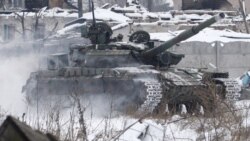
More intense fighting during the cease-fire -- RFE/RL's multimedia unit has just issued this footage of Ukraine's 11th Territorial Defense Battalion clashing with Russia-backed separatists at a checkpoint in the village of Nikishino, near Debaltseve, in the Donetsk region. Video of the fighting was recorded on September 25-26 by RFE/RL correspondent Levko Stek. (Contains graphic images)
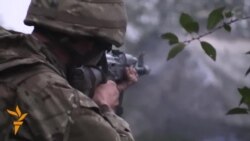

And here is footage that is said to be of fighting in the same area that was given to Levko Stek by a Ukrainian soldier. RFE/RL cannot independently verify the circumstances under which the following video was recorded.

This report by @tsnua from inside #Donetsk airport 2 days ago. Today pitched battle being fought there. https://t.co/FZmcPtnNri
— Christopher Miller (@ChristopherJM) September 28, 2014