

Paul Goble on some of the fact and fiction in the minds of Russians regarding the historical roots of an independent Ukraine.
The European Union reacts to the apparent seizure by Russian forces in mid-September of a Lithuanian fishing vessel on the high seas, which it has raised with Moscow's envoy to Brussels.
Recall that Russia and Estonia are embroiled in what has become a tit-for-tat row that started when Russia seemingly duped or simply abducted Estonian intelligence agent Eston Kohver in early September. (He's still in custody and faces serious jail time in the Russian court system.) Then two Russian nationals, purportedly former KGB agents, were said to have been detained a few days ago for an allegedly crossing the border, apparently while fishing.
We are wrapping up the live blog for Tuesday, September 30, 2014. Please check back here in the morning for our continuing coverage of the Ukraine crisis.
EU Neighborhood and Enlargement Commissioner-designate Johannes Hahn, speaking today during his confirmation hearing at the European Parliament in Brussels:
"For us as Europeans, there is no 'in-between' -- until the territorial sovereignty of Ukraine is reestablished, we cannot yield to Russia [regarding sanctions for its actions in Ukraine]."
Ben Aris has written a -- frankly quite scary -- op-ed piece for Business New Europe on how the Russian military seems to be getting ready for a war:
Russia is actively preparing for a war that nobody wants and that will probably never happen. But its increasingly obvious commitment to real preparations for a potential military conflict with the West have been convincing enough to create trump cards in the diplomatic and sanctions war that has been raging for much of this year. On the eve of the Minsk summit that brought the shaky ceasefire to Eastern Ukraine, the US seemed to cave in.
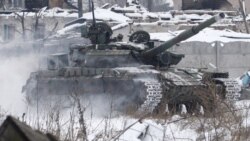
What was sabre-rattling has become overtly aggressive military actions that are seriously destabilising the whole of the European continent and freaking Nato out. Russian fighter planes have made almost as many incursions this year into the airspace of the Baltic states, all Nato members, than they have in all of the last decade taken together. Russia has carried out the largest surprise military excises it is allowed to, without giving forewarning to Nato under the terms of its treaties with its old nemesis. And Russia has also started military exercises that include moving nuclear missiles about for the first time in two decades.
Nato of course finds all this peripatetic armour extremely unsettling, but it is part of a larger aggressive policy Russia has adopted.
"Putin's Russia today is ready and willing to go to war. Europe and the West are not ready and not willing to go to war. There is no leadership in Europe or in the world able to stop Putin," Lithuanian President Dalia Grybauskaite, who lives on what could be the next front in Russian aggression, told the Washington Post in an interview on September 24.
Not just Central European politicians but also military analysts are asking: will there be war? And increasingly the answer is not clearcut. "The slow, ongoing militarisation of the Russian state - not only in a purely military sense, but also economically - socially and politically, which has been observed at least since 2007 - raises questions about its long-term consequences," writes Polish military analyst Andrzej Wilk of the Centre for Eastern Studies (OSW).
Despite the economic slowdown, Russian military spending will surge to 4.0% of GDP in 2015 – twice the level that Nato members are obliged to spend – according to the recently announced three-year budget. This compares with 3.5% of GDP in 2014, which was already a rise of more than 10% in real terms to around $84bn from a year earlier, according to Wilk.
Along with the rise in spending is a rise in nationalist rhetoric and propaganda, according to which Russia must fight against the aggression of the West. "The spiral of militarisation which has been set in motion in Russia over recent years has already reached a critical 'point of no return': the ruling team in Moscow has become largely a hostage to its own policies." Wilk warns. "The consequence of the current activities may actually be that Moscow starts a full-blown regular war."
Read the entire article here