



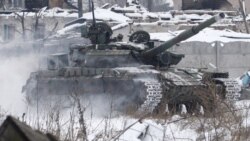
Large fire currently burning at the #Donetsk Airport pic.twitter.com/n5q6PBSzdd
— Conflict News (@rConflictNews) October 2, 2014
Thick smoke coming from the airport now visible from the center of #Donetsk
— Paul Gypteau (@paulgypteau) October 2, 2014
Was it another toppling or a Voodoo ritual in Krivy Rih? Puzzled by the gap in the forehead. pic.twitter.com/yooHpMt2Jz”
— Leonid Ragozin (@leonidragozin) October 2, 2014
Political scientist Alexander Motyl from Rutgers University has been writing about the differing perceptions of the Ukraine crisis, particularly between Moscow and the West.
Russia and the West do not just see things differently. Their perceptions of reality are diametrically opposed; they negate each other. If the Russians are right, the West is wrong--and vice versa. Both sides cannot be right, and the two sets of views cannot be reconciled with each other. Calls for "understanding" the Russians and giving their views a "fair hearing" are thus little more than calls for abandoning one's own views. That would be justifiable, indeed right, if one's views were wrong. But it's manifestly absurd if one's views are right.
There is deeper issue here. We can determine whether perceptions of reality are correct or not. Despite the insistence of radical post-modernists that all truth claims are equally invalid, reasonable people the world over know that there is a simple test of the veracity of some perception: does it actually correspond to things as they are?
Did Yanukovych flee as a result of a coup by a small cabal of fascists or was he forced from power by the sustained exertions of thousands of democratically-inclined Ukrainians? The evidence overwhelmingly supports the latter view. Was Yanukovych a legitimate ruler or had his corruption and abuse of power undermined his legitimacy in the eyes of a majority of Ukrainians? Once again, the latter proposition can be easily proven. Has NATO ever expressed openly anti-Russian views or undertaken openly anti-Russian actions since the collapse of the USSR or is it an alliance without purpose, whose member states cannot imagine deploying their troops to a conflict in Europe? There is no evidence for the former claim. Are there or are there not Russian agents, soldiers, and volunteers and massive amounts of Russian military equipment in eastern Ukraine? Obviously there are.
In sum, Russian perceptions of the reality are wrong. We can easily explain Russian inability to see "straight." Putin has embraced and propagated, almost since coming to power, an ideology of hyper-nationalism, revanchism, and neo-imperialism that builds on deep-seated Russian resentment at having lost their position of greatness in the world, promotes a paranoid worldview, and deliberately constructs enemies in order to lend his regime legitimacy.
Should the West therefore try to understand Russian perceptions even if it knows that they are completely wrong? Obviously, understanding Russian delusions can help the West and Ukraine craft a better response to Putin's expansionism. But it makes little sense to say that the West and Ukraine should try to accommodate these delusions in their search for peace in eastern Ukraine and the Crimea.
Should the democratic world have accommodated Hitler's perceptions of Jews? Or of Germany's need for Lebensraum? Or of the innate superiority of the Aryan race? The questions are rhetorical, but they are exactly the ones we should be asking about Russian perceptions.
Read the entire article here
A fascinating infographic of toppled statues of Vladimir Lenin in Ukraine. http://t.co/UQWqikYgrD
— Khodorkovsky Center (@mbk_center) October 1, 2014
Mustafa Dzhemilev says high probability of RUS troops crossing into Ukraine from Crimea http://t.co/RTXGBf2OmR pic.twitter.com/kE2D0dTqAn
— Ryskeldi Satke (@RyskeldiSatke) October 2, 2014
Capital flight from Russia is increasing. Will Vladimir Putin calm investors' fears when he addresses an Investment Forum in Moscow today?
— Steve Rosenberg (@BBCSteveR) October 2, 2014
Good morning. We'll get the live blog rolling today with this update from our news desk:
German Chancellor Angela Merkel says Russia has a duty to exert influence on pro-Russian separatists in eastern Ukraine.
Merkel made the remark during a phone call with Russian President Vladimir Putin on October 1.
According to a German government spokesman, the two leaders expressed concern that violence was still being used in Ukraine every day.
Merkel said the border between Ukraine and Russia needed to be monitored and the Organisation for Security and Cooperation (OSCE) had a big role to play in that.
She said Germany would continue to support the OSCE mission in Ukraine, adding that it could play an important role in planned local elections in the regions around Donetsk and Luhansk.
Earlier, NATO's new Secretary-General Jens Stoltenberg said the cease-fire in Ukraine presented the chance of a resolution to the Ukraine crisis but Russia still had the power to disrupt the country.
"The ceasefire in Ukraine offers an opportunity but Russia maintains its ability to destabilize Ukraine. Russia remains in breach of international law," Stoltenberg told his first news conference in Brussels as NATO leader.
Stoltenberg also had conciliatory words for Russia, saying he saw no contradiction between aspiring for a constructive relationship with Moscow and being in favor of a strong NATO.
Meanwhile, reports from eastern Ukraine said some 10 people have been killed in shelling in the rebel-held city of Donetsk.
Three people were reportedly killed when a shell exploded in a school playground on October 1.
Several others reportedly died when a shell hit a mini-van in a nearby street.
The blasts occurred as pupils returned to school, after the start of the school year was postponed from September 1 due to fighting between Ukrainian government forces and pro-Russian separatists.
Shelling has repeatedly been reported in Donetsk despite an September 5 cease-fire in the conflict, which has killed more than 3,000 people since April.
The Donetsk airport has been a focus of fighting since the cease-fire.
(TASS, Reuters)
This ends our live-blogging for October 1. Be sure to check back tomorrow for oour continuing coverage.