



Meanwhile, in space:
Russian cosmonauts say watched Ukraine crisis from space
MOSCOW. Oct 4 (Interfax-AVN) - Russian cosmonauts Aleksandr
Skvortsov and Oleg Artemyev, who have returned to Earth after a
six-month stay aboard the International Space Station, said they had
been following developments in Ukraine but had no political arguments
with fellow astronauts from the United States or Japan.
"We didn't have any politics there. Our colleagues and ourselves
realized that the International Space Station was probably the only
point of contact where we would be able to cooperate, with America in
particular: No matter how badly we row on Earth, this project survives,
and, thank God, we have enough brains not to destroy it and to remain
friends," Artemyev said in answering a question from Interfax at what
was the two cosmonauts' first news conference after their return.
"There are no borders up there," he said.
Good morning. Morning update from our news desk on the fighting around Donetsk:
Heavy fighting has been continuing in eastern Ukraine amid attempts by pro-Russia rebels to capture the Donetsk airport despite a month-old cease-fire.
Ukrainian military spokesman Andriy Lysenko said on October 4 that 12 separatists were killed, along with two government soldiers, during failed assaults on the facility over the previous 24 hours.
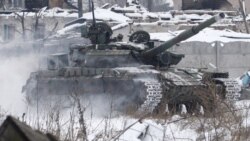
Artillery and rocket barrages in the battle have been intensifying during the past week, with separatist fighters also using tanks to fire salvos at the airport’s main terminal.
Donetsk, is eastern Ukraine's largest city and the separatists' main stronhold, but the airport has remained under the Ukrainian government's control.
The Donetsk city council meanwhile said an artillery attack on the city on October 4 claimed two civilian lives, describing the local situation as "tense."
Neither side has been willing to implement the cease-fire by pulling back from the battle to create a 15-kilometer buffer zone between front lines.
This concludes our live-blogging of the Ukraine crisis for Saturday, October 4. Please check back in the morning for our continuing coverage.
From RFE/RL's News Desk:
Germany’s Ministry of Economic Cooperation and Development says it has sent a humanitarian aid convoy of more than 100 trucks to war-torn eastern Ukraine.
Economic Cooperation Minister Gerd Mueller said in a statement that the convoy is due to arrive in eastern Ukraine in mid-October.
He said the convoy is transporting mobile homes, field kitchens, radiators, electrical power generators, water and fuel tanks, winter clothing, bedding, camp beds, and hygiene kits.
Mueller said the humanitarian aid is estimated to be worth about $12 million and is meant “to send a signal of solidarity” that the people of Ukraine can count on Germany “as a reliable partner.”
The convoy is being accompanied by Polish police and fire services. It is due to cross from Poland into Ukraine early on October 7.
From the German news agency dpa:
In Mariupol, a port city 115 kilometers south of Donetsk, Russia and international monitors began work on Saturday determining the borders of a 30-kilometer buffer zone on the front line.
"The route of the mission is not being released for security
reasons," city spokesman Dmitri Gorbunov said.
The mission involving the two countries and the Organization for
Security and Cooperation in Europe (OSCE) was agreed on in September along with the cease-fire.
The warring parties are to withdraw heavy weapons and high-caliber artillery out of the buffer zone, according to the agreement.
The OSCE is to monitor compliance with the help of drones.
From Interfax:
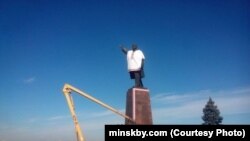
Activists on Saturday pulled a Ukrainian folk shirt of a huge size over a statue of Vladimir Lenin in Zaporizhzhya in a bid to prevent the 20-meter-high monument from being pulled down by nationalist rioters and thereby stop potential violent attacks on them from admirers of the Bolshevik leader.
A crane was used to pull the white embroidered shirt over the statue. The sides of the marble pedestal were adorned with a traditional ornamental pattern.
"It's not for the sake of any reaction that I was doing this -- I'm not running for any elected office," one of the authors of the project, journalist Yury Hudymenko, told Interfax. "There's only one kind of reaction that I expect: to stop this monument from being pulled down at this specific moment. That is the only result I'm pressing for. If the authorities want to listen to my recommendations and put up a plaque there listing Lenin's crimes against the Ukrainian people, I would probably be satisfied," he said.
The authors of the project want a legal decision on the future of the monument by the local authorities.