



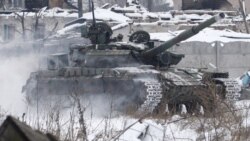

Interfax reports that a third Lenin statue has been pulled down in Dnipropetrovsk's Kryvyy Rih. The first two were a full statue downtown and a bust in the courtyard of a residential building.
Wonder how many more statues are hiding in Kryvyy Rih.
Loyola University's Michael Khodarkovsky in the opinion pages of "The New York Times":
"...[P]ronouncements by the Russian president and his close advisers are increasingly stated in vague and mystical language, with references to the “Russian world.” The leader of the Russian Orthodox Church, Patriarch Kirill, explained during his regular TV program on Sept. 8 that the “Russian world” is a distinct civilization and that its unique spiritual and cultural values must be preserved. According to the patriarch, it includes Ukraine, Belarus and any non-Slavic peoples who share these values. He derided the concept of a melting pot, suggesting that it was a perfect example of the failure of contemporary Western civilization.
Such pronouncements may appear bizarre. Yet they cannot simply be dismissed as the ideas of the political fringe because they belong to the Kremlin’s inner circle. In a desperate attempt to preserve their power, Russia’s ruling class has concocted an ideological brew that borrows from every corner of the repressive and outdated world of Slavic nationalism, isolationism and anti-Westernism.
The German chancellor, Angela Merkel, was right when several months ago she described Mr. Putin as inhabiting his own mental universe. Worse, the worldview of Mr. Putin’s Russia leaves little room for compromise.
A Reuters exclusive by Ron Bousso and Joshua Schneyer hints at another blow to Russia's economy, if it is indeed true:
Saudi Arabia is quietly telling the oil market it would be comfortable with much lower oil prices for an extended period, a sharp shift in policy that may be aimed at slowing the expansion of rival producers including those in the U.S. shale patch.
Some OPEC members including Venezuela are clamouring for production cuts to push oil prices back up above $100 a barrel.
But Saudi officials have given a different message in meetings with investors and analysts: the kingdom, OPEC's largest producer, will accept oil prices below $90 per barrel, and perhaps down to $80, for as long as a year or two, according to people who have been briefed on the recent conversations.
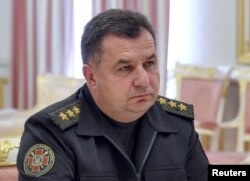
Defense Minister: Kyiv's Least Secure Job
For the third time in six months a Ukrainian defense minister has been forced out. Why is Kyiv repeatedly replacing its top military official in the midst of a war? MORE
News via AFP on the court decision today to delay the trial of Ukrainian military pilot Nadiya Savchenko as she purportedly undergoes mental fitness testing at the hands of Russian authorities:
A court in Moscow has delayed hearings on a captured Ukrainian military officer's appeal against the authorities' decision to put her in a mental clinic for checks.
The 33-year-old Nadezhda Savchenko was captured by pro-Russian insurgents during fighting in eastern Ukraine in June and landed in Russian custody the following month.
Russian investigators accused Savchenko, a Ukrainian air force officer, of involvement in the killing of two Russian journalists in eastern Ukraine. The Ukrainian government has strongly demanded Savchenko's release, and her name has become symbolic for the battle against the insurgency.
On Monday, a Moscow district court was due to consider Savchenko's appeal against investigators' moves to have her undergo psychiatric checks, but put off the hearings for a month as she remained in a Moscow mental clinic.
An image from the protest by outgoing Ukrainian National Guard conscripts near the presidential building in Kyiv today. "Demobilization" is among the demands there and at a similar demonstration in Kharkiv.

From Reuters:
Russia and China signed energy, trade and finance agreements on Monday proclaimed by Moscow as proof that a policy turn to Asia is bearing fruit and will help it to weather Western sanctions over the Ukraine crisis.
The 38 deals, signed on a visit to Moscow by Premier Li Keqiang, allow for deeper cooperation on energy and a currency swap worth 150 billion yuan ($25 billion) intended partly to reduce the sway of the U.S. dollar.
They are among the first clear successes of the eastward shift, ordered by President Vladimir Putin to avoid isolation over the sanctions, since the vast nations reached a $400 billion, 30-year natural gas supply agreement in May.
"I consider it important that, in spite of the difficult situation, we are opening up new possibilities," Russian Prime Minister Dmitry Medvedev said after the signing ceremony.
In a sign that mistrust has still not been completely buried, Li was less effusive, even when holding out the prospect of a deal in 2015 to build a second pipeline along what is called the Western route to ferry Russian gas to China.