



Reuters reports on Russian hackers attacking NATO, Ukraine:
Russian hackers exploited a bug in Microsoft Windows and other software to spy on computers used by NATO, the European Union, Ukraine and companies in the energy and telecommunications sectors, according to cyber intelligence firm iSight Partners.
ISight said it did not know what data had been found by the hackers, though it suspected they were seeking information on the Ukraine crisis, as well as diplomatic, energy and telecom issues, based on the targets and the contents of phishing emails used to infect computers with tainted files.
The five-year cyber espionage campaign is still going on, according to iSight, which dubbed the operation "Sandworm Team" because it found references to the "Dune" science fiction series in the software code used by the hackers.
The operation used a variety of ways to attack the targets over the years, iSight said, adding that the hackers began only in August to exploit a vulnerability found in most versions of Windows.
ISight said it told Microsoft Corp about the bug and held off on disclosing the problem so the software maker had time to fix it.
A Microsoft spokesman said the company plans to roll out an automatic update to affected versions of Windows on Tuesday.
There was no immediate comment from the Russian government, NATO, the EU or the Ukraine government.
Researchers with Dallas-based iSight said they believed the hackers are Russian because of language clues in the software code and because of their choice of targets.
Lithuania prepares for similar "hybrid" attacks as Ukraine suffered this year:
Lithuania is creating a rapid-reaction force to counter unconventional threats highlighted by the crisis in Ukraine.
The Baltic country's top general said on October 13 that 2,500 troops will be on high alert and ready to respond to "hybrid warfare" involving unconventional attacks by unmarked combatants, like those in eastern Ukraine and Crimea.
Major General Jonas Vytautas Zukas told reporters: "We must immediately increase our readiness for unplanned military actions during peacetime."
He said new threats include "manipulating national minorities, provocations, attacks by nonstate armed groups, illegal border crossing, [and] breach of military transit procedures."
Kyiv and NATO accuse Russia of using those tactics to annex Crimea in March and aid pro-Russian separatists in eastern Ukraine.
Russia denies involvement in the conflict in eastern Ukraine.
NATO member Lithuania's new force is to begin operating on November 1. (AFP and Xinhua)
That concludes our live blogging for Monday, October 13.
From our newsroom:
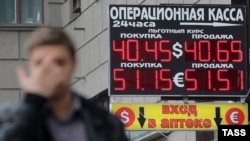
The Russian ruble hit new all-time lows against the euro and dollar on October 13 despite recent government intervention.
The ruble dropped to 51.33 to the euro -- breaking the previous low from March -- and fell to 40.49 to the dollar.
The record lows came after Russian Central Bank chief Elvira Nabiullina said the bank had pumped some $6 billion into propping up the currency since October 3.
International sanctions against Russia over its annexation of Ukraine's Crimean peninsula and Moscow's support for pro-Russian rebels have cut several major Russian firms off from key international debt markets.
Russia's oil-dependent economy is also hurt by low oil prices, dropping to $88 per barrel on October 13.
The International Monetary Fund said capital flight from Russia will reach some $100 billion this year and inflation is more than 8 percent.
Based on reporting by AFP and Interfax
Interfax reports that a third Lenin statue has been pulled down in Dnipropetrovsk's Kryvyy Rih. The first two were a full statue downtown and a bust in the courtyard of a residential building.
Wonder how many more statues are hiding in Kryvyy Rih.
Loyola University's Michael Khodarkovsky in the opinion pages of "The New York Times":
"...[P]ronouncements by the Russian president and his close advisers are increasingly stated in vague and mystical language, with references to the “Russian world.” The leader of the Russian Orthodox Church, Patriarch Kirill, explained during his regular TV program on Sept. 8 that the “Russian world” is a distinct civilization and that its unique spiritual and cultural values must be preserved. According to the patriarch, it includes Ukraine, Belarus and any non-Slavic peoples who share these values. He derided the concept of a melting pot, suggesting that it was a perfect example of the failure of contemporary Western civilization.
Such pronouncements may appear bizarre. Yet they cannot simply be dismissed as the ideas of the political fringe because they belong to the Kremlin’s inner circle. In a desperate attempt to preserve their power, Russia’s ruling class has concocted an ideological brew that borrows from every corner of the repressive and outdated world of Slavic nationalism, isolationism and anti-Westernism.
The German chancellor, Angela Merkel, was right when several months ago she described Mr. Putin as inhabiting his own mental universe. Worse, the worldview of Mr. Putin’s Russia leaves little room for compromise.