



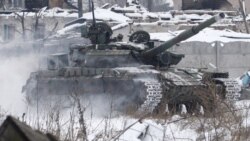
This piece by Christopher Miller for Mashable on life in Donbas has deservedly been generating a lot of heat on social networks:
On city squares, entertainment is often provided by kids — one child poet, carrying a toy gun and wearing a camouflage bandana around her head, jumped on a stage recently, giving a live mic performance in which she damned the Ukrainian “Nazi morons."
On another day, a group of school children performed a play in which they depicted Ukrainians as Nazis while black-and-white footage of World War II fascists played on big screen behind them.
Propaganda like this is ubiquitous. The city resembles the pages of a certain George Orwell novel, with gunmen roaming the streets reminding people to “speak the truth,” and billboards portraying the current fight to that of the Second World War.
The message is working. Many here believe they are fighting a continuation of their grandfathers’ war against the fascists. Question firing squad executions, extrajudicial detentions or the parade of prisoners of war through Donetsk and you’re likely to be called a fascist yourself and thrown into the makeshift prison called “Isolation” — an art center before rebels seized it and turned it into a dungeon.
Against this surreal backdrop, the rebel leadership wants to project normalcy and give the impression that life is returning to routine. To ensure schools would open on Oct. 1, separatist leaders paid teachers one-time cash payments of about $231. They’ve also begun paying some pensions to retirees who have not received any payments since May.
But credibility has been tough to come by for the separatists.
But credibility has been tough to come by for the separatists.It’s unclear where the money doled out to the teachers and pensioners is coming from and, more importantly, how long it will last. And while Donetsk and Luhansk held referendums on independence in May, only the breakaway Georgian territory of South Ossetia has recognized the regions as self-ruling statelets.
Even supporters seem skeptical about the future of Donetsk.
“We wanted to leave Ukraine — that’s why we voted in the referendum,” says Maria Valeryevna, a 67-year-old pensioner who came to Lenin Square recently to protest the human cost of the conflict. “We wanted independence. But this," she says, referring to the thousands of lives lost, "is too high a price to pay."
Read the entire article here
Here is some more news from the Crimean Desk of RFE/RL's Ukrainian Service. Also, in case you missed it at the weekend, here is a link to Brian Whitmore's podcast on the current plight of the Crimean Tatars.):
The pro-Russia leadership in Crimea is urging Muslim residents of the annexed territory to get rid of "banned Islamic literature" by January 1, 2015.
The Moscow-backed leader of the region, Sergei Aksyonov, told reporters in Simferopol today that the authorities "will not confiscate for three months Islamic literature that was allowed by Ukrainian authorities and is banned by Russian legislation."
Aksyonov added that the list of Islamic literature banned by Russian law will be made public by local media.
Aksyonov initially said authorities would stop confiscating banned printed materials from Muslims at his meeting with Crimean Muslims on October 13.
Muslims in Crimea are mainly Crimean Tatars, the majority of whom opposed Russia's annexation of the peninsula in March.
Leading members of the Crimean Tatar community have been targeted by police for possessing so-called "banned Islamic books" in recent weeks.
41% of Ukrainians "hate" Putin, 34% "despise" him, and 20% are "infuriated" by him. 4% "sympathize," 3% "scared." http://t.co/pC4E3RxfWF
— max seddon (@maxseddon) October 14, 2014
Turchynov signs bill on special status of some territories in Donbas http://t.co/BzvkvXnK6y
— Kyiv Post (@KyivPost) October 14, 2014
RFE/RL's Ukrainian Service has sent us this item on OSCE monitoring of the cease-fire in eastern Ukraine:
The U.S. ambassador to the Organization for Security and Cooperation in Europe (OSCE) says unmanned drones should be flying over eastern Ukraine before November to help monitor a shaky cease-fire agreement between Ukraine and pro-Russian separatists.
U.S. Ambassador Daniel Baer told RFE/RL on October 14 that the first two drone aircraft were delivered last week to monitors from the OSCE.
He said a crew to operate the drones has not yet arrived in Ukraine.
Baer said Russia should "tell those under their control in the east of Ukraine that they should not be shooting" at the OSCE drones because they "are really only a tool for the monitors on the ground."
Baer also said that a group of German-French troops that might be sent to Ukraine would not be there to protect the drones, saying the planes are "military equipment," which will be operated by the people trained to operate them.
7 civilians killed in village outside Mariuopol by shells fired from rebel areas http://t.co/orxacUKBHQ All sides shelling indiscriminately.
— pete_leonard (@pete_leonard) October 14, 2014
Kyiv is about to rise again. @poroshenko have to show he is serious about fighting corruption. pic.twitter.com/dOYIemHSkx
— Anders Östlund (@andersostlund) October 14, 2014
Here are some details from the Crimean Desk of RFE/RL's Ukrainian Service about reports that one of two missing Crimean Tatar men has been found dead:
Media reports in Crimea say the body of one of two missing Crimean Tatars was found in the annexed region's capital, Simferopol, on October 14.
Reports cite the Kryminform website as reporting that Belyal Belyalov, who was university student, died after smoking an unspecified substance.
According to the Moscow-backed Kryminform, the second missing young Crimean Tatar, Artyom Dayrabekov, who also reportedly smoked the substance, was saved by doctors.
Dayrabekov's relatives, who had reported the two young men's disappearance, refused to comment on Kryminform's report.
Crimea's pro-Russia Interior Ministry also refused to comment on the situation.
Crimean Tatar Edem Asanov, 25, was also found dead last week after being reported missing.
Most Crimean Tatars -- a Turkic-speaking Muslim minority native to Crimea -- opposed Russia's annexation of the peninsula.
Reports coming in on social media now that one of the missing Crimean Tatars has been found dead:
One of two missing Crimean Tatars, Belyal Bilyalov, has been found dead. The other is in critical condition. #Crimea http://t.co/uvjPeymoj5
— Devin Ackles (@EasternEnsemble) October 14, 2014
Here's an update from RFE/RL's news desk:
Russian President Vladimir Putin says the "main tragedy" of the Ukraine crisis is the "estrangement of the Ukrainian and Russian people".
Putin spoke about Ukraine at a Kremlin meeting of his advisory council on human rights and civil society on October 14.
He said that "the main tragedy unfolding before our eyes is the estrangement of the Ukrainian and Russian people."
Putin said that "it is necessary to seek a way to overcome this situation."
Many Ukrainians blame Russia and Putin himself for the crisis and the animosity it has generated.
Russia annexed Crimea from Ukraine in March. Kyiv and the West also accuse Moscow of sending troops and arms into eastern Ukraine to help pro-Russian separatists fighting government forces in a conflict that has killed more than 3,660 people.
Russia denies any involvement.
Fighting has lessened since a September 5 cease-fire, but more than 330 people have been killed during the truce.
(Interfax)