



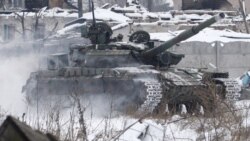
Here's an overnight wrapup from our Ukrainian Service. Poroshenko has promised that Ukraine will have Russian natural gas this winter. The only holdup is a price.
Ukrainian President Petro Poroshenko says the country will have natural gas from Russia this winter.
Poroshenko said in an interview on Ukrainian television on October 18 that Russia and Ukraine must only agree on the price for that gas.
He said the two sides have agreed that Ukraine will pay $385 per 1,000cubic meters for gas that was delivered through March 31.
Poroshenko -- who met with Russian President Vladimir Putin three times in Milan on October 17 -- said Kyiv had proposed to pay $325 per 1,000 cubic meters for gas used by Ukraine in May and June and to pay $385 for gas in the winter.
He said Russia was insisting on the $385 per 1,000 cubic meters for all parts of the year.
Russian, Ukrainian, and EU officials will meet on October 21 in Brussels to discuss the gas-pricing issue.
The Ukrainian government is hard-pressed to pay its multibillion dollar gas debt to Russia's Gazprom.
Poroshenko said state energy company Naftogaz is unable to pay its arrears partly because of debts created by consumers in the eastern Donetsk and Luhansk regions, the scene of fighting due to parts being controlled by pro-Russian separatists.
He said Kyiv has several "different options" for repaying Russia so that gas supplies can resume, including funding help from the International Monetary Fund.
He said an IMF mission is scheduled to come to Kyiv in mid-November to discuss possible changes to Ukraine's current loan program.
Russia provides about one-third of the EU's natural-gas consumption, half of which transits via Ukraine, and previous disruptions in 2006 and 2009 led to sharp increases in prices.
Meanwhile, Poroshenko also said that parliament will approve the exact borders of a buffer zone between pro-Russian separatists and security forces in eastern Ukraine.
Poroshenko said on Ukrainian TV that the buffer zone is part of the Minsk agreements, signed in early September to end five months of fighting.
Poroshenko added that the Organization for Security and Cooperation in Europe (OSCE) would provide drones and personnel from France and Germany to monitor the cease-fire.
The cease-fire ended most fighting between the two sides although battles at the Donetsk airport, in the south near the city of Mariupol, and in villages near the city of Luhansk continue on an almost daily basis.
It is hoped that the some 15-kilometer buffer zone -- from behind which all large artillery and other heavy weapons are to be withdrawn -- will bring an end to the intermittent fighting that continues each day and causes casualties.
Ukraine's military said two soldiers were killed in such fighting on October 18.
The UN says more than 3,700 people have died in six months of fighting in eastern Ukraine, with hundreds of thousands of people fleeing their homes.
With reporting by Reuters and TASS
That concludes our live blogging for Saturday, October 18. Follow our continuing coverage of Ukraine and all of RFE/RL's broadcast region HERE.

Because nothing makes it sound more like an attempt to restore the Soviet Union than hearing someone say it's not an attempt to restore the Soviet Union. From Interfax:
Russian Federation Council Speaker Valentina Matviyenko said the creation of the Eurasian Economic Union (EEU) cannot be regarded as an attempt to restore the Soviet Union.
Matviyenko said the EEU comprises 170 million people and is the eighth largest economy in the world. "It's the largest integration association in terms of territory and we are not talking about attempts to re-create the Soviet Union. Russia or other members of the EEU are not thinking about creating a new unified state," Matviyenko said on the Federation Council's television council Vmeste - RF."
"The situation today is somewhat reminiscent of a scene from the Soviet comedy film Wedding in Malinovka, which was set in a Ukrainian village during the time of the Russian Civil War. With power alternating almost daily between red and Ukrainian nationalist forces, the villagers of Malinovka are never sure who is in charge, so they modify their behaviour and dress accordingly. The movie’s catchphrase is “the authorities are changing again”, and the characters’ habit of either donning or removing a budenovka partisan hat, could well be applied to any of the towns on the frontlines today."
Read more here:
Ann Applebaum in "The Washington Post" takes on "The Myth Of Russian Humiliation":
"...[T]imes change, and the miraculous transformation of a historically unstable region became a humdrum reality. Instead of celebrating this achievement on the 25th anniversary of the fall of the Berlin Wall, it is now fashionable to opine that this expansion, and of NATO in particular, was mistaken. This project is incorrectly “remembered” as the result of American “triumphalism” that somehow humiliated Russia by bringing Western institutions into its rickety neighborhood. This thesis is usually based on revisionist history promoted by the current Russian regime — and it is wrong....
And her conclusion:
"The crisis in Ukraine, and the prospect of a further crisis in NATO itself, is not the result of our triumphalism but of our failure to react to Russia’s aggressive rhetoric and its military spending. Why didn’t we move NATO bases eastward a decade ago? Our failure to do so has now led to a terrifying plunge of confidence in Central Europe. Countries once eager to contribute to the alliance are now afraid. A string of Russian provocations unnerve the Baltic region: the buzzing of Swedish airspace, the kidnapping of an Estonian security officer.
Our mistake was not to humiliate Russia but to underrate Russia’s revanchist, revisionist, disruptive potential. If the only real Western achievement of the past quarter-century is now under threat, that’s because we have failed to ensure that NATO continues to do in Europe what it was always meant to do: deter. Deterrence is not an aggressive policy; it is a defensive policy. But in order to work, deterrence has to be real. It requires investment, consolidation and support from all of the West, and especially the United States. I’m happy to blame American triumphalism for many things, but in Europe I wish there had been more of it."