




From Reuters:
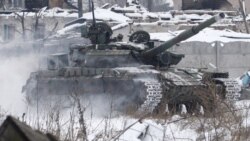
A Ukrainian election candidate allied to the prime minister was shot at and came under a grenade attack as he left his home late on Monday, and only survived because he was wearing body armor, his party said.
Volodymyr Borysenko, from Prime Minister Arseniy Yatsenyuk's People's Front party, was being treated in hospital for shock after the assault -- the first of its kind reported during campaigning for Sunday's parliamentary vote, officials added.
Borysenko was attacked as he left his home in Boryspil, a dormitory town near the capital, the party said.
"He was first shot at and then a homemade bomb was thrown under his feet," the party added in a statement. Police described the bomb as a grenade but did not give details on how many attackers were involved.
"Body armor saved Volodymyr's life. He has worn it since receiving phone threats," the party said.
Borysenko is running for a seat in the 450-seat parliament in the first parliamentary election in Ukraine since street protests overthrew a Moscow-backed president in February.
From the German dpa news agency:
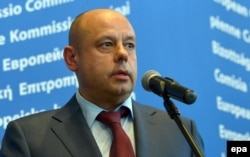
Russian Energy Minister Alexander Novak and his Ukrainian counterpart, Yuri Prodan, met in Brussels on Tuesday for a
new round of talks aimed at resolving a dispute over gas supplies before the winter sets in.
Russia has not sold gas to Ukraine since June, in a dispute over billions of dollars in unpaid arrears. Ukraine is trying to negotiate a lower price for deliveries than that being offered by Russian energy giant Gazprom.
EU Energy Commissioner Guenther Oettinger has been mediating in the dispute since May, with fears rife that the row could lead to energy shortages in other parts of Europe. This happened in 2009 when a spat about unpaid bills led Russia to cut off gas supplies to Ukraine.
"I am cautiously optimistic," Oettinger said last week of the talks. "I think that given our intensive preparatory work ... a winter package for the safety of our [energy] supplies should be achievable."
Oettinger held preliminary talks in Kyiv on Sunday and Monday. The issue was also on the table at talks between Russian President Vladimir Putin, his Ukrainian counterpart, Petro Poroshenko, and EU leaders in Milan on Friday, aimed at achieving a breakthrough over the crisis in eastern Ukraine.
The outlines of an agreement appeared to have been reached at the weekend, but Ukrainian Prime Minister Arseny Yatzenyuk warned that nothing was certain until a deal was signed.
Poroshenko said Kyiv had agreed to pay $385 per 1,000 cubic meters of Russian gas between now and March 31 -- much lower than the $485 that Gazprom has been demanding.
Under the deal on the table, Ukraine would also have to pay $3 billion by the end of the year to start settling its gas debts.
More from our News Desk on that Human Rights Watch report:
Human Rights Watch (HRW) has accused Ukrainian government forces of using cluster munitions in populated areas in the eastern city of Donetsk earlier this month.
The New York-based group said on October 20 that it documented “widespread use” of cluster munitions in fighting between government forces and pro-Russian separatists in more than a dozen locations.
HRW said it was not possible to determine responsibility for many of the attacks, but added that there is “strong evidence” that Ukrainian government forces were responsible for several cluster munition attacks on Donetsk.
HRW said the use of cluster munitions, which scatter multiple smaller devices over a large area, in populated zones violates the laws of war due to the indiscriminate nature of the weapon and that their use "may amount to war crimes."
Also on October 20, Amnesty International said both rebels and Ukrainian forces may be guilty of "execution-style and other deliberate" killings in the conflict in eastern Ukraine.
Read the full report here.
A reminder for those who missed the Sikorski comments yesterday, via RFE/RL's News Desk:
Polish parliamentary speaker Radoslaw Sikorski says that in 2008 Russian President Vladimir Putin proposed to Poland's then-prime minister that they divide Ukraine between themselves.
Sikorski, who until September served as foreign minister, told the U.S. "Politico" website that Putin made the proposal during Prime Minister Donald Tusk's visit to Moscow in 2008.
Sikorski was quoted as saying in the interview dated October 19, "He wanted us to become participants in this partition of Ukraine ... This was one of the first things that Putin said to my prime minister, Donald Tusk, when he visited Moscow."
According to Sikorski, who accompanied Tusk on his trip to Moscow, Tusk did not reply to Putin's suggestion.
Following the annexation of Crimea in March, Russian parliamentary speaker Vladimir Zhirinovsky sent a letter to the governments of Poland, Romania and Hungary, proposing a joint division of the country.
From our News Desk:
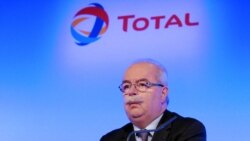
The chief executive of French oil giant Total has died after his corporate jet collided with a snow-removal machine at Moscow's Vnukovo Airport.
Officials said the collision occurred at midnight on October 20, killing Christophe de Margerie and three French crew members.
The Russian Investigative Committee said the operator of the snow-removal machine was “in a drunk state."
The jet, headed for France, collided with the snow removal- machine during takeoff in thick fog.
Margerie, 63, had been chief executive of the world’s fifth-largest oil and gas firm since 2007.
Earlier this year, Margerie argued Europe should maintain its energy relationship with Russia amid the conflict in Ukraine.
Total is one of the top foreign investors in Russia.
From Human Rights Watch:
Ukrainian government forces used cluster munitions in populated areas in Donetsk city in early October 2014, Human Rights Watch said. The use of cluster munitions in populated areas violates the laws of war due to the indiscriminate nature of the weapon and may amount to war crimes.
During a week-long investigation in eastern Ukraine, Human Rights Watch documented widespread use of cluster munitions in fighting between government forces and pro-Russian rebels in more than a dozen urban and rural locations.
While it was not possible to conclusively determine responsibility for many of the attacks, the evidence points to Ukrainian government forces’ responsibility for several cluster munition attacks on Donetsk.
An employee of the International Committee of the Red Cross (ICRC) was killed on October 2 in an attack on Donetsk that included use of cluster munition rockets.
Read the full report here.