

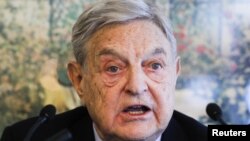
Billionaire investor and philanthropist George Soros has taken to the pages of "The New York Review of Books" to warn of "a challenge from Russia to [Europe's] very existence."
In a piece titled "Wake Up, Europe," the Hungarian-born American behind the Open Society Foundations says the International Monetary Fund (IMF) "should provide an immediate cash injection of at least $20 billion, with a promise of more when needed."
Here are some highlights:
"Putin will await the results of the elections on October 26 and then offer Poroshenko the gas and other benefits he has been dangling on condition that he appoint a prime minister acceptable to Putin. That would exclude anybody associated with the victory of the forces that brought down the Viktor Yanukovych government by resisting it for months on the Maidan—Independence Square."
OOO
"Western authorities have ignored the importance of what I call the “new Ukraine” that was born in the successful resistance on the Maidan. Many officials with a history of dealing with Ukraine have difficulty adjusting to the revolutionary change that has taken place there. The recently signed Association Agreement between the EU and Ukraine was originally negotiated with the Yanukovych government. This detailed road map now needs adjustment to a totally different situation. For instance, the road map calls for the gradual replacement and retraining of the judiciary over five years whereas the public is clamoring for immediate and radical renewal. As the new mayor of Kiev, Vitali Klitschko, put it, “If you put fresh cucumbers into a barrel of pickles, they will soon turn into pickles.”
OOO
"It is high time for the members of the European Union to wake up and behave as countries indirectly at war. They are better off helping Ukraine to defend itself than having to fight for themselves. One way or another, the internal contradiction between being at war and remaining committed to fiscal austerity has to be eliminated. Where there is a will, there is a way.
"In its last progress report, issued in early September, the IMFestimated that in a worst-case scenario Ukraine would need additional support of $19 billion. Conditions have deteriorated further since then. After the Ukrainian elections the IMF will need to reassess its baseline forecast in consultation with the Ukrainian government. It should provide an immediate cash injection of at least $20 billion, with a promise of more when needed. Ukraine’s partners should provide additional financing conditional on implementation of the IMF-supported program, at their own risk, in line with standard practice.
"The spending of borrowed funds is controlled by the agreement between the IMF and the Ukrainian government. Four billion dollars would go to make up the shortfall in Ukrainian payments to date; $2 billion would be assigned to repairing the coal mines in eastern Ukraine that remain under the control of the central government; and $2 billion would be earmarked for the purchase of additional gas for the winter. The rest would replenish the currency reserves of the central bank.
"The new assistance package would include a debt exchange that would transform Ukraine’s hard currency Eurobond debt (which totals almost $18 billion) into long-term, less risky bonds. This would lighten Ukraine’s debt burden and bring down its risk premium. By participating in the exchange, bondholders would agree to accept a lower interest rate and wait longer to get their money back. The exchange would be voluntary and market-based so that it could not be mischaracterized as a default. Bondholders would participate willingly because the new long-term bonds would be guaranteed—but only partially—by the US or Europe, much as the US helped Latin America emerge from its debt crisis in the 1980s with so-called Brady bonds (named for US Treasury Secretary Nicholas Brady)."
OOO
"It is also high time for the European Union to take a critical look at itself. There must be something wrong with the EU if Putin’s Russia can be so successful even in the short term. The bureaucracy of the EU no longer has a monopoly of power and it has little to be proud of. It should learn to be more united, flexible, and efficient. And Europeans themselves need to take a close look at the new Ukraine. That could help them recapture the original spirit that led to the creation of the European Union. The European Union would save itself by saving Ukraine."
Our lively roundtable on this weekend's Ukrainian elections is just wrapping up. But you can still watch it HERE:
From Reuters:
Ukraine has complained to the World Trade Organisation (WTO) about a decision by Russia to ban imports of fruit and vegetables from the country, the agriculture ministry said on Thursday.
The ban, which came in force on Oct. 22, was the latest trade barrier erected by Russia in a trade and sanctions war linked to international tensions over Ukraine.
Russia said it was imposing the ban because there was a suspicion that the goods are from the European Union and were being imported through Ukraine to evade Russian measures against the EU.
The Ukrainian ministry said Russia had violated international and bilateral agreements and did not submit any request to Kiev before it imposed the ban.
It said Ukrainian losses could total $17 million by the end of this year.

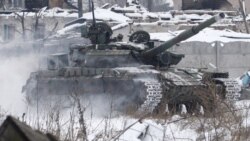
Via Reuters, "Charred tanks in Ukraine point to Russian involvement":
Reuters showed photographs of the two badly damaged tanks, one of which had lost its turret, to four independent military experts, who said they were of a type used exclusively by the Russian army.
At least one, they agreed, was a T-72BM - a Russian-made modification of a well known Soviet tank. This version of the tank, they said, is not known to have been exported.
"It is operated by the Russian Army in large numbers, but crucially it is not known to have been exported or operated outside of Russia," Joseph Dempsey, a military analyst for the London-based International Institute for Strategic Studies, wrote in late August when a tank like that was discovered on grainy footage of rebel convoy.
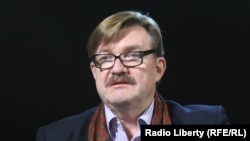
Nice little detail added to the TASS story (picked up from "Ukrainskaya Pravda") on the apparent mixup as Ukrainian authorities at Borispol Airport mistakenly blocked the entry to the country of longtime Ukrainian resident and television journalist Yevgeny Kiselyov. They appear to have mistaken him for Putin media crony Dmitry Kiselyov.
"Kiselyov's next programme is due to go on air on Friday."
So there's no real rush, I guess.