



Ukrainian Prime Minister Arseniy Yatsenyuk has issued a couple of defiant tweets to mark the anniversary of the fall of the Berlin Wall:
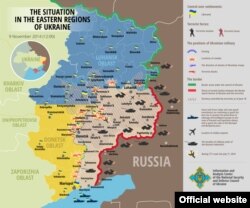
Here is a map of today's military situation in eastern Ukraine issued by Kyiv's National Security and Defense Council (click map to enlarge):
This was published a week ago, but is still worth reading if you haven't come across it already: an excellent "Letter from Ukraine" by Oliver Carroll for "Politico" on the "Cossack People's Republic of Stakhanov" in Luhansk:
The nearer you get to the frontline, the better the soup. This unexpected principle is one of few that still unify the warring parties in eastern Ukraine. And in the heavily sandbagged military HQ in separatist-held Stakhanov, no amount of artillery fire in nearby Pervomaysk or evident difficulties in the food supply chain can get in the way of cook Galina Dmitrevna’s exceptional borsch.
Dmitrevna is one of six women working 24-7 in three shifts. She does so without respite, feeding dozens of ragged and largely uncommunicative fighters that stream in and out of her kitchen. The only time she seems to look up is to register emotion at the news coming from the other side of the front, as dutifully transmitted by “Cossack Radio.” The updates are unrelentingly gloomy: “Two pensioners have been violently robbed by Ukrainian soldiers”; “Ukrainian teachers are being forced to work without pay”; “The World Bank is discussing ending financial assistance to Ukraine.” Only Russia is the beneficiary of good news: The West is now, apparently, ready to remove all sanctions. It’s an exclusive of sorts.
A few doors down from the kitchen is the smoke-filled nerve center of Commander Pavel Dremov’s military operation. Dremov is a 37-year old former bricklayer who has emerged as the savior of Stakhanov, a hitherto-forgotten mining town in the northwest corner of the self-proclaimed Luhansk People’s Republic. What is interesting is that the commander has styled himself in complete opposition to his fellow separatists in Luhansk and what he calls its “shady businessmen,” who deal “money, power, and ceasefires with the Kiev ‘junta.’” Dremov has offered Stakhanov citizens an alternative vision—a new, socialist, neo-Soviet “Cossack” republic that works for the people, especially the poor and elderly. And, as goes without saying, one that ignores any talk of a ceasefire deal.
It’s a call that falls on easy ears in Stakhanov. Named after the Soviet shock worker famed for record coal production (fallaciously, historians say), the town’s best days are long behind it. For a start, this most-famous-of-all-mining towns no longer has any working mine to speak of. The decline of Stakhanov, which accelerated during the post-Soviet 1990s, saw working men and women undergo a humiliating transformation from the Soviet Union’s most privileged class to one living among a cancer of crime, poverty, gambling and oligarchy. Many Stakhanov citizens were forced to travel to Russia in search of any old seasonal work to support their families. Others reluctantly acquiesced to the new ways of working. In short, Stakhanov was looking for a break; and when Ukraine fell into revolutionary anarchy earlier this year, some of its more active citizens took their chance.
Read more here