



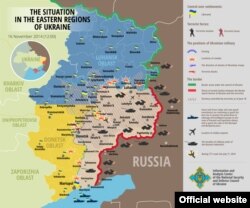
The latest situation map from Ukrainian authorities:
Debris from MH17 will be gathered near the crash site, then taken to the city of Kharkiv, then transported to the Netherlands, which is leading the investigation.
Another image of the Dutch recovery and export team watching as wreckage from Malaysia Airlines Flight 17, which was shot down over eastern Ukraine in July, killing all 298 people aboard, is loaded onto a truck for removal for investigation.
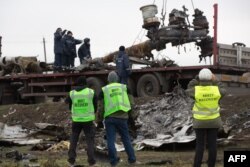
Western agencies quote Dutch authorities saying that recovery workers in separatist-controlled eastern Ukraine have begun collecting debris from the Malaysia Airlines crash site again, four months after the plane was brought down.
The operation is being carried out under the supervision of Dutch investigators and officials from the Organization for Security and Cooperation in Europe (OSCE).
The operation is expected to take around 10 days.
Continued fighting between Ukrainian government forces and pro-Russian separatists has prevented the collection operation for months.
Debris will first be collected at a location near the crash site before being taken to the Ukrainian city of Kharkiv and then to the Netherlands.
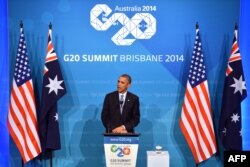
U.S. President Barack Obama speaking today, also at the final G20 news conference in Brisbane:
"You don't invade other countries or finance proxies and support them in ways that break up a country that has mechanisms for democratic elections."
"At this point the sanctions that we have in place are biting plenty good. We retain the capabilities and we have our teams constantly looking at mechanisms in which to turn up additional pressure as necessary."
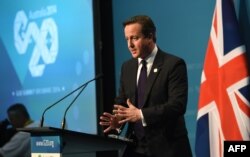
British Prime Minister David Cameron speaking at the G20 summit's concluding press conference today:
"There has been good unity between European countries and the United States of America -- we have just been discussing it at a separate meeting -- that we will continue to maintain the sanctions against Russia, we will continue to keep up the pressure and that if Russia continues to destabilize Ukraine further measures would follow. This is important because although some have said, of course, that there is a cost to sanctions -- and there is a cost to sanctions -- there would be a far greater cost of allowing a frozen conflict on the continent of Europe to be created and maintained."
"I think [Russian] President [Vladimir] Putin can see that he is at a crossroads -- if he continues to destabilize Ukraine there will be further sanctions, further measures, and there will be a completely different relationship between European countries and America on the one hand and Russia on the other. But he knows that there is a different path that he could take. He could recognize -- as he put it to me last night -- that Ukraine is a single political space and recognize that that single political space should be respected and should have the ability to make its own decisions about its own future."
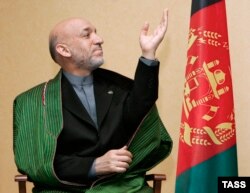
In an interview with RFE/RL's Radio Free Afghanistan that was broadcast this morning, former Afghan President Hamid Karzai defended Russia's unrecognized annexation of Crimea from Ukraine:
"As to Crimea, Afghanistan has its own political and historical position. [Crimea] was a part of Russia and was given to Ukraine by former Soviet leader [Nikita] Khrushchev when Ukraine itself was a part of the Soviet Union. Therefore, Russians took their own land back and we supported and appreciated their right to do so. It was an exemplary act for Afghanistan because we have also been stabbed in the heart by colonial Britain -- our land has been taken from us, the Durand Line has been drawn and the nation has been divided. We could not reclaim our land due to our domestic problems, lack of political influence and the kind of education that is needed. It was Afghanistan’s right to recognize the separation of Crimea from Ukraine and it is Afghanistan’s right to demand its own land and we will keep this right alive."
In the final months of his presidency, Karzai said in March following the Kremlin-orchestrated referendum in occupied Crimea that he "respected" the decision by Crimeans to "reunite" with Russia. Afghanistan's is one of a tiny handful of governments -- including Cuba, Nicaragua, Syria, and Venezuela -- to have suggested it recognized the results of the referendum, which took place with Russian troops patrolling the streets, armed gunmen at polling stations, and widespread intimidation or violence directed at those who objected to seceding from Ukraine and joining Russia.
From our newsroom, with Putin speaking ahead of his quick exit:
Russian President Vladimir Putin said on November 16 that Kyiv is making “a big mistake” by imposing an economic blockade on eastern Ukraine’s pro-Russian regions.
Speaking at the G20 summit in Australia, Putin said the moves cut off the regions from the rest of the country and that Ukraine’s government is “removing their grip on these territories.
Putin said he plans to discuss the moves with Ukrainian President Petro Poroshenko.
Poroshenko issued several decrees November 15 that close state institutions and banking services in the regions of Donetsk and Luhansk.
One decree says all state companies, institutions, and organizations should end their work within a week and "evacuate workers, with their permission, (and) where possible remove property and documents."
It says: "Ukraine will no longer finance them. This includes schools, kindergartens and hospitals."
Kyiv already had cut all state funding to separatist–controlled areas after rebel-run elections there in October that Poroshenko condemned as illegal.
Based on reporting by Reuters, AP, and AFP