


Here's the latest Ukraine-related update from our news desk:
The United Nations Security Council has scheduled an emergency meeting today on the presence of Russian troops in southeastern Ukraine. The meeting comes after Ukraine's President Petro Poroshenko said Russia had brought forces into Ukraine.
The meeting comes after Ukraine's President Petro Poroshenko said Russia had deployed forces in eastern Ukraine.
Meanwhile, British Prime Minister David Cameron has warned of "further consequences" for Moscow unless it halts the advance of Russian tanks into Ukraine.
A top NATO official said on August 28 that more than 1,000 Russian soldiers have invaded eastern Ukraine, with 20,000 more mobilized just across the border.
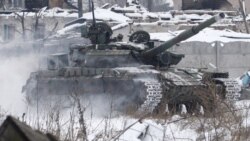
Kyiv's National Security and Defense Council says Russian tanks and troops seized the Ukrainian border town of Novoazovsk on the Sea of Azov, and that others were taking positions in the east.
A Ukrainian military spokesmen said government forces have regrouped to defend the city of Mariupol to the west of Novoazovsk.
(AFP, Reuters, BBC, ITAR-TASS, Interfax)
#Ukraine protesters want better leadership, weapons in war against #Russia http://t.co/DR6LQGRaT0 pic.twitter.com/EbsEEuxukI
— Brian Bonner (@BSBonner) August 28, 2014
RFE/RL's Glenn Kates has been writing about the reaction in Russia to their troops apparently fighting in eastern Ukraine:
But now, as Moscow reinvigorates a flailing pro-Russian separatist insurgency with a barely concealed incursion into southeastern Ukraine, indications are that Russian military men are dying. And as captured Russian paratroopers are paraded on Ukrainian television and servicemen are buried in secrecy, some Russians are asking a seemingly simple question:
"Are we at war?"
The answer to the question, originally posed in an editorial in the "Vedomosti" business daily, is one that is becoming increasingly obvious for military families. It is the details that they say are not forthcoming.
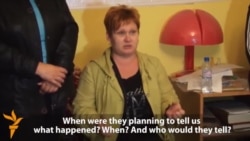
In Kostroma, 1,300 kilometers from Russia's border with eastern Ukraine, family members of a group of 10 Russian paratroopers captured in Ukraine say all their information has come from secondhand, online sources.
One mother, Olga Pochtoyeva, says when she originally approached officials with photos on her son's Vkontakte page that appeared to show he had been taken prisoner in Ukraine, her claims were dismissed as "provocations." "We showed them [these pictures] and they didn't believe it," she says. "It's Photoshop, they told us. I'm sorry, my son has never used Photoshop."
Read the entire article here. (Kates' piece also includes this video of RFE/RL's Russian Service speaking to relatives of the Russian paratroopers detained in Ukraine:

RFE/RL's Andrei Babitsky is in Donetsk and has sent us this footage of fierce fighting on the streets of the eastern Ukrainian city this afternoon. (WARNING: Graphic content, including footage of dead bodies):

UKR foreign ministry:Recent Russian actions clearly demonstrate that Moscow is bluntly drawing Ukraine & entire world into a full-scale war
— Shaun Walker (@shaunwalker7) August 28, 2014
Let's be clear. #Russia has invaded #Ukraine. My take on how we must respond in @ftcomment. http://t.co/8Q80pdjutv
— Ivo Daalder (@IvoHDaalder) August 28, 2014
RT: @nycjim New NATO satellite imagery purportedly showing #Russian combat forces inside #Ukraine pic.twitter.com/9XXuezVfX2
— David Patrikarakos (@dpatrikarakos) August 28, 2014
RFE/RL's Power Vertical blogger Brian Whitmore has been writing about the possibility of Donbass becoming a "frozen" conflict along similar lines to Transdniester, Abkhazia, etc.
So are we about to add Donbas to the list of Kremlin-orchestrated frozen conflicts? Perhaps, with some important caveats.
The wars in South Ossetia, Abkhazia, and Transdniester that led to those territories becoming de facto Russian protectorates all took place in the early 1990s, in the chaos following the break-up of the Soviet Union.
"The majority of the current unrecognized states in the former Soviet space emerged atop the wave of the 'parade of sovereignties,' when this was a sort of political trend," journalist Vladimir Dergachev wrote on gazeta.ru recently.
And as a result, the uprisings there appeared to much of the world at the time to be genuine local rebellions, and therefore not so different from the former Soviet republics' independence struggles. In this environment, Russia was able to plausibly claim to be a mediator -- and ultimately to play the role of "peacekeeper" -- in conflicts that it had itself stoked.
And they were able to do so with the West's implicit blessing, or at least tacit consent.
This time, the mask would be off and Moscow wouldn't be able to pursue its goals by stealth. Setting up a frozen conflict in Donbas would intensify Russia's conflict with the West, lead to even more crippling sanctions, and Moscow's deeper isolation.
"Moscow retained for itself the status of a relatively neutral intermediary in Abkhazia and South Ossetia until 2008, and in Transdniester and Nagorno-Karabakh to this day. In this instance it will no longer be possible," Dergachev wrote.
And knowing the threat that a frozen Donbas conflict would be for Ukraine's statehood, Kyiv would likely prefer to keep the conflict hot. Ukrainian President Petro Poroshenko has said he would not allow a Transdniester scenario in eastern Ukraine.
Read the entire blog here
Deeply disturbed by reports that Russia plans to move Nadia Savchenko, a Ukrainian military pilot, to Russia's infamous psychiatric hospital
— Jen Psaki (@statedeptspox) August 28, 2014