


RFE/RL's Power Vertical blogger Brian Whitmore has been writing about the possibility of Donbass becoming a "frozen" conflict along similar lines to Transdniester, Abkhazia, etc.
So are we about to add Donbas to the list of Kremlin-orchestrated frozen conflicts? Perhaps, with some important caveats.
The wars in South Ossetia, Abkhazia, and Transdniester that led to those territories becoming de facto Russian protectorates all took place in the early 1990s, in the chaos following the break-up of the Soviet Union.
"The majority of the current unrecognized states in the former Soviet space emerged atop the wave of the 'parade of sovereignties,' when this was a sort of political trend," journalist Vladimir Dergachev wrote on gazeta.ru recently.
And as a result, the uprisings there appeared to much of the world at the time to be genuine local rebellions, and therefore not so different from the former Soviet republics' independence struggles. In this environment, Russia was able to plausibly claim to be a mediator -- and ultimately to play the role of "peacekeeper" -- in conflicts that it had itself stoked.
And they were able to do so with the West's implicit blessing, or at least tacit consent.
This time, the mask would be off and Moscow wouldn't be able to pursue its goals by stealth. Setting up a frozen conflict in Donbas would intensify Russia's conflict with the West, lead to even more crippling sanctions, and Moscow's deeper isolation.
"Moscow retained for itself the status of a relatively neutral intermediary in Abkhazia and South Ossetia until 2008, and in Transdniester and Nagorno-Karabakh to this day. In this instance it will no longer be possible," Dergachev wrote.
And knowing the threat that a frozen Donbas conflict would be for Ukraine's statehood, Kyiv would likely prefer to keep the conflict hot. Ukrainian President Petro Poroshenko has said he would not allow a Transdniester scenario in eastern Ukraine.
Read the entire blog here
Deeply disturbed by reports that Russia plans to move Nadia Savchenko, a Ukrainian military pilot, to Russia's infamous psychiatric hospital
— Jen Psaki (@statedeptspox) August 28, 2014
Another update from RFE/RL's news desk:
The United Nations Security Council is holding an emergency meeting on today about the crisis in eastern Ukraine.
Meanwhile, envoys from all 28 NATO member states have scheduled urgent talks in Brussels tomorrow with Kyiv's NATO ambassador about Russia's military incursion into eastern Ukraine.
The meetings come after Ukraine's President Petro Poroshenko said on August 28 that Russia has deployed forces in eastern Ukraine.
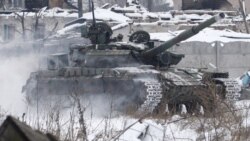
Ukraine's National Security and Defense Council said Russian tanks and troops seized the border town of Novoazovsk after pummeling government forces with Grad rockets and cross-border artillery fire.
A spokesman in Kyiv said government forces had regrouped on August 28 to defend Mariupol to the west of Novoazovsk.
A NATO official said on August 28 that more than 1,000 Russian soldiers have invaded eastern Ukraine, with 20,000 more mobilized just across the Russian border.
(Reuters, AP, AFP, BBC, ITAR-TASS, Interfax)
#NATO satellite images show #Russia self-propelled artillery in #Ukraine as #Putin tries to secure Crimea Corridor http://t.co/ZjPHyXP43p
— Maxim Tucker (@MaxRTucker) August 28, 2014
Russia's NGO Soldiers Mothers says 250 more paratroopers from Ryazan to get dropped in Ukraine next week http://t.co/BQY4wOXlf2
— Ryskeldi Satke (@RyskeldiSatke) August 28, 2014
Exclusive - Over 100 Russian soldiers killed in single Ukraine battle - Russian rights activists http://t.co/uwi7JnLL63 via @reuters
— Mark Trevelyan (@MarkTrev64) August 28, 2014
NATO briefed today that there were 1000+ Russian tps in #Ukraine. I hear their classified view is 4 battalion task grps are in - nearer 5000
— Mark Urban (@MarkUrban01) August 28, 2014
As becomes clear regular Russian soldiers are in #Ukraine, few dozen anti-war protestors at Kremlin. @leonidragozin pic.twitter.com/XXXar5NF6O
— Alec Luhn (@ASLuhn) August 28, 2014
Hmm, it seems that Canadian tweet has raised some Russian hackles (and incidentally isn't Moscow supposed to have recognized Abkhazia as a state...?):
Helping our Canadian colleagues to catch up with contemporary geography of #Europe @CanadaNATO pic.twitter.com/MjzRxpFFfN
— Russians at NATO (@natomission_ru) August 28, 2014
The UN Security Council meeting on Ukraine is under way and the United States' Susan Power has had some harsh words for Moscow:
U.S. Ambassador Samantha Power told an emergency session of the UN Security Council on August 28 that Russia must "stop lying" about its invasion of eastern Ukraine and its direct military support for pro-Kremlin separatists there.
Power told the UN Security Council that Washington will continue working with its partners from the Group of Seven leading industrialized nations "to ratchet up consequences on Russia.”
Saying that Russia's "mask is beginning to come off," Power said that the Kremlin's "blatant disregard for the United Nations Charter will not be tolerated."
She told the Security Council: "Now, the key question to be answered is not what we can say to Russia to make them hear us, but what we can do."
Urging strong international action against Moscow, Power said that in the face of the threat now posed by Russia, "the cost of inaction is unacceptable."