



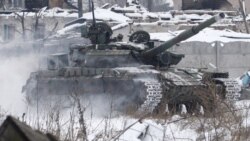
LATEST: NATO Secretary-General Anders Fogh Rasmussen has dismissed what he said were Russia's "hollow denials" of involvement in Ukraine's separatist conflict.
He said that "it is now clear that Russian troops and equipment have illegally crossed the border." He said Russia is engaged in "direct military operations in Ukraine." He spoke in Brussels after an emergency NATO meeting to discuss the Ukraine crisis.
Rasmussen said Russia's actions were not isolated but "part of a dangerous pattern over many months to destabilize Ukraine."
He said Russia had supplied rebels with tanks, armor, artillery, and rocket launchers and had fired on Ukrainian troops from both Russian territory and Ukrainian soil.
Rasmussen said he fully respects Ukraine's decisions regarding its security policy and alliance affiliations. He spoke shortly after Prime Minister Arseniy Yatsenyuk said the government in Kyiv would pursue membership in NATO.
.@NATO's full statement on Russia's invasion in Ukraine http://t.co/WdAHH5X757 pic.twitter.com/oPju7rZVAY
— Maxim Eristavi (@MaximEristavi) August 29, 2014
Putin: annexation of Crimea in keeping with UN charter and Western leaders can't tell him why shouldnt be recognized pic.twitter.com/4cRmg0wKoA
— Ian Bateson (@ianbateson) August 29, 2014
Putin talking with students for over two hours. Don't think his heart is in it anymore. #Russia pic.twitter.com/PxpHVmsYVv
— Ian Bateson (@ianbateson) August 29, 2014
Elias Groll has been writing for "Foreign Policy" and trying to guess what Russia is actually up to in Ukraine:
Beginning with Moscow's decision to seize Crimea and later with its decision to foment unrest in eastern Ukraine, there has been element of unpredictability to Russian actions. Even as many observers have argued that Russian actions represent an effort to regain territory lost when the Soviet Union crumbled, there has been no clear evidence that Putin has made a decision to seize a large chunk of territory in eastern Ukraine and potentially find himself in a major land war.
"Putin has been throughout this crisis a bit of a gambler," said Jonathan Eyal, the international director at the Royal United Services Institute, a British think tank. "We underestimate the element of improvisation within the Russian decision-making in this crisis."
According to this line of thinking, it is imperative that Putin not be presented with any further opportunities to expand the territory under his control. If his forces are able to easily consolidate control of Mariupol and its environs, Russian troops may very well continue their drive along the Ukrainian coast, perhaps all the way to Transnistria.
Regardless of whether Putin expands the offensive, the Russian leader in the meantime achieves his short-term goal of propping up the separatists he backs. "He wants a failed, destroyed Ukrainian state and to prevent Ukraine from falling in the Western sphere of influence," Eyal said. "The strategy is to not have a strategy."
With NATO estimates putting the total number of Russian troops in Ukraine at about 1,000 and Ukrainian officials saying that two columns of tanks and military vehicles moved into southeastern Ukraine from Russia on Thursday, Moscow's forces lack the equipment and troops to mount a broader campaign toward Transnistria. According to Steven Pifer, a former U.S. ambassador to Ukraine and the director of the Arms Control and Non-Proliferation Initiative at the Brookings Institution, Russia would need on the order of 50,000 to 80,000 troops just to occupy the city of Luhansk or Donetsk. To carve out a corridor from Luhansk to Donetsk would require a vastly larger number and would place Russian troops in areas where they are likely to receive a hostile reception by the local population.
Read the entire article here
Got our hands on leaked draft conclusions for Saturday's #EU summit. Language on #Ukraine very much work in progress http://t.co/4MYuo2Cvb2
— Peter Spiegel (@SpiegelPeter) August 29, 2014