



It seems officials in Crimea are trying hard to adapt to Russian norms of intolerance:
The senior official in Crimea says sexual minorities "have no chance" on the peninsula that Russia annexed from Ukraine in March.
Speaking about gays during a Crimean government session on September 2, Sergei Aksyonov said that "we in Crimea do not need such people."
Aksyonov said that if gays tried to hold public gatherings, "our police and self-defense forces will react immediately and in three minutes will explain to them what kind of sexual orientation they should stick to."
He said Crimean children should be brought up with a "positive attitude to family and traditional values."
Russia annexed Crimea after a referendum that was condemned as illegal by the United States and European Union.
President Vladimir Putin signed a law last year that Western governments and activists say curtails gay rights and encourages discrimination. (Interfax and ITAR-TASS)
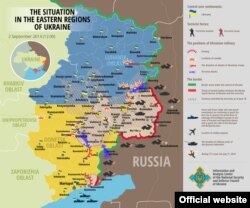
Here's today's map of the military situation in eastern Ukraine from the National Security and Defense Council:
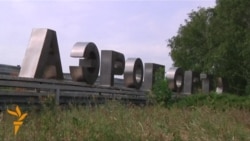
The Ukrainian military on September 1 pulled its forces back from a vital airport outside the eastern city of Donetsk. Wreckage and debris littered the airport grounds following a battle against separatists, who Kyiv says have the direct support of hundreds of Russian troops and armor. (Reuters)

The latest news from Ukraine, via our news desk:
The Kremlin has backtracked after President Vladimir Putin was quoted as saying his military could capture Kyiv in two weeks if he gave the order, while Ukrainian government forces suffered new losses in the fighting against separatists the West says are backed by Russian soldiers.
The Italian newspaper "La Repubblica" reported on September 1 that Putin told outgoing European Commission President Jose Manuel Barroso, "If I want, I can take Kyiv in two weeks."
The newspaper report implied Putin's warning was a response to the possibility the EU would impose further sanctions on Russia over its role in the Ukraine crisis.
The comment was reportedly relayed by Barroso to leaders at a European Union summit on August 30 during which EU leaders decided they should step up sanctions if Moscow does not pull its troops back from Ukraine, where NATO estimated last week that there were more than 1,000 Russian soldiers.
Putin's senior foreign policy aide, Yuri Ushakov, said on September 2 that the remarks were "taken out of context and had a completely different meaning."
He said that "whether the comments were made or not," it was "unworthy of a serious political figure" to reveal details of a private conversation.
Putin's reported remark was the latest in a series of comments that have raised concerns about his intentions toward Ukraine.
Russia annexed the former Soviet republic's Crimea region in March, and the West has rejected its denials that it is supporting pro-Russian rebels who control parts of the southeastern regions of Donetsk and Luhansk.
On August 31, Putin called for talks on "statehood" for southeastern Ukraine, though his spokesman said that did not mean Moscow endorsed independence for rebel-held areas.
The pro-Western government in Kyiv says recent gains by separatists, who had appeared to be close to defeat last month, came as a result of Russian military support.
Government forces abandoned the international airport outside the city of Luhansk on September 1 and video footage indicated they had also retreated from the airport in Donetsk.
Ukrainian military spokesman Andriy Lysenko said on September 2 that 15 military personnel had been killed and 49 others injured in the previous 24 hours. He did not report losses suffered by the separatists.
UN refugee agency spokesman Vincent Cochetel said on September 2 that the number of people displaced within Ukraine by the conflict as nearly doubled in the past three weeks to at least 260,000.
More than 2,600 people have been killed since the fighting began in April.
The Ukrainian government, NATO and Western nations say Russia has sent troops, artillery and tanks across the border to reinforce the separatists.
Moscow denies the claim and has accused the Ukrainian government of undermining efforts to reach a negotiated settlement.
Russian Foreign Minister Sergei Lavrov on September 2 accused Washington, European nations and NATO of supporting what he called the "party of war" in Kyiv. He was referring in part to calls by senior Ukrainian officials for the country to abandon its non-aligned status and seek NATO membership.
NATO, at a summit this week, is expected to agree on plans to boost its military presence in Central and Eastern Europe amid heightened concerns in member states near Russia's borders about Moscow's possible intentions.
A senior Russian official said NATO's plans were "evidence of the desire of US and NATO leaders to continue their policy of aggravating tensions with Russia."
Mikhail Popov, the deputy head of Russia's National Security Council, said deteriorating relations with the United States and NATO will be reflected when Russia's 2010 defense doctrine is adjusted later this year.
NATO says the planned rotation of troops and equipment will not breach an agreement struck with Russia in 1997, limiting its presence in Eastern Europe.
U.S. President Barack Obama is expected to arrive in Baltic NATO member Estonia on September 2 before heading to Britain for the alliance's summit.
Italian Foreign Minister Federica Mogherini, who will be the next EU foreign affairs chief, said the European Union will take a decision on a package of new sanctions against Russia by September 5.
Mogherini told the European Parliament on September 2 the EU planned to boost sanctions, including in defense, dual use goods and finance. (Reuters, AFP, and Interfax)