



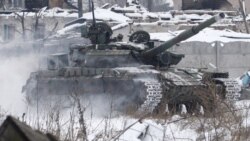
About one-third of Donbas region, Lutsenko says:
Four Ukrainian troops have been killed and 29 wounded since the cease-fire went into effect on September 5, according to Defense Ministry official Vitaliy Andronatiy, quoted by AFP and local media.
Via Interfax, seemingly less beligerent language out of the separatists:
Authorities of the self-proclaimed Donetsk People's Republic (DPR) and Luhansk People's Republic (LPR) support independence of the self-proclaimed territories within the administrative border of the Donetsk and Luhansk regions, DPR First Deputy Prime Minister Andrei Purgin told Interfax.
"We stand rigidly on the position of self-determination within the administrative borders of the Donetsk and Luhansk regions," Purgin said, commenting on Ukrainian presidential aide Yury Lutsenko's statement that a third of the Donbas territory will receive a special status "within a cohesive Ukraine."
"Of course, it will be necessary to reach some compromises with Kyiv. In particular, regarding economic, cultural and other issues," Purgin said.
"We worked in one territory for many years and, of course, some ties should not be broken," Purgin said.
"Ukraine will aspire to keep us as part of its space, however we will continue the course for self-determination," the DPR first deputy prime minister said.
Ukraine's military says the international airport near the separatist-held city of Donetsk in eastern Ukraine came under rocket fire overnight, adding that there were no casualties.
Donetsk airport is controlled by Ukrainian government forces but has come under attack regularly since May by the separatists.
The Dutch Safety Board has published its press release to accompany the preliminary report on the MH17 downing. Here is the text as it appears on the board's website:
Flight MH17 with a Boeing 777-200 operated by Malaysia Airlines broke up in the air probably as the result of structural damage caused by a large number of high-energy objects that penetrated the aircraft from outside. This is mentioned in the preliminary report on the investigation into the crash of MH17 that has been published today by the Dutch Safety Board. There are no indications that the MH17 crash was caused by a technical fault or by actions of the crew.
The cockpit voice recorder, the flight data recorder and data from air traffic control all suggest that flight MH17 proceeded as normal until 13:20:03 (UTC), after which it ended abruptly. A full listening of the communications among the crew members in the cockpit recorded on the cockpit voice recorder revealed no signs of any technical faults or an emergency situation. Neither were any warning tones heard in the cockpit that might have pointed to technical problems. The flight data recorder registered no aircraft system warnings, and aircraft engine parameters were consistent with normal operation during the flight. The radio communications with Ukrainian air traffic control confirm that no emergency call was made by the cockpit crew. The final calls by Ukrainian air traffic control made between 13.20:00 and 13.22:02 (UTC) remained unanswered.
The pattern of wreckage on the ground suggests that the aircraft split into pieces during flight (an in-flight break up). Based on the available maintenance history the airplane was airworthy when it took off from Amsterdam and there were no known technical problems. The aircraft was manned by a qualified and experienced crew.
Pattern of damage
As yet it has not been possible to conduct a detailed study of the wreckage. However, the available images show that the pieces of wreckage were pierced in numerous places. The pattern of damage to the aircraft fuselage and the cockpit is consistent with that which may be expected from a large number of high-energy objects that penetrated the aircraft from outside. It’s likely that this damage resulted in a loss of structural integrity of the aircraft, leading to an in-flight break up. This also explains the abrupt end to the data registration on the recorders, the simultaneous loss of contact with air traffic control and the aircraft's disappearance from radar.
Further investigation
In its preliminary report, the Safety Board presents the initial findings of an investigation that is still fully underway. More research will be necessary to determine more precisely what caused the crash and how the airplane disintegrated. The Board believes that additional evidence will become available in the period ahead. From this point on, the research team will start working towards producing the definitive investigation report. The Board aims to publish the report within one year of the date of the crash.
Procedure
The draft preliminary report has been sent to the Accredited Representative of the states that participate in the investigation (Malaysia, Ukraine, the Russian Federation, the United Kingdom, the United States of America and Australia) for review. All Accredited Representatives have sent a reaction. The Dutch Safety Board assessed the provided suggestions and amended the report where appropriate.
Tjibbe Joustra, Chairman of the Dutch Safety Board
“The MH17 crash has shocked the world and raised many questions. The Dutch Safety Board wishes to determine the cause of the crash, for the sake of the loved ones of the victims and for society at large.”
“The initial results of the investigation point towards an external cause of the MH17 crash. More research will be necessary to determine the cause with greater precision. The Safety Board believes that additional evidence will become available for investigation in the period ahead.”
“The preliminary report issues the first findings in a ongoing investigation. From this point on, the investigation team will be working towards producing its final report. The Board aims to publish this report within one year of the date of the crash.”
Here's the pdf version of the Dutch Safety Board's "Preliminary Report: Crash Involving Malaysia Airlines Boeing 777-200 Flight MH17."
Dutch report says among findings:
"No evidence or indications of manipulation of the [flight and cockpit] recorders were found."
"Both recordings ended at 13:20.03" on July 17, it notes.
Under conclusions, heading ATC/Airspace...so nearest commercial plane was 30 kilometers away and there was "no distress message":
"At the time of the occurrence, flight MH17 was flying at FL330 in unrestricted airspace of the Dnipropetrovs'k (UKDV) FIR in the eastern part of the Ukraine, the aircraft flew on a constant heading, speed and altitude when the Flight Data Recording ended. UkSATSE had issued NOTAMs that restricted access to the airspace below FL320.
"The last radio transmission made by the crew began at 13:19.56 hrs and ended at 13:19.59 hrs.
"The last radio transmissions made by Dnipropetrovs'k air traffic control centre to flight MH17 began at 13:20.00 hrs and ended at 13.22.02 hrs. The crew did not respond to these transmissions.
"No distress messages were received by the ATC.
"According to radar data three commercial aircraft were in the same Control Area as flight MH17 at the time of the occurrence. All were under control of Dnipro Radar. At 13:20 hrs the distance between the closest aircraft and MH17 was approximately 30 km.
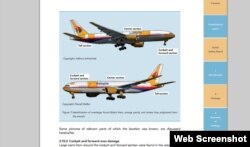
Under "Damage" in the report's "Summary of Findings":
"Damage observed on the forward fuselage and cockpit section of the aircraft appears to indicate that there were impacts from a large number of high-energy objects from outside the aircraft.
"The pattern of damage observed in the forward fuselage and cockpit section of the aircraft was not consistent with the damage that would be expected from any known failure mode of the aircraft, its engines or systems.
"The fact that there were many pieces of the aircraft structure distributed over a large area, indicated that the aircraft broke up in the air."