

Latest from our news desk:
A senior Kremlin official said on September 26 that Russian President Vladimir Putin and Ukrainian President Petro Poroshenko have discussed by telephone the possibility of a meeting.
Putin's foreign policy adviser, Yury Ushakov, told reporters in Moscow on September 25 that Putin and Poroshenko "are, in phone calls, discussing a possible personal contact in a bilateral or international format ... with the participation of the German chancellor and the French president."
Ushakov added that the exact date of such a meeting is not known.
Meanwhile, Reuters quoted an unnamed German government spokesman as saying that there are no current plans for German, French, Russian and Ukrainian leaders to meet, adding though that such talks are not ruled out if helpful.
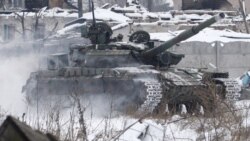
Kyiv and its Western backers accuse Moscow of sending in troops and arming the separatists in Ukraine's east. Moscow denies this. (Reuters, Interfax and ITAR-TASS)
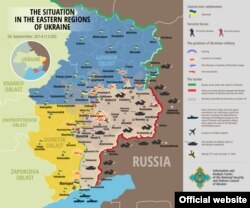
Here is today's map of the military situation in eastern Ukraine courtesy of the National Security and Defense Council:
More from the EU-Russia-Ukraine gas meeting taking place in Berlin:
Ahead of the meeting, Ukrainian Energy Minister Yuriy Prodan said he hoped a compromise on a "fair market price for gas" would be reached during the meeting.
He said a price that can be found at "European hubs, on European markets."
More from Berlin gas talks: according to ITAR-TASS, Russia and the EU have "discussed, bilaterally, all planned issues for the settlement of Ukraine's debt and gas supplies."
The Russian news agency quotes Russian Energy Minister Aleksandr Novak as saying: "At the bilateral meting we discussed all issues concerning the settlement of debt and the need to ensure regular gas supplies and transit."
A new crack in Russia's ban of food imports in response to Western sanctions may be filled with cheese, Interfax reports:
Russia's Economic Development Ministry is not ruling out the possibility of currently banned cheeses and fermented milk products returning to the Russian market since lactose-free milk has been removed from the sanctions list.
"The likelihood exists of renewing shipments of milk products from countries that fell under the food embargo," the Economic Development Ministry said in its social and economic development forecast for Russia in 2015-2017. The ministry added that this move might occur in connection with the removal of lactose-free milk from the list.
According to experts, a number of dairy products, such as long-ripened cheeses, fermented milk products and others, have a low level of lactose, which does not create particular difficulties for foreign companies to reorient their facilities to produce, register and export dairy products to the Russian market as lactose-free, the Economic Development Ministry said.