



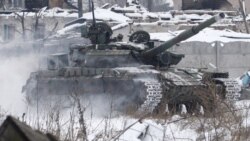
Targeted sanctions pinch the Chechen leader:
Former U.S. Ambassador to Russia Michael McFaul has let fly via Facebook over Putin media tsar Dmitry Kiselyov's comparison of the U.S. president with the head of the radical Islamic State group:
"I watched thousands of hours of Soviet television in my day and I do not remember such revolting statements like this one, comparing Obama to ISIL leader al Bagdadi (starts around minute 38) Disgusting and shameful. I am embarrassed for my friends in the Russian government and state-run media who have to be be associated with such nonsense."
Hmmmm, I wonder who the Russian Institute for Strategic Studies' Vladimir Kozin will blame for "Cold War 2.0" in his piece for the fiercely anti-Western "Russian Insider." Yep, turns out that all eight "real and objective...major features" that laid the groundwork for it were actions by the West.
And more specifically:
The Cold War 2.0 was intentionally initiated by President Barack Obama for obvious reasons: to undermine Russia’s military and economic potential, to increase NATO military expenditures, to create more pro-Western states along the perimeter with Russian territory.
His prescription "out from this impasse" lies, of course, in a total transatlantic abandonment of Western defense and other measures taken in response to Russia's forcible annexation of Crimea and support for separatism in eastern Ukraine:
First, the US and its NATO allies should stop any military build-up near Russia's border. US tactical nuclear weapons, with relevant infrastructure and BMD assets, must be removed from Europe. A qualitatively new CFE has to be negotiated and signed by all NATO member-states, especially by new entrants, and Russia. An international treaty banning arms deployment in outer space should be signed by all states. And de facto and de jure nuclear-weapon states have to assume commitments not to use nuclear weapons in a first strike. A new US-Russian START may be debated provided all previous agreements are reached.
Second, economic and financial sanctions against Russia should be lifted in full and for good.
Third, the people of Donbass will have the right to determine their own future. A peaceful solution to the Ukrainian crisis requires not merely a ceasefire but a complete withdrawal of all Ukrainian regular troops and irregular formations from the territory of the Donetsk and Lugansk regions. Kiev authorities should sign a non-aggression pact with them. Ukraine will have to re-declare its pledge to retain its non-nuclear and non-aligned status.
Fourth, in general terms, the time has come to prohibit from international diplomacy the use of threats and pressure against one another.
Simple, right?

"Rossiiskaya gazeta" reports that Russia's human rights ombudsperson has sharply criticized the European Union for "ignoring human suffering" in eastern Ukraine.
Ella Pamfilova says in an interview published today that although Europe is "an icon in the style of human rights, democracy, and freedom of speech," it "openly prefers to disregard the situation in southeastern Ukraine." She adds that Europe's media "are simply fulfilling the order to brand and to accuse Russia of everything."
She admits that "there are things to criticize Russia for," but adds that "one must have a moral right to do so." She adds that she is disappointed that human rights have become "a bargaining chip in big politics."
Pamfilova served as social affairs minister under President Boris Yeltsin and as a liberal member of the State Duma between 1994 and 1999. She has headed President Vladimir Putin's commissioner for human rights since March.
From our newsroom:
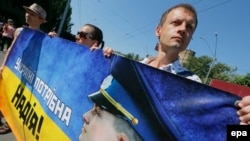
A group of Russian human rights activists plans to protest today against the trial of Ukrainian pilot Nadiya Savchenko, who was abducted in eastern Ukraine and smuggled to Russia to face charges of participating in the killing of two Russian journalists.
The protest was to take the form of a series of one-person pickets to avoid violating Russia's strict laws on public gatherings, and was being organized through social networks.
Savchenko is being held in Moscow's Serbsky psychiatric hospital, where she is undergoing psychiatric examinations.
On October 18, one of Savchenko's lawyers, Nikolai Polozov, wrote on Twitter that the pilot is being subjected to sleep deprivation at the hospital.
"All night long, a prison official sits in her doorway and watches her. We regard this as torture," Polozov wrote.
On October 13, Moscow's Basmanny District Court postponed the next hearing in the case, which will focus on defense objections, until November 11.
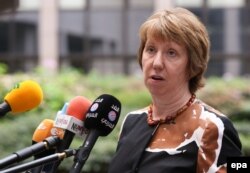
Reuters and TASS quote the European Union's foreign policy chief, Catherine Ashton, as saying the bloc's Foreign Affairs Council will meet today to discuss the status of the cease-fire in eastern Ukraine and a possible review of EU sanctions against Russia.
Ashton, speaking on arrival at a meeting of EU foreign ministers in Luxembourg, said the council would "analyze the situation and decide what our next steps will be."
The European Union has previously said that Russia's practical aid in fulfilling the provisions of the September 5 Minsk agreements and in establishing stability in Ukraine are the main factors to be considered in connection with a partial or complete easing of sanctions against Russia.
RT propagating an anonymously sourced tip from Russian defense circles suggesting whatever submarine the Swedes are trying to track down in waters off Stockholm "is probably Dutch." There is no evidence presented aside from the Russian denial that one of their subs is involved and the "source in the Russian Defense Ministry" pointing a finger at the Dutch.
That report is obligingly followed by a similar one ("BREAKING") by RIA Novosti: