



“This is clearly not just about Ukraine, but about Russia’s ambitions in the whole neighbourhood” w/ Andrew Wilson http://t.co/2T6N4HKRud
— toomas hendrik ilves (@IlvesToomas) October 22, 2014
Here's one of the stand-out quotes from the interview tweeted above:
SRB: What do you think this conflict, or crisis, means for the West and how does that affect East-West relations?
AW: Clearly, Russia is doing what it’s doing because it thinks we’re weak and divided, slow to react. We haven’t entirely been slow. By hook or by crook, we’ve got to roughly the right position on sanctions – whether we would have done so without the MH17 tragedy we don’t know, though to be fair America had announced the same sanctions the day before. We are now in a position where sanctions are doing a lot of damage to the Russian economy.
But more broadly, Russia thinks it can play at divide-and-rule, thinks our attention span is limited and that we’re already fleeting on to the next crisis in Syria, Iraq and elsewhere. That’s true, and in this sense we have an attention deficit disorder and Russia can stay more focused and exploit that. The crisis has also shown how Russian channels of influence-pedalling extend beyond the former USSR; how Russia operates through propaganda in Europe; how it exploits certain anti-systemic forces and political parties.
This is not always the case though. It was really interesting to read Russia’s commentary on the Scottish referendum. They simply couldn’t understand that a) it was really democratic and b) that the separatists didn’t win. They are locked into this expectation that Europe is collapsing and corrupt. So it had to be a fix, according to Russia. Obviously, it wasn’t.
This a real challenge to the West in terms of devising an effective policy response. Sanctions have roughly got to the right place, though I don’t think Germany has played a very good role, pushing for a bad peace. Germans don’t understand Putin’s modus operandi. The Germans pushed Ukraine into this stupid compromise of delaying the EU Association Agreement and Putin just tried to renegotiate the whole agreement. So there are people in Europe who don’t understand how Russia works.
And for America there are big challenges about how far it can retreat from its traditional global policeman role. If troubles just flare up in the areas they pay less attention to, there’s no net gain. When they come back they have to work even harder to stabilize things. So America has been playing less attention to Eastern Europe. How much more it will now pay is a test of America’s smart power. America really believes that financial sanctions can do the traditional work of armies and drones. We’ll see.
Russian veto blocks more OSCE obsvrs on Rus side of Rus/Ukr border. Russia signed Minsk protocol, must implement. http://t.co/Yeq5EAeS20
— Daniel Baer (@danbbaer) October 22, 2014
Buzzfeed News reporter Max Seddon has filed an excellent but somewhat depressing report from Luhansk:
The only other customers at the Weeping Willow, one of two working restaurants in this war-ravaged city near the Russian border, were wearing camouflage and discussing Love Actually as the movie’s soundtrack played on a CD that periodically skipped. They asked us to join them.
“We’re Russian military servicemen,” they said, by way of introduction.
The six men had been in Luhansk for about a month, said one, who gave his name as Maxim. When they first came to the Weeping Willow, it had no electricity and no kitchen, and they drank lukewarm bottles of beer in the dark. Maxim said they had come to Luhansk to “train the local population,” without elaborating.
“No one sent us here. We’re volunteers,” Maxim said. “They gave us an order: who wants to go volunteer? And we put our hands up like this,” he said, meekly raising his hand in mock compliance. “We’re on a business trip.”
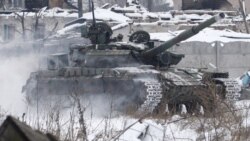
Moscow casts a long shadow in Ukraine’s eastern provinces, where rebels have carved out two separatist pro-Russian rump states. A massive Russian counter-offensive in late summer routed Ukraine’s military just as it seemed on the verge of victory. Ukraine was forced to conclude a ceasefire that essentially formalized a frozen conflict zone and conferred semi-legal status on the self-proclaimed Donetsk and Luhansk People’s Republics. The open presence of Russian active duty soldiers — who spoke to reporters from BuzzFeed News and the Financial Times on Saturday, weeks after combat operations had ceased — indicates that Moscow still has a tight rein on security, though the Kremlin has repeatedly denied that its soldiers were ever even there.
Luhansk is half-deserted after a months-long siege by the Ukrainian military this summer. Nearly every store is closed. Some buildings are missing most of their windows. Others are missing walls and roofs. Others have been completely reduced to rubble. The eternal flame at the World War II memorial has gone out.
It’s hard to see how this depressed industrial city, which had a pre-war population of 600,000, will recover without Russia’s help. Rebels are keen to use the ceasefire to build the foundations for a future state and have set elections for Nov. 2. But they have no way of independently securing enough water or electricity to sustain the city. Moscow is providing all of the republic’s gas and most of its food and medical supplies. There is no clear way forward for the region’s industrial- and mining-based economy, which slowed to a standstill as the war intensified. Kiev considers the rebel governments “terrorist organizations” and has told residents to flee to territory it controls.
The Kremlin denies that it has ever been a party to the Ukrainian conflict or that it has any intention of annexing Donetsk and Luhansk, as it did Crimea. But rebel leaders say that months of war with Kiev has made reintegration into Ukraine impossible.
Read the entire article here
According to EU Observer, former Georgian President Mikheil Saakashvili appears to be weighing in on the kerfuffle surrounding former Polish Foreign MInister Radoslaw Sikorski's reported claim that in 2008 Russian President Vladimir offered to carve up Ukraine with then Polish Prime Minister Donald Tusk:
[Saakashvili] told Poland’s TVN24 broadcaster on Tuesday that Putin really did make the offer to Tusk and that he made similar comments to Hungarian and Romanian leaders.
“Tusk repeated it to me. He thought Putin was joking. But he [Putin] said the same thing to Hungary and to Romania”, Saakashvili noted.
“He [Putin] also told me that something has to be done about Moldova … and that Nato cannot defend the Baltic states".
Read the entire report here
FT knocks down Russia's claim that it has no soldiers in eastern Ukraine. Fab report from Lugansk by @courtneymoscow http://t.co/MaXpr9x4LH
— Guy Chazan (@GuyChazan) October 22, 2014