



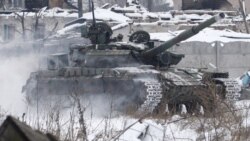
Simon Shuster has written a worrying piece for "Time" magazine on a recent history conference in Moscow and how some Russian scholars seem to be playing fast and loose with the facts:
Even without the simultaneous translations provided for the foreign guests, they would have gotten the political message. The photographs shown by several of the Russian speakers put the atrocities of the Nazi SS right alongside pictures from the current war in eastern Ukraine. There is not much difference, the Russian historians suggested, between the actions of the Ukrainian military in its war against separatist rebels and the atrocities that Hitler’s forces committed during World War II.
"Right now, fascism is again raising its head," declared Yaroslav Trifankov, a senior researcher at the state historical museum in the Russian region of Bryansk, which borders Ukraine. "Right now,” he said from the podium, “our brother Slavs in Ukraine have been so thoroughly duped and brainwashed by their puppet government, which answers only to the U.S. State Department, that they truly have come to see themselves as a superior race."
This rhetoric—calling it an argument would overstate its relation to facts—has recently come into vogue among Russian historians. Under their interpretation of history, the struggle that began with the German invasion of the Soviet Union in 1941 continues for Russia today, in a direct line through the generations, with the conflict in Ukraine. That is the connection President Vladimir Putin first presented to the Russian people in March, when he sent his troops to invade and annex the Ukrainian region of Crimea. The Russian-speaking residents of that peninsula, he said in a speech on the day of the annexation, need Russia’s protection from Ukraine’s new leaders, whom he referred to as “neo-Nazis and anti-Semites.” Ukraine’s ensuing war to prevent Russia from seizing any more of its territory has likewise been branded a fascist campaign against ethnic Russians.
Practically every arm of the Russian state, from the education system to the national police, has since taken up this message. The state media have consistently painted Ukrainian authorities as “fascists” in the service of the U.S. government. In late September, Russia’s main investigative body even opened a criminal probe accusing Ukraine’s leaders of committing “genocide” against ethnic Russians in eastern Ukraine. But the more recent involvement of the nation’s historians has marked a worrying turn in this endeavor.
Read the entire article here
Here's an update on the gas talks in Brussels:
Russia says its dispute with Ukraine over gas supplies will not be resolved unless the European Union guarantees cash-strapped Kyiv pays up front for gas it wants from Russia this winter.
After three-way talks in Brussels that began on October 29 and dragged on into the night, Russian Energy Minister Aleksandr Novak said the sides have agreed on the "basic parameters" of documents setting out prices, volumes, and a mechanism for restructuring Ukraine's gas debt to Russia.
But he said Russia will not turn on the taps to Ukraine unless it is certain it will be paid for future deliveries.
"If there's money, there will be gas," Novak said.
Gazprom's chief said the talks would resume later today only if EU and Ukraine agree on a protocol guaranteeing payments.
"If such agreement is not reached, there will be no meetings or negotiations tomorrow [October 30] and no documents will be signed," Aleksei Miller said yesterday.
(TASS, Interfax, Reuters)
Some more Mistral info now, from RFE/RL's news desk:
French Finance Minister Michel Sapin said his country is not ready to hand over the first of two warships ordered by Russia because Moscow has not met the conditions to take ownership of the vessel.
Sapin told RTL radio on October 30 that "the conditions have not been met to deliver the Mistral."
The Mistral is a helicopter carrier, which Russia contracted to purchase from France in 2010.
Sapin said the main condition is visible improvement in the conflict in eastern Ukraine.
Sapin said, "On one level things are better" but there were "still concerns."
President Francois Hollande has said a September 5 cease-fire between Ukraine and pro-Russian separatists must be "completely respected" before France delivers the ship.
Russian Deputy Prime Minister Dmitry Rogozin said on October 29 that Russia expected to receive the first Mistral on November 14.
(Reuters, AFP, Interfax)