



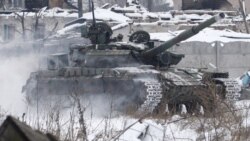
The European Leadership Network has published a report titled "Dangerous Brinkmanship: Close Military Encounters Between Russia And The West In 2014" in which it outlines the "visible increase" in the "intensity and gravity of incidents involving Russian and Western militaries and security agencies." It describes the situation as "ripe with potential for escalation."
Among its assertions:
"This upsurge of activity on all sides and the subsequent increased need to collect intelligence, combined with the general deterioration of the relationship between Russia and the West, has increased the likelihood, and perhaps certainty, that more of these less-than-friendly encounters between the militaries involved will take place.
"The increased number and gravity of incidents described also points [sic] to a disturbing dynamic. The Russian armed forces and security agencies seem to have been authorized and encouraged to act in a much more aggressive way towards NATO countries, Sweden and Finland. Since this appears to be deliberate policy, Russia is probably pursuing multiple objectives.
"At the military level, it may be initiating and using such incidents to observe patterns of response and test the preparedness of specific elements of national and allied defence systems, as well as levels of cooperation between NATO Allies and partners. Perhaps equally important, Russian actions may serve propaganda-related and political aims. They serve as a demonstration of Russia's capability to effectively use force for intimidation and coercion, particularly against its immediate neighbours. With regard to non-NATO Finland and Sweden, they may bring home the message that further integration or membership in NATO would cause further Russian harassment."
It adds, ominously:
"This mix of beefed-up military postures along the NATO-Russia border, more aggressive Russian activities, and the readiness of Western forces to show resolve in the face of the challenge, is ripe with potential for escalation. In the current environment, any incident that results in a loss of life or in extensive damage to one side or the other would be likely to provoke a response involving an increased alert level, higher tempo of military operations in border regions, or even direct punitive military action. This could feed a spiral of growing tensions that may be difficult for any side to completely control or stop."
This still sounds like an unrealistically low outflow figure to some folks (like me):
Pay no attention to the (armed) man behind the curtain (and next to it, and just inside the door, and next to the ballot box, and...)!
Prosecutors in the eastern Ukrainian city of Kharkiv have opened a "terrorism" investigation into an explosion last night that injured 11 people at a pub frequented by soldiers and security forces returning from the conflict with pro-Russian rebels farther south, according to RFE/RL's Ukrainian Service.
The pub, called Stina (The Wall), is also a site of fund-raising and other forms of support for the military and refugees from the conflict zone.
Here's video of the aftermath that was circulating last night:
The pub's manager, Mykhaylo Ozerov, said he believes the blast was an attack meant as retaliation for those activities
Ukrainian authorities sometimes refer to rebels fighting against government forces in the conflict, which has killed more than 4,000 people since April, as terrorists.
Kyiv accuses Russia of sending troops and weapons into eastern UKraine to aid the rebels, who control large swaths of territory in he Donetsk and Luhansk provinces.
There were earlier suggestions -- although none of them from official sources, apparently -- that the blast might have been a result of a gas leak. But one of those sources (cited in the report below) also cited a purported claim by "the bartender" that someone had left a suspicious package in the bar.
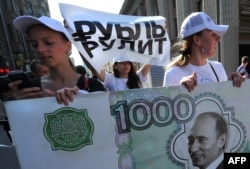
President Vladimir Putin says the Kremlin will restrict the movement of money or take other "emergency measures" to stem the slide of the ruble.
Speaking to businesspeople ahead of the APEC summit in Beijing, President Vladimir Putin said Russia is taking "necessary steps" in response to the "serious fluctuation" of the ruble.
The ruble has lost 40 percent of its value this year due to concern over the Ukraine crisis, related Western sanctions, and falling prices for oil and gas whose export is crucial to the economy.
Putin said that Russia's "fundamentals in terms of currency reserves and balance of payments remain at good levels. That allows us to control the situation without taking any extraordinary emergency steps."
"We are not planning to impose any restrictions at all on capital flows."
Here's video from our Ukrainian Service of weekend fighting. Forces from the pro-government Kyiv 2 battalion came under fire from separatist positions near Volnovakha, 60 kilometers south of Donetsk, on November 8. They responded with rocket launchers, reporting that they had destroyed the separatist firing positions and suffered no casualties. The fighting came as shelling in Donetsk itself intensified.

RFE/RL's Ukrainian Service reports that a state security officer who was Ukraine's counterintelligence chief in the final weeks of former President Viktor Yanukovych's rule has been arrested on suspicion of "high treason." The head of Ukraine's Security Service (SBU), Valentyn Nalyvaychenko, said in a televised interview overnight that Volodymyr Bik is suspected of helping "a foreign country to prepare saboteur activities in Ukraine."
Nalyvaychenko said Bik was arrested on November 8.
Nalyvaychenko said investigators are still searching for former SBU chief Oleksandr Yakymenko, who is wanted for alleged giving a command to shoot at the protesters.
There are dozens more ongoing high-treason probes targeting Yanukovych-era SBU officials.