



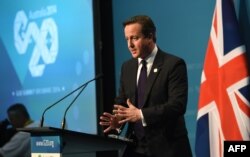
British Prime Minister David Cameron speaking at the G20 summit's concluding press conference today:
"There has been good unity between European countries and the United States of America -- we have just been discussing it at a separate meeting -- that we will continue to maintain the sanctions against Russia, we will continue to keep up the pressure and that if Russia continues to destabilize Ukraine further measures would follow. This is important because although some have said, of course, that there is a cost to sanctions -- and there is a cost to sanctions -- there would be a far greater cost of allowing a frozen conflict on the continent of Europe to be created and maintained."
"I think [Russian] President [Vladimir] Putin can see that he is at a crossroads -- if he continues to destabilize Ukraine there will be further sanctions, further measures, and there will be a completely different relationship between European countries and America on the one hand and Russia on the other. But he knows that there is a different path that he could take. He could recognize -- as he put it to me last night -- that Ukraine is a single political space and recognize that that single political space should be respected and should have the ability to make its own decisions about its own future."
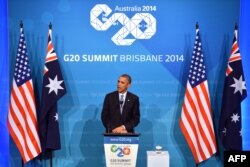
U.S. President Barack Obama speaking today, also at the final G20 news conference in Brisbane:
"You don't invade other countries or finance proxies and support them in ways that break up a country that has mechanisms for democratic elections."
"At this point the sanctions that we have in place are biting plenty good. We retain the capabilities and we have our teams constantly looking at mechanisms in which to turn up additional pressure as necessary."
Western agencies quote Dutch authorities saying that recovery workers in separatist-controlled eastern Ukraine have begun collecting debris from the Malaysia Airlines crash site again, four months after the plane was brought down.
The operation is being carried out under the supervision of Dutch investigators and officials from the Organization for Security and Cooperation in Europe (OSCE).
The operation is expected to take around 10 days.
Continued fighting between Ukrainian government forces and pro-Russian separatists has prevented the collection operation for months.
Debris will first be collected at a location near the crash site before being taken to the Ukrainian city of Kharkiv and then to the Netherlands.
Another image of the Dutch recovery and export team watching as wreckage from Malaysia Airlines Flight 17, which was shot down over eastern Ukraine in July, killing all 298 people aboard, is loaded onto a truck for removal for investigation.
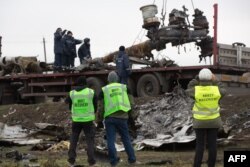
Debris from MH17 will be gathered near the crash site, then taken to the city of Kharkiv, then transported to the Netherlands, which is leading the investigation.
The latest situation map from Ukrainian authorities:
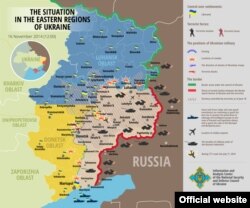
The Ukrainian National Security and Defense Council claims that more trucks filled with who-knows-what have entered illegally from Russia: