



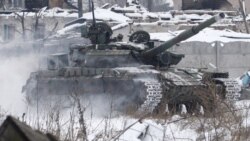
A parting shot?
From the joint press conference with German Foreign Minister Frank Walter Steinmeier and Ukrainian Prime Minister Arseniy Yatsenyuk in Kyiv (via Reuters):
Steinmeier:
"This is one of the reasons why I am here in Kyiv after this past weekend where a lot talks took place in Brisbane with Russian President [Vladimir Putin], also between the German Chancellor [Angela Merkel] and Mr. Putin. After talks with [Ukrainian President Petro Poroshenko], I will leave this afternoon to see whether the talks in Brisbane created an atmosphere which would allow for work on more concrete implementations of the Minsk agreement."
Yatsenyuk:
"The basic points of [the Minsk agreement] -- namely the restoration of control over the Ukrainian-Russian border, ceasing of weapons supply from the Russian Federation to Ukrainian territory and withdrawal of the Russian army and Russian terrorists from the Ukrainian territory -- have not been fulfilled."
Yatsenyuk:
"Since we don't have another agenda except for the Minsk agreement, Russia must fulfil what it signed and what it promised to the whole world."
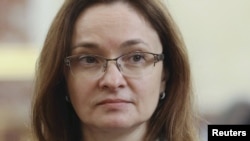
Russia's Central Bank Chairwoman Elvira Nabiullina speaking to the State Duma in Moscow, explaining the so-called floating ruble policy:
"In our opinion, the floating exchange rate is especially needed now -- should external circumstances deteriorate, it will be the [floating] rate that will shock-absorb the main negative consequences protecting the internal financial market and economy."
"Our constitutional duty is precisely to ensure the stability of the ruble. However, in my opinion, we ought to stop measuring this stability only by foreign currencies -- how many dollars does one ruble buy. People are much more concerned about the amount of goods they can buy in rubles. Ruble's stability is first and foremost expressed in its purchasing power."
On the Russian central bank's decision to adopt what's being described as a "freely floating ruble" policy, according to TASS:
The Russian regulator's decision to switch to a freely floating ruble was not sudden or premature, Central Bank Chief Elvira Nabiullina said on Tuesday.
"The transition to a freely floating ruble requires a period of adaptation and the exchange rate can't be set free sharply. The market had a possibility to gradually adapt to it," she said in the lower house of Russia's parliament.
"The Central Bank planned to complete the transition to a freely floating ruble by the end of this year. So, the decision, which we made on November 10, was neither sudden nor premature," she said.
From Tallinn with love:
More from our newsroom on the release of convicted Putin assassination plotter Adam Osmayev by Ukrainian authorities:
A Ukrainian court has ordered the release of a Russian citizen who was jailed in 2012 over an alleged plot to kill Russian President Vladimir Putin.
The court in the Black Sea port city of Odesa on November 18 sentenced Adam Osmayev to time served -- about two years and nine months -- after convicting him of illegal explosives possession, damaging private property, and forgery.
But amid tension between Moscow and Kyiv over the conflict in eastern Ukraine, authorities dropped the attempted assassination charge against Osmayev last month.
Osmayev, an ethnic Chechen, was arrested in February 2012 after his associate, Kazakh citizen Ilya Pyanzin, was injured in the accidental explosion of a handmade bomb in Odesa. The blast killed a third man.
Osmayev and Pyanzin were charged with plotting to kill Putin.
Pyanzin was extradited to Russia and sentenced to 10 years in prison in September 2013.
Osmayev's extradition had been halted at the request of the European Court for Human Rights.
Based on reporting by TASS and Interfax