



Here's a follow-up from our news desk on the release in Ukraine of a man accused of plotting to kill Vladimir Putin:
A Russian lawmaker says a Ukrainian court's November 18 decision to release a suspect in an alleged plot to kill Russian President Vladimir Putin is politically motivated.
Frants Klintsevich, first deputy leader of the United Russia faction in the State Duma, said hours after the court's ruling that the decision of the court in the Black Sea port city of Odesa was "anti-Russian."
The court sentenced Adam Osmayev to time served -- about two years and nine months -- after convicting him of illegal explosives possession, damaging private property, and forgery.
But amid tensions between Moscow and Kyiv over the conflict in eastern Ukraine, authorities dropped the attempted assassination charge against Osmayev last month.
Osmayev, an ethnic Chechen, was arrested in February 2012 after his associate, Kazakh citizen Ilya Pyanzin, was injured in the accidental explosion of a handmade bomb in Odesa. The blast killed a third man.
(UNIAN, Interfax)
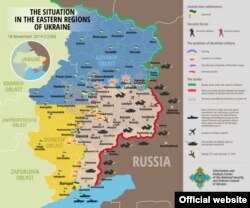
Here is a map of the military situation in eastern Ukraine today, as issued by Kyiv's National Security and Defense Council (click map to enlarge):
And now for another sanctions update (from RFE/RL's news desk):
Russia says it has banned meat imports from Montenegro in an effort to close loopholes on a ban against food products from the European Union.
Russia’s agricultural watchdog Rosselkhoznadzor made the announcement today.
The Interfax news agency quoted Rosselkhoznadzor Director Sergei Dankvert as saying that Montenegro may have allowed shipments of EU meat to Russia with fake certificates from the former Yugoslav republic.
Dankvert added that Albania and Macedonia would face similar bans if the two countries do not dispel doubts about their certificates by November 24.
Montenegro mainly supplied pork and pork products to Russia.
But Dankvert's assistant, Alexei Alekseyenko, said Montenegro "was not a major player on the market of imported meat products," adding that the ban "will not do harm to the range of imported products" from the country
(TASS, dpa)