



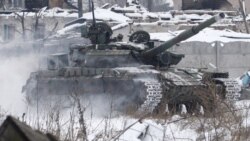
Good morning. We'll start the live blog today with an item from RFE/RL's news desk on how a senior U.S. official has called for a rethink of Washington's decision not to send lethal aid to Ukraine:
A senior aide to U.S. President Barack Obama has said that the United States should reconsider its policy of not providing lethal aid to Ukraine, which is grappling with pro-Russian separatists in the east of the country.
Tony Blinken, the deputy national security adviser, cited "serious violations" by Moscow of the Minsk agreement.
Signed by Russia, Ukraine and rebels from Ukrainian separatist regions of Donetsk and Luhansk on September 5 in the Belarus capital, the agreement imposed a cease-fire and set out steps toward peace.
Blinken said providing Kyiv with lethal military aid may prompt Moscow "to think twice and deter them from further action."
Blinken was speaking on November 19 at a congressional hearing on his nomination to be Obama's deputy secretary of state.
Analysts say providing defensive military equipment to Ukraine has broad support in Congress.
Ukraine accused Russia last week of sending soldiers and weapons to help separatist rebels in eastern Ukraine launch a new offensive in a conflict that has already killed more than 4,100 people.
NATO has accused Russia of sending tanks and troops to eastern Ukraine in recent days to support the separatists.
NATO chief Jens Stoltenberg said on November 18 that there had been a "serious military buildup" both in eastern Ukraine and on the Russian side of the border, and urged Moscow to pull back its forces.
Russia backs the separatists but denies it is directly involved in the conflict.
Blinken's comments come a day ahead of a scheduled two-day visit to Kyiv by U.S. Vice President Joe Biden.
A day after arriving in the Ukrainian capital, Biden is due to meet Ukrainian President Petro Poroshenko and Prime Minister Arseniy Yatsenyuk on November 21.
On November 19, Yatsenyuk rejected a call by Russian Foreign Minister Sergei Lavrov for Kyiv to hold direct talks with the separatists.
Lavrov told the State Duma earlier on November 19 that Kyiv should establish "stable contacts" with the rebels in the regions of Luhansk and Donetsk.
But Yatsenyuk told Moscow to stop "playing games" aimed at legitimizing "terrorists."
Meanwhile, Russian President Vladimir Putin said Moscow was ready for "practical cooperation" with Washington as long as the United States treats Russia as an equal partner and stays out of its internal affairs.
Putin spoke at a ceremony during which he received the credentials of foreign envoys including John Tefft, the new U.S. ambassador to Moscow.
In a statement issued after the ceremony, Tefft said he was committed to maintaining "open and frank lines of communication" with the Russian authorities.
(AP, Reuters)
And here's an update on the latest diplomacy from our news desk:
President Vladimir Putin has told the new U.S. ambassador to Moscow that the United States should not interfere in Russia's affairs.
The warning came at a Kremlin ceremony on November 19 in which Putin received the credentials of new foreign envoys including U.S. Ambassador John Tefft.
Putin said, "We are ready for practical cooperation with our American partners in various fields, based on the principles of respect for each other's interests, equal rights, and non-interference in internal affairs."
The remark echoed conditions Putin set out in a foreign policy decree at the start of his third term in 2012, and a similar warning issued by Foreign Minister Sergei Lavrov in an address to Russian lawmakers earlier on November 19.
Tefft, 64, is a career diplomat who previously served as U.S. ambassador to Ukraine, Georgia, and Lithuania -- three ex-Soviet republics whose ties with Moscow are tense.
His posting starts at a time when U.S.-Russian relations are badly strained over the Ukraine crisis.
Tefft replaces Michael McFaul, who was ambassador from January 2012 until February 2014.
McFaul, the architect of U.S. President Barack Obama's first-term "reset," which improved ties with Moscow, swiftly became a prime target in a campaign of anti-Americanism that has marked Putin's current term.
(Reuters, AFP, TASS)
It seems Big Macs are back on the menu on Moscow's Pushkin Square (from RFE/RL's news desk):
The first McDonald's restaurant in Moscow reopened on November 19 after closing for nearly three months over health and safety violations.
The fastfood restaurant on Moscow's Pushkin Square, which opened in 1990, closed in late August in what became a string of closures of McDonald's restaurants throughout Russia.
The move was viewed broadly as a retaliation for Western sanctions on Moscow for its role in the Ukraine crisis.
Many have reopened since, but, according to the company, there are still 200 inspections ongoing and four restaurants outside Moscow remain closed.
The country's food safety agency, Rospotrebnadzor, said the closures, which came after unexpected inspections, were not related to the Russia standoff with the West.
A spokeswoman for McDonald's Russian operations, Svetlana Polyakova, said the company has complied with Rospotrebnadzor's demands.
(AFP, Reuters, dpa, Interfax)