



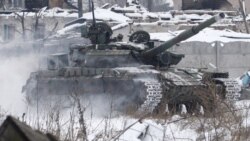
Ukrainian authorities say two soldiers have been killed in fighting in the past 24 hours.
In case you missed the news yesterday, The Interpreter carries a rundown of what we know so far about the murder of Ukrainian anticorruption activist Oleksandr Kostrenko:
From our newsroom:
Russia has drastically revised its economic forecast for 2015, abandoning its earlier prediction of 1.2 percent growth and instead predicting that gross domestic product will contract by 0.8 percent next year.
Russian Deputy Economy Minister Aleksei Vedev announced the revised economic forecast on December 2.
He said the ministry also cut its forecast for the average oil price in 2015 from $100 to $80 per barrel.
Oil and natural gas are a vital source of income for Russia, accounting for 70 percent of the country’s exports and half of government revenues.
Oil prices have fallen by more than a third since the summer and Russia’s ruble currency has fallen by 40 percent this year.
Russia’s economy also is suffering from U.S. and EU sanctions imposed over its annexation of Ukraine’s Crimean peninsula and support for separatist rebels in eastern Ukraine.
Based on reporting by Reuters, AP, AFP, and RIA Novosti
Reuters: Foreign ministers from NATO nations and Ukraine condemn Russia's "deliberate destabilization of eastern Ukraine" and military buildup in Crimea.
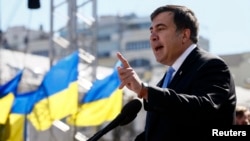
RFE/RL's Georgian Service reports that Georgian ex-President Mikheil Saakashvili says he has indeed rejected a deputy prime minister’s post in Ukraine. Ukrainian media had reported earlier that Saakashvili, who is hated by Russia's leadership, could be offered such a post.
Media reports in Ukraine on December 2 said that two members of Saakashvili's former government, Aleksandr Kvitashvili and Eka Zguladze, had been named by Ukrainian President Petro Poroshenko's bloc as potential candidates for the posts of health minister and deputy interior minister, respectively.
Georgian Deputy Prime Minister Kakha Kaladze said on December 2 that it would be "painful" to see former Georgian officials, some of whom are suspected of crimes, in Ukraine's government.
Saakashvili, whose term ended in 2013 after nearly a decade in office, has been charged with several crimes by the government that came to power after his party's defeat in a 2012 parliamentary election.
He and members of his former government say the charges against them are politically motivated.
Saakashvili lives self-imposed exile in the United States.
Suggesting they might be given roles in the soon-to-be-formed Ukrainian government: