


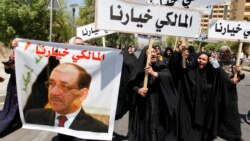
Maliki becomes even more isolated
Maliki’s Dawa Party has called on Iraqi politicians to work with his new prime minister-designate Abadi to form a new government, according to Reuters.
In a statement yesterday, the Dawa Party said it "called on political blocs to cooperate with the constitutionally designated prime minister, Mr. Abadi, and accelerate the formation of a government in the defined time period."
Maliki has refused to stand aside.
Political transition
RFE/RL's Radio Free Iraq spoke exclusively to figures from four major blocs about the political transition in the country and their reaction to Abadi's nomination:
Spokesman for the Supreme Islamic Council's "Citizen" bloc, Baligh Abu Gulel:
"A seven-man committee representing all the major factions has been formed to agree on the ground rules for forming the new government."
Kurdistan Regional Government (KRG) President Masoud Barzani's media adviser, Kifah Mahmoud:
"We support PM designate Haider al Abadi's efforts to form a new government but it is premature to send a KRG delegation to Baghdad in this connection."
Mohammed al Khalidi, leading member of the Sunni "United for Reform" bloc:
"We will support Haider al Abadi in his efforts to form a new government in light of his response to our demands."
Leading member of Maliki's State of Law faction Kadhum al Sayyad:
"We suggest to wait for the federal court to rule on Maliki's complaint that nominating Haider al Aabdi as prime minister was unconstitutional before we proceed any further."
Report: Britain deploys special forces in Iraq
Britain’s “Daily Telegraph” newspaper reports today that the British government has deployed Special Air Service (SAS) forces in northern Iraq.
The newspaper cites Britain's trade envoy to Iraq, Emma Nicholson, as saying that SAS officers, the army's special forces regiment, were working with U.S. troops to gather intelligence and had been in Iraq for “six weeks or more.”
Britain's Ministry of Defense said did not comment on the story.
Britain has sent military planes and helicopters to the region to help deliver humanitarian aid.
You can read the full story here.
KRG President Visits Frontlines
Changes
UN agencies
UN agencies have been working around the clock for the past two weeks. Here is a summary of what the various agencies have been doing:
-- United Nations High Commissioner for Refugees (UNHCR) has reached 166,000 people. Since August 1, it provided shelter and relief items to 30,000 people in the Kurdistan region, including those escaping Mount Sinjar.
-- World Food Programme (WFP) has established 4 field kitchens and is feeding over 100,000 people per day, totalling over 1.6 million meals in Dahuk Governorate.
-- United Nations International Children's Emergency Fund (UNICEF) has moved 30 truckloads of relief supplies closer to areas where displaced people are arriving. In total, 60 tons of emergency aid are prepared. UNICEF has delivered aid to 73,000 children, women and their families.
-- World Health Organization (WHO) is supporting local health authorities in the field, with two mobile health teams on Mount Sinjar and emergency relief at Pesh Khabur, where 16 ambulances are transporting those arriving, and mobile clinics providing emergency health care to the displaced across Dahuk Governorate.
-- United Nations Population Fund (UNFPA) is working to distribute hygiene supplies and clothing to over 1,300 pregnant women as well as medical supplies to support 150,000 people.
-- International Organization for Migration (IOM) is transporting IDPs from affected areas to agreed safe areas. Over the last 48 hours, 2,121 IDPs have been provided with transportation. Between 4 and 12 August, IOM reached 15,000 beneficiaries.
Situation improving on Mount Sanjir
Ben Rhodes, the deputy National Security Advisor for Strategic Communications & Speechwriting, says situation on Mount Sanjir is improving. He mirrors the assessment of American officials who recently visited Sanjir, where thousands of Yazadis are believed to be stranded.